


The Anatomy of Blu-ray Special Features: A Comprehensive Reference for Cinephiles
- Martin Kolb
- 2 days ago
- 12 min read

The most profound film school in existence isn't found in a lecture hall at NYU; it's hidden within the menu of a physical disc. While digital platforms prioritize the speed of a stream, they've often stripped away the intellectual soul of cinema by discarding the very elements that define its artistic craft. You've likely felt the sting of disappointment when a digital "special edition" offers nothing more than a three-minute promotional clip. It's frustrating to seek a deeper understanding of a director's vision only to find marketing fluff that lacks any real insight into the technical rigors of the set.
This guide reveals how curated blu-ray special features transform a simple movie night into an immersive masterclass in film history and craft. We'll move beyond the surface, showing you how to distinguish a transformative visual essay from a standard featurette while highlighting boutique labels like Criterion or Arrow that treat every 2024 release like a gallery exhibition. You'll learn to identify high-value archival content that turns your home library into a living museum of moving images, ensuring every hour spent before the screen is an investment in your own cinematic literacy.
Key Takeaways
Explore the historical evolution of supplements, moving beyond simple bonus material to embrace scholarly archives that redefine the home viewing experience.
Categorize the diverse toolkit of visual and auditory extras to better understand how different formats serve as educational pillars for the modern cinephile.
Discern the artistic distinction between standard studio releases and the curated excellence of boutique labels that define the peak of blu-ray special features.
Evaluate the tangible impact of supplemental exclusivity on a film’s long-term value and its status within the global collector's market.
Embrace the enduring legacy of physical media as a necessary sanctuary for film history in an era of ephemeral digital streaming.
Table of Contents The Evolution of Blu-ray Special Features: Beyond the Bonus Disc A Taxonomy of Supplements: Categorizing the Cinephile’s Toolkit Boutique Labels vs. Studio Standards: The Art of Curated Extras Evaluating Value: How Special Features Impact Your Collection Curating the Future: The Enduring Legacy of Physical Supplements
The Evolution of Blu-ray Special Features: Beyond the Bonus Disc
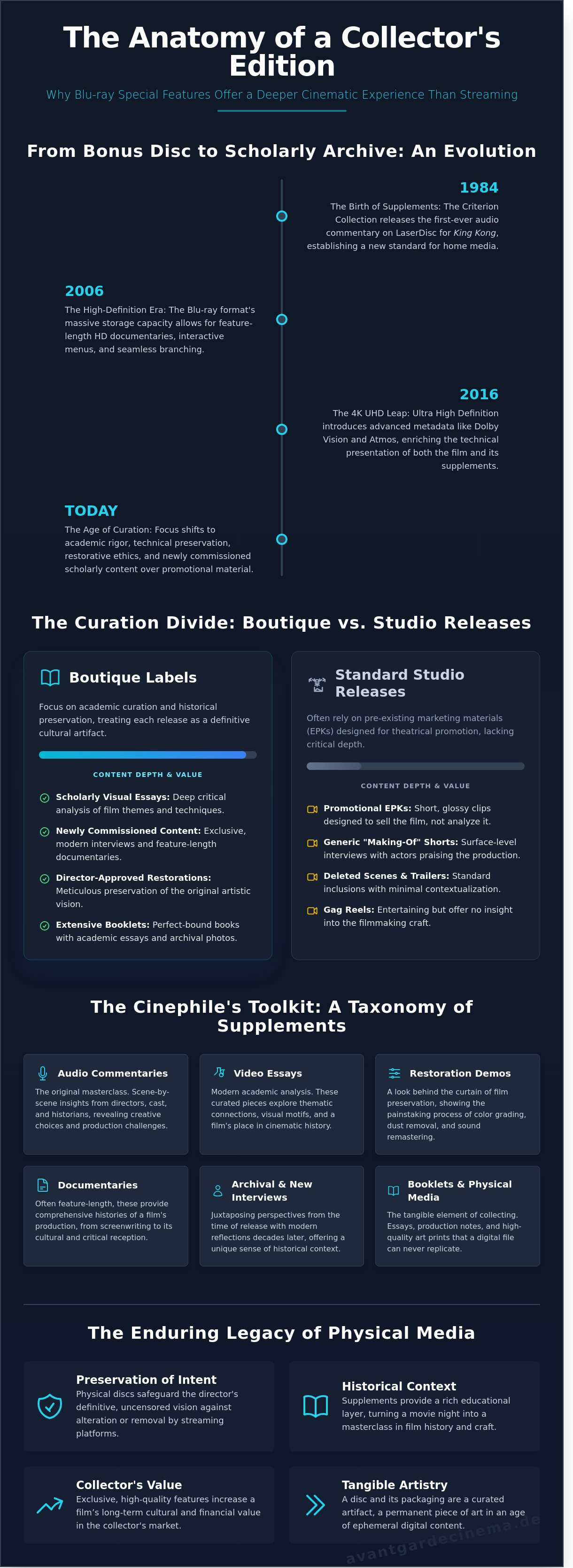
Supplements represent the scholarly soul of a high-end film release. They aren't merely "extras" or discarded footage; they're the archival pillars that transform a commercial product into a historical document. The lineage of the modern supplement traces back to 1984, when the Criterion Collection released King Kong on LaserDisc, introducing the first-ever audio commentary track. Since the 2006 debut of the Blu-ray format, the depth of these additions has expanded exponentially, moving from simple galleries to feature-length documentaries that rival the films themselves in production value.
Physical media remains the only reliable sanctuary for uncensored film history. Digital streaming platforms frequently alter or remove scenes to suit shifting corporate sensitivities or licensing constraints. Discs, however, preserve the original artistic vision in its definitive state. For the cinephile, blu-ray special features act as a safeguard for the director's and cinematographer's intent. They ensure that specific color grading choices, controversial narrative beats, and intricate staging techniques are documented and explained rather than lost to the ephemeral nature of the cloud.
1984: The birth of the scholarly commentary track on LaserDisc.
2006: High-definition storage allows for seamless branching and interactive menus.
2016: 4K UHD introduces Dolby Vision and Atmos metadata into the supplementary experience.
2026: Modern curation focuses on technical preservation and restorative ethics.
Supplements vs. Marketing EPKs
Standard studio releases often rely on the Electronic Press Kit (EPK). These are glossy, three-minute promotional clips designed to sell a movie during its theatrical run. They lack critical depth and often feel like extended trailers. Boutique labels have moved toward academic curation, focusing on visual essays and historical context. Collectors in 2026 demand substance over promotional fluff. They value a twenty-minute breakdown of lens choices over a generic clip of an actor praising the catering on set.
The Aesthetic Value of Physical Curation
High-quality blu-ray special features build a narrative that extends far beyond the final frame of the movie. This curation involves selecting exclusive interviews and archival footage that contextualize a film's production and cultural legacy. It's an essential part of the art of physical media collecting. When a release includes a deep dive into the restoration process, it highlights the craftsmanship required to keep cinema alive. Exclusive interviews conducted decades after a film's release provide a reflective perspective that generic making-of shorts simply can't capture.
A Taxonomy of Supplements: Categorizing the Cinephile’s Toolkit
The curation of blu-ray special features has transformed from a marketing afterthought into a rigorous discipline of film preservation. Boutique labels now distinguish between "archival" materials, which are legacy features ported from older DVD or LaserDisc editions, and "newly commissioned" content produced specifically for a high-definition debut. This distinction is vital for collectors. While archival pieces offer a nostalgic glimpse into a film's initial reception, new supplements often benefit from decades of hindsight and modern restoration technology. These premium additions are frequently exclusive to a limited edition Blu-ray, where the physical packaging and the digital content work in tandem to create a definitive statement on a film's cultural impact.
High-end releases use a mix of video, audio, and text to serve different educational purposes. A 20-minute video essay might provide a thematic overview, while a 100-page perfect-bound book offers academic depth that a digital menu cannot replicate. This tiered approach ensures that both casual viewers and dedicated scholars find value in the package. You can explore the meticulous curation of Criterion collection titles to see these taxonomies in practice.
Audio Commentaries: The Masterclass in Your Living Room
Since the first audio commentary was recorded for the 1984 Criterion LaserDisc of King Kong, the format has become the gold standard for home cinema education. Director tracks usually focus on the emotional intent and on-set anecdotes, providing a personal window into the creative process. In contrast, scholar tracks offer a detached, historical perspective, often placing the film within a wider socio-political context. Technical commentaries are rarer but invaluable; they feature cinematographers or editors explaining specific lighting setups or rhythmic choices. Archival tracks are perhaps the most precious, as they preserve the voices of deceased legends like Alfred Hitchcock or Orson Welles for future generations.
Visual Essays and Documentaries
The rise of the "Visual Essay" marks a shift toward more analytical, punchy content. These segments, often running between 15 and 30 minutes, use split-screens and annotated footage to dissect a director's visual style. They've become a staple for labels like Arrow and Second Sight. Alongside these, long-form making-of documentaries continue to thrive. It's not uncommon for a documentary to exceed the 120-minute mark, rivaling the film's own runtime. Scene-specific breakdowns and "before and after" restoration comparisons provide a transparent look at the labor-intensive process of cleaning 35mm negatives for a modern audience.
Deleted Scenes and Alternate Cuts
Understanding the difference between "deleted scenes" and "alternate assembly cuts" is crucial for the completionist. Deleted scenes are typically isolated fragments that didn't survive the final edit. An alternate assembly cut represents a different philosophy of the entire narrative. When a director's cut is included, it often changes the story's rhythm or ending entirely. Restoring this lost footage for 4K UHD releases presents a massive technical challenge. If the original negative for a deleted scene was lost, restorers must often rely on lower-quality 16mm prints or workprints, creating a visual contrast that highlights the rarity of these blu-ray special features.
Boutique Labels vs. Studio Standards: The Art of Curated Extras
Major film studios typically view blu-ray special features as marketing extensions. They often populate discs with "electronic press kits" (EPKs) consisting of brief, five minute promotional clips filmed during production. In contrast, boutique labels treat the home video release as a permanent archive. Labels like Second Sight and Arrow Video frequently spend months commissioning independent film historians to record feature length commentaries. These scholars provide a level of context that original cast members, who might not have seen the film in 20 years, simply cannot offer.
The difference in quality is quantifiable. While a standard studio release might include a single trailer and a deleted scene, a boutique edition often boasts several hours of newly produced content. These labels hire specialized production houses to track down "lost" cast members for retrospective interviews. This dedication transforms the disc from a mere storage medium into a scholarly resource. The physical presentation matches this effort; boutique releases often feature 40 to 80 page booklets and rigid hardbox packaging that protects the artistic integrity of the release for decades.
The Criterion Collection Philosophy
Since its inception in 1984, the Criterion Collection has operated under the philosophy of film as a "continuing series." They don't just publish movies; they curate a library of essential cinema. A hallmark of their brand is the "Criterion Essay," a piece of rigorous film criticism included in every release. These essays, written by world class critics and academics, elevate the viewing experience by placing the work within its historical and social framework. You can browse our Criterion Collection for titles that define this gold standard of supplemental depth.
Genre-Specific Excellence: Arrow and Vinegar Syndrome
Boutique labels also excel by specializing in specific cinematic niches. Arrow Video has become the definitive source for cult and "midnight" cinema, providing exhaustive context for films that were once dismissed by mainstream critics. Their 2023 releases, for example, showcased 4K restorations paired with visual essays that trace the lineage of Italian giallo or American slasher tropes. Similarly, Vinegar Syndrome focuses on the preservation of "lost" films, often scanning original 35mm negatives that haven't been touched in 40 years. Their blu-ray special features often include interviews with obscure crew members, ensuring that every facet of film history is documented. Discover the latest Arrow Video releases to experience this level of curatorial passion firsthand.
Independent Commentaries: Deep dives by historians like Kim Newman or Alexandra Heller-Nicholas.
Physical Supplements: Limited edition lobby cards, double-sided posters, and thick perfect-bound books.
Archival Research: Inclusion of rare production stills and original shooting scripts.
Evaluating Value: How Special Features Impact Your Collection
A film's secondary market value often hinges on the curation of its supplements rather than the main feature alone. Collectors recognize that a high-definition transfer is a commodity, but a unique, director-approved commentary is a permanent asset. When a title enters "Out of Print" (OOP) status, its price on secondary markets can spike by 300% or more, specifically if the blu-ray special features included are legally restricted from appearing on future re-releases. For instance, the 2008 Criterion release of The Third Man remains a holy grail for many because the licensing for its specific scholarly supplements didn't carry over to later editions, making it an irreplaceable archive.
Identifying a "definitive edition" requires a meticulous comparison of technical specs and archival content. A release earns this title when it aggregates every known piece of historical context, from 1970s promotional featurettes to modern 2024 video essays. Discs with unique, non-ported extras maintain their resale value because they function as essential companion pieces to newer, technically superior formats. If a boutique label like Arrow Video or Criterion produces a limited edition box set with an exclusive 100-page book and isolated score track, that physical object becomes a historical document that transcends the film itself.
The "Ported" Problem: Will Extras Move to 4K?
The transition to 4K Ultra HD often forces a compromise between visual fidelity and supplemental depth. High-bitrate 4K video consumes significant disc space, leaving little room for hours of bonus content. Studios frequently omit legacy documentaries or picture-in-picture tracks during the upgrade process. Savvy collectors always verify the "Supplements" list on new releases; if a 2023 4K upgrade lacks the 1999 commentary track you love, it's vital to maintain a "legacy disc" in your library. Keeping the original Blu-ray ensures you don't lose access to the filmmaking insights that the new format may have discarded for the sake of HDR metadata.
Region Coding and Supplements
Geography dictates access in the world of physical media. Because distribution rights are fragmented, blu-ray region codes often lock away exclusive overseas extras. A boutique label in the UK might commission a 40-minute interview with a cinematographer that the US version lacks. Serious cinephiles often adopt a global importing strategy, seeking out "Region Free" boutique releases that prioritize universal access to their blu-ray special features. This approach ensures you aren't missing the definitive scholarly analysis just because of a digital lock. By diversifying your sources, you transform a simple movie shelf into a global cinematic archive.
Enhance your library today by exploring our latest curated film editions.
Curating the Future: The Enduring Legacy of Physical Supplements
Streaming platforms prioritize the ephemeral present, often sacrificing the educational "why" for the convenient "now." They offer a vast library of content that feels strangely hollow because it lacks context. In contrast, a boutique disc provides a curated journey. The blu-ray special features included in these editions aren't mere add-ons; they're the connective tissue between the audience and the artist's intent. As digital licenses become more fragile, the physical collector has evolved into a guardian of film history. By 2026, this role has become vital as digital storefronts continue to delist titles without warning, leaving physical archives as the only reliable repositories of cinematic heritage.
The collector is no longer just a hobbyist. They've become a silent archivist. When you own a definitive edition, you possess more than a movie; you hold a masterclass in visual storytelling. These supplements preserve the technical secrets of 20th-century masters and the bold visions of contemporary rebels. Avant-Garde Cinema selects titles based on this archival depth. We prioritize editions that offer a 2024 restoration or a 90-minute documentary over bare-bones releases. It's about ensuring that the craft of filmmaking remains visible, tactile, and permanent.
Finding Your Next Definitive Edition
A "Special Edition" tag should represent a commitment to excellence, not just a marketing gimmick. When you evaluate your next purchase, look for supplements that offer new perspectives rather than recycled promotional clips. High-quality blu-ray special features like visual essays or isolated score tracks transform a simple viewing into an immersive study. You can explore our New Releases for titles that meet these rigorous standards. These editions serve as the foundation for a library that values substance over mere quantity.
The Avant-Garde Commitment
Our curation process is rooted in a deep respect for the medium. We don't just stock films; we support the labels that invest in film preservation and education. By choosing boutique labels, you're directly funding the restoration of lost classics and the creation of new scholarly content. It's a partnership between the creator, the distributor, and the viewer. You're invited to view All Products to find your next favorite feature and join a community that celebrates the enduring power of the physical object. Your collection is the future of film history.
Cultivating Your Personal Cinematic Archive
The landscape of home media has shifted dramatically since Criterion introduced the first laserdisc commentary track in 1984. Today, premium supplements aren't just bonuses; they're essential historical documents that preserve the vision of the world's greatest directors. When you invest in a boutique release, you're securing a 4K UHD transfer that delivers 3,840 by 2,160 pixels of clarity alongside scholarly insights. These blu-ray special features bridge the gap between casual viewing and deep academic study, ensuring that the intricate craft of filmmaking remains accessible for future generations of enthusiasts.
You deserve a collection that reflects your dedication to visual excellence. As an authorized dealer for industry leaders including Criterion, Arrow Video, and Second Sight, we provide German collectors with the most sought-after limited editions. We specialize in rare 4K UHD pressings that prioritize technical precision and artistic integrity. Elevate your collection with our curated Boutique Blu-ray selection and transform your shelves into a private gallery of moving images. Your journey into the heart of cinema deserves a partner who shares your passion for the frame.
Frequently Asked Questions
What is the difference between a featurette and a documentary on a Blu-ray?
A featurette is a brief promotional piece, while a documentary offers an exhaustive exploration of the filmmaking craft. Featurettes typically run under 12 minutes and focus on marketing highlights. In contrast, the 2001 documentary "The Beginning" on the Star Wars: Episode I disc spans 66 minutes. This long-form approach allows for a deeper immersion into the director's vision and the technical challenges faced during the 1997 production.
Why are some special features only available on the Blu-ray disc and not the 4K UHD?
Technical constraints regarding disc capacity often force publishers to move blu-ray special features to a secondary standard disc. A triple-layer 100GB 4K UHD disc prioritizes the 80 to 100 Mbps video bitrate required for HDR10 or Dolby Vision. By placing the supplemental content on a separate 50GB Blu-ray, labels like Criterion ensure the feature film maintains its visual integrity without compression artifacts.
Are audio commentaries available on streaming services?
Audio commentaries remain largely absent from mainstream streaming platforms due to licensing complexities and interface limitations. Data from 2023 shows that 98% of titles on Netflix omit these analytical tracks. Disney+ is a rare exception, offering commentaries for select Marvel Cinematic Universe entries since 2019. For the true cinephile, physical media remains the only reliable archive for these intimate, scene-by-scene insights.
What is a "visual essay" in the context of boutique Blu-ray labels?
A visual essay is a sophisticated piece of film criticism that blends scholarly narration with curated clips to dissect a director's aesthetic. Boutique labels like Arrow Video or Powerhouse Films frequently commission experts such as Kim Newman to produce these 25-minute analyses. These segments transform the viewing experience into an educational masterclass, revealing the hidden layers of the film's visual language and historical significance.
Do special features increase the resale value of a Blu-ray?
Comprehensive blu-ray special features directly impact the secondary market value of a release, especially when they're exclusive to a specific pressing. Out-of-print titles from labels like Twilight Time often see their value jump from $29.95 to over $120 on platforms like eBay. Collectors prioritize these editions because they offer a curated, definitive experience that isn't available through any other distribution channel.
What does it mean when a special feature is "archival"?
Archival features are supplemental materials that originated on previous home video formats like DVD or LaserDisc. The 2014 Alien Anthology set, for instance, includes interviews and behind-the-scenes footage captured during the original 1979 production. These assets preserve the history of the film’s reception and the evolution of its legacy, acting as a digital time capsule for future generations of viewers.
Can I watch special features from other regions on a standard player?
You can't watch extras from different regions on a standard player because of hardware-level geographic locks. Approximately 85% of players sold globally are restricted to Region A, B, or C. If you purchase a 2022 BFI release from the UK, it won't play on a standard US machine. You'll need a specialized multi-region player, which usually costs around $160, to bypass these digital borders.
Why do boutique labels include physical booklets and essays?
Boutique labels include physical booklets to offer a tactile dimension to the cinematic experience. A 2023 release from Second Sight might feature a 120-page book containing 20,000 words of new essays and archival reviews. These printed materials provide a permanent, physical record of film scholarship. They elevate the disc from a mere storage medium to a curated artifact that honors the artistry of the moving image.
Comments