


The Polanski Paradox: A Collector’s Guide to the Essential Films of Roman Polanski
- Martin Kolb
- 2 days ago
- 13 min read

To own a physical copy of a Polanski masterpiece in 2024 is to hold a fragment of cinematic history that demands a difficult, deliberate separation between the frame and the filmmaker. You likely recognize the tension inherent in curating the movies Roman Polanski directed, yet the pull of his visual storytelling remains undeniable for any serious cinephile. Finding the right edition is often a journey through out-of-print labels and varying restoration qualities that can leave even seasoned collectors feeling frustrated by the lack of clarity in the market.
We believe that technical excellence should match artistic vision; this is why we've curated this guide to the definitive boutique Blu-ray and 4K UHD releases. You'll learn which 2023 4K upgrades provide a genuine leap in grain precision and which expensive, out-of-print box sets from the last five years are truly worth the secondary market price. We'll examine the technical benchmarks of labels like Criterion and Indicator to help you build a library that reflects the highest standards of the medium, ensuring every purchase is a lasting investment in aesthetic quality.
Key Takeaways
Understand why the intricate shadow detail and psychological dread of Polanski’s visual language demand the uncompromising bitrates of boutique physical media.
Gain insights into the "Apartment Trilogy" by comparing the artistic merits of the Criterion Collection’s transfers against modern 4K restoration efforts.
Navigate the transition of neo-noir landmarks like Chinatown to the 4K format to ensure your library of movies roman polanski meets the highest standards of excellence.
Identify which boutique labels—from Arrow Video to Indicator—offer the most faithful transfers and learn why certain out-of-print editions have become highly coveted assets.
Master the art of high-end curation by learning how to source exclusive pre-orders and navigate the competitive market of specialized boutique retailers.
Table of Contents The Polanski Paradox: Why His Visual Language Demands Physical Media The Apartment Trilogy: Essential Boutique Editions Hollywood Peak and European Exile: Chinatown vs. The Pianist Boutique Labels and the Hunt for Out-of-Print Polanski Curating Your Collection with Avant-Garde-Cinema
The Polanski Paradox: Why His Visual Language Demands Physical Media
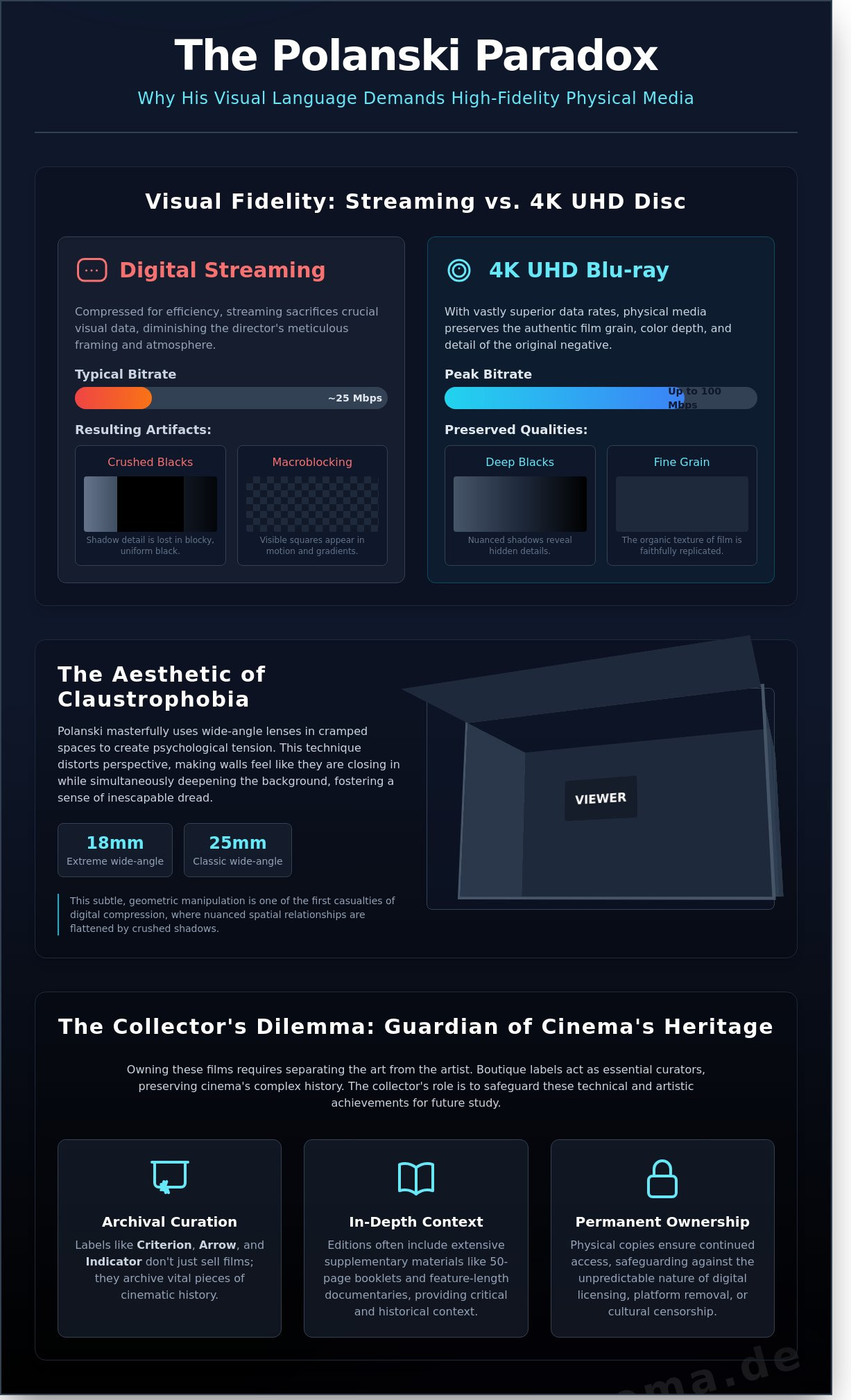
The visual grammar of Roman Polanski remains a masterclass in psychological manipulation through geometry. His frames don't just observe; they constrict. For the discerning cinephile, the movies roman polanski directed represent a pinnacle of technical craftsmanship that streaming services often fail to replicate. Digital platforms typically compress data to a fraction of its original size, which strips away the nuanced grain and shadow detail essential to his noir-inspired aesthetic. By 2026, the demand for high-fidelity restorations has reached a fever pitch, as collectors realize that a 25 Mbps stream cannot compete with the 100 Mbps peak bitrate of a physical disc.
Preserving these works requires more than just a digital file. It demands an appreciation for the tactile nature of film history. Polanski's reliance on voyeurism and psychological dread is built on the subtlest of visual cues. A flicker of movement in a dark corner or the specific texture of a decaying wall becomes lost in the "macroblocking" artifacts of low-bitrate video. The 2026 landscape of world cinema is defined by a push to rescue these masterworks from digital degradation, ensuring that the director's vision is seen with the clarity it deserves.
The Aesthetic of Claustrophobia
Polanski frequently employs wide-angle lenses, specifically 18mm and 25mm glass, within cramped interiors to distort the viewer's perception of distance. This technique pushes the walls closer while it makes the background feel unnervingly deep. Spatial tension is the hallmark of Polanski’s 1960s output. On a standard digital stream, the deep black levels of a film like Repulsion often suffer from "crushing," where shadows turn into blocky, grey artifacts. High-bitrate 4K UHD discs preserve the microscopic silver halide grain, ensuring that the darkness remains as ink-black and terrifying as the director intended.
The Collector’s Dilemma: Art vs. Artist
Owning these works in 2026 requires a nuanced understanding of the separation between the creator and the creation. Boutique labels like Criterion and Arrow serve as vital curators in this ethical landscape. They don't just sell a film; they archive a piece of history that remains essential to the evolution of the medium. These editions often include 50-page booklets or feature-length documentaries that provide the necessary historical and critical context. Preserving physical copies ensures that the technical achievements of the movies roman polanski created remain accessible for study, regardless of the shifting tides of digital licensing or cultural censorship. The role of the collector is to act as a guardian of cinema's complicated, yet undeniable, artistic heritage.
The Apartment Trilogy: Essential Boutique Editions
The Apartment Trilogy represents the architectural core of movies roman polanski, capturing the slow descent into madness within the suffocating confines of urban dwellings. These films aren't merely thrillers; they're psychological studies that utilize domestic spaces as extensions of a fractured mind. For the serious collector, owning these titles isn't just about film history. It's about possessing a masterclass in staging and atmosphere. The trilogy serves as the backbone of any avant-garde collection, offering a bridge between European arthouse sensibilities and Hollywood's Golden Age of paranoia.
Repulsion and the Criterion Standard
The 1965 masterpiece Repulsion remains one of the most visceral depictions of isolation ever captured on celluloid. The 2009 release from the Criterion Collection set a benchmark for monochrome transfers that few have matched. By utilizing a 35mm fine-grain master positive, the transfer preserves a tangible, organic grain structure that feels alive. This texture is vital for appreciating Gilbert Taylor’s high-contrast cinematography, where shadows seem to physically encroach upon Catherine Deneuve. Beyond the visual fidelity, the supplemental features, including a 2003 commentary with Polanski and Deneuve, provide an intimate look at the production’s meticulous craftsmanship. Collectors seeking this level of archival quality should explore the curated selection of Criterion Collection products to see how these transfers redefine the home viewing experience.
Rosemary’s Baby: A Masterclass in Technicolor Dread
Transitioning from the stark greys of London to the deceptive warmth of New York, Rosemary’s Baby (1968) introduced a new kind of horror. While the 2012 Blu-ray was highly regarded, the 2023 4K UHD restoration offers a transformative leap in color timing. The Dolby Vision grading restores the sickly, saturated yellows and deep reds of the Bramford apartment that previous versions often muted. Audiences should prioritize the original 1.0 Mono soundtrack included in these releases. Modern 5.1 remixes often dilute the claustrophobic intimacy of the sound design. The 4K UHD format is the definitive way to view this film, as it captures the subtle nuances of William Fraker’s cinematography that were lost in lower resolutions. It’s a necessary upgrade for those who value visual storytelling in its purest form.
The trilogy concludes with The Tenant (1976), a film that was largely misunderstood upon its initial release but has since gained status as a surrealist masterpiece. Polanski’s own performance as Trelkovsky is a harrowing display of identity dissolution. It remains a must-own for psychological horror fans because it synthesizes the themes of the previous two films into a Kafkaesque nightmare. The 2020 high-definition transfers finally do justice to the film’s grim, brownish palette and its unsettling, dreamlike logic. If you're looking to expand your library with works that challenge the boundaries of the genre, you can find these and other essential boutique editions in our full catalog.
Hollywood Peak and European Exile: Chinatown vs. The Pianist
Roman Polanski reached a definitive creative zenith with Chinatown in 1974, just years before his permanent departure from the United States. Decades later, The Pianist (2002) served as his artistic redemption, proving that his vision remained sharp despite a long exile. These two movies roman polanski helmed are essential for any serious collector, representing a bridge between the high-gloss cynicism of New Hollywood and the raw, historical introspection of European prestige cinema. While Chinatown explores the corruption of a city's soul through sun-blinded noir, The Pianist documents the systematic destruction of a culture amidst the desaturated ruins of Warsaw. Both films stand as his most commercially successful works, yet they refuse to compromise on their rigorous, often uncomfortable, artistic integrity.
Chinatown: The Definitive 4K UHD Experience
The 50th Anniversary 4K release in June 2024 finally gives this neo-noir masterpiece the visual depth it deserves. The implementation of Dolby Vision and HDR10 breathes new life into the 35mm negative, emphasizing the oppressive heat of the Los Angeles basin. John A. Alonzo’s cinematography benefits from the increased dynamic range by revealing nuanced textures in the shadows of Gittes’s office and preserving the searing, overexposed highlights of the drought-stricken valley. Collectors looking for premium packaging should monitor the availability of Limited Edition Steelbooks that often feature original theatrical artwork and exclusive booklets.
The Pianist: Restoring History
Restoring The Pianist presented unique technical hurdles, as early 2000s film stocks often require delicate handling to avoid an overly digital appearance. The 2023 4K restoration manages to retain the film's organic grain while clarifying the harrowing detail of the Warsaw Ghetto. High-resolution lossless audio is equally vital here; the 24-bit DTS-HD Master Audio track ensures that Wladyslaw Szpilman’s performance of Chopin’s Nocturne in C-sharp Minor resonates with haunting clarity.
Visual Palette: A shift from the golden, "sun-drenched rot" of California to the cold, grey, and skeletal remains of Poland.
Audio Fidelity: The 4K releases emphasize the silence of the ruins, punctuated by the precision of the piano score.
Regional Variations: European boutique releases frequently offer higher bitrates and different color grading than North American counterparts.
Collectors often find that these movies roman polanski directed offer the most rewarding home cinema experiences due to their meticulous production design. Whether it's the period-accurate 1930s suits in Los Angeles or the crumbling facades of 1940s Warsaw, the 4K format captures every stitch and stone with staggering precision. These editions don't just present a movie; they preserve a legacy of technical excellence that defined two distinct eras of global cinema.
Boutique Labels and the Hunt for Out-of-Print Polanski
The hunt for the definitive edition of movies roman polanski requires a keen eye for detail and an understanding of the shifting landscape of physical media licensing. Boutique labels have transformed the home video experience from a mere commodity into a curated art form. While Criterion often secures the North American rights for masterpieces like Rosemary’s Baby, European labels like Indicator or Arrow Video frequently offer alternative perspectives through different color grading philosophies and localized supplements that satisfy the most demanding cinephiles.
Criterion vs. The World
Criterion remains the gold standard for "film-like" transfers, prioritizing the preservation of original 35mm grain and organic texture. However, collectors often look toward Second Sight Films for what many consider technical perfection. Their 4K restorations often utilize higher bitrates and more aggressive HDR implementations, such as Dolby Vision, which can provide a more immersive depth than standard SDR releases. The tactile experience also varies; Criterion’s minimalist digipaks contrast with the robust, hardbound slipcases and 80-page booklets provided by UK-based boutique houses.
The Secondary Market and OOP Gems
Scarcity defines the market for movies roman polanski. When a licensing agreement between a boutique label and a major studio like Paramount or Warner Bros. expires, titles vanish from retail shelves almost overnight. The Fearless Vampire Killers serves as a prime example; once the initial pressing sells out, prices on auction sites often climb from a $30 retail price to over $120. Identifying "stealth" releases, such as the French Pathe editions or Italian imports, can be a strategic way to find superior transfers that haven't yet reached the mainstream English-speaking market. These imports often feature the same 4K masters but with unique cover art and exclusive archival interviews.
Secure your piece of cinematic history by exploring our Out Of Print collection before these limited editions disappear forever.
As we approach 2026, the technical divide between formats remains a critical consideration for the international collector. While 4K UHD discs are globally region-free, the accompanying Blu-ray discs containing exclusive documentaries and scholarly commentaries are still frequently locked to Region A or B. Serious collectors must invest in multi-region hardware to ensure they don't lose access to the essential historical context that defines these premium releases. Checking the back of the packaging for the small globe icon or specific region letter is a habit every Polanski enthusiast should adopt to avoid the frustration of an unplayable disc.
Curating Your Collection with Avant-Garde-Cinema
The pursuit of cinematic excellence requires more than just a casual interest; it demands a curated approach to physical media. Mass-market platforms often prioritize volume over quality, frequently overlooking the technical nuances that cinephiles crave. Selecting movies Roman Polanski directed for your personal library means seeking out labels like Criterion, Arrow, or Second Sight that respect the grain, the color timing, and the original vision of the filmmaker. A true collection is a gallery of visual storytelling, not merely a shelf of plastic cases.
Stay Ahead of the Curve
Serious collectors know that the difference between a standard release and a definitive restoration lies in the specific scan and encoding. Monitoring our Coming Soon section ensures you never miss a limited edition 4K announcement or a boutique pre-order. 2026 stands as a pivotal year for physical media enthusiasts; it marks a significant threshold where many 1960s and 70s masterpieces reach their 60th anniversaries, often triggering high-bitrate 4K restorations. We act as your expert curator, filtering out mediocre transfers to present only the most pristine versions of world cinema.
Building a thematic collection adds a layer of intellectual depth to your viewing experience. You might consider pairing Polanski’s "Apartment Trilogy" with the claustrophobic suspense of Alfred Hitchcock or the clinical dread of Michael Haneke. This comparative approach reveals the evolution of the thriller genre. It highlights the specific technical handiwork, such as deep-focus cinematography and sound design, that defines these masters of suspense. Your collection becomes a dialogue between different eras of film history.
The Ultimate Polanski Checklist
Creating a foundational library of movies Roman Polanski has crafted involves identifying the definitive editions. Every serious collector should prioritize these five essential discs for their technical merit and historical significance:
Chinatown (4K UHD): Look for the latest restoration that preserves the amber-hued warmth of John A. Alonzo’s cinematography.
Rosemary’s Baby (Criterion Collection): Essential for its meticulous color grading and deep-dive archival supplements.
Repulsion (Blu-ray): A masterclass in high-contrast black-and-white grain structure.
The Tenant (Special Edition): Crucial for completing the Apartment Trilogy with a transfer that respects its dark, moody palette.
The Pianist (4K Restoration): A testament to modern restoration techniques that maintain the delicate film grain of the early 2000s.
We encourage you to explore our New Releases frequently. Boutique labels often produce limited runs that sell out within 30 to 60 days of their debut. Our commitment to artistic integrity ensures your collection remains a testament to the power of the moving image. Ready to elevate your home theater? Browse our full catalog of world cinema and discover the pinnacle of physical media today.
Refining Your Cinematic Archive
Owning the movies roman polanski crafted isn't merely a hobby; it's an act of cultural preservation. From the 1965 claustrophobia of Repulsion to the 4K restoration of 1974's Chinatown, these works demand the high bitrates that only physical discs provide. Serious collectors know that a standard digital stream won't suffice for such intricate mise-en-scène. You need the 1080p or 2160p precision found in boutique labels like Criterion and Arrow. Our selection at Avant-Garde-Cinema focuses on these high-end editions, ensuring every frame of the Apartment Trilogy remains as haunting as intended. We specialize in sourcing rare boutique labels for the serious film collector, offering a vision of excellence that transcends the ordinary. Every order includes national shipping with our signature collector-grade packaging to ensure your investment arrives in pristine condition. Explore our curated selection of Roman Polanski masterpieces on 4K and Blu-ray and start building a library that reflects your commitment to cinematic excellence. Let's honor the artistry of film through the permanence of the finest physical media available today.
Frequently Asked Questions
Which Roman Polanski movie has the best 4K UHD transfer?
The 50th Anniversary release of Chinatown, published by Paramount in June 2024, stands as the definitive 4K UHD transfer in the catalog of movies Roman Polanski has directed. This restoration utilized the original camera negative to deliver a breathtaking 2160p image enhanced by Dolby Vision. Every frame of John A. Alonzo's sun-drenched cinematography exhibits a level of grain structure and textural detail that surpasses all previous home media iterations.
Is the Criterion Collection version of Rosemary’s Baby still the best?
The 2012 Criterion Collection Blu-ray remains the most comprehensive package for scholars, yet the 2023 Paramount 4K UHD release provides a technically superior visual experience. While Criterion's edition includes a 46-minute documentary and exclusive interviews, the 4K disc offers a 3840x2160 resolution that captures the subtle shadows of the Bramford with greater precision. Serious collectors often keep both to balance archival depth with modern technical excellence.
Are Roman Polanski’s early Polish films available on Blu-ray?
Yes, the 2003 Criterion Collection release titled "Three Films by Roman Polanski" brought his foundational Polish works to high-definition enthusiasts. This set features the 1962 masterpiece Knife in the Water alongside essential short films like Two Men and a Wardrobe from 1958. These transfers preserve the stark, high-contrast aesthetic of his early career; they ensure that his 94-minute debut remains as visually arresting today as it was six decades ago.
Why are some Roman Polanski Blu-rays so expensive and hard to find?
Scarcity stems from expiring distribution licenses and limited production runs, such as the 3,000-unit limit often set by boutique labels like Twilight Time. When a title like the 2014 release of The Tenant goes out of print, prices on platforms like eBay frequently surge by 300 percent. These physical copies become rare artifacts as streaming rights for movies Roman Polanski created often fluctuate or vanish due to complex legal landscapes.
Do I need a region-free player to watch Polanski imports in Germany?
You'll need a region-free player for standard Blu-rays from North America, which are locked to Region A, unlike Germany's Region B. However, the 4K UHD format is globally region-free by industry standard, meaning a US 4K disc will play on any German player. Approximately 95 percent of boutique Polanski releases from labels like Criterion or Kino Lorber require specific hardware unless you opt for the universal 4K format.
What is the difference between the theatrical cut and the director’s cut of his films?
Polanski usually delivers a single definitive vision, though The Fearless Vampire Killers is a notable exception to this rule. The 1967 US theatrical version was truncated by 20 minutes and saddled with a cartoon prologue against his wishes. Collectors should seek the 107-minute original version found on the Warner Archive Blu-ray. This cut restores the intended pacing and the atmospheric, macabre tone that the studio originally stripped away.
Will there be a 4K release of The Fearless Vampire Killers in 2026?
There's currently no confirmed 4K release scheduled for 2026, despite the film's enduring cult status. Industry insiders often point toward 2027 as a more likely window to coincide with the film's 60th anniversary. Given that Warner Bros. Discovery holds the rights, a restoration would require a fresh scan of the original 35mm elements. Until a formal press release appears, the 2019 Warner Archive Blu-ray remains the highest quality option available.
How does HDR improve the viewing experience of Chinatown?
High Dynamic Range (HDR) expands the contrast ratio and color palette, specifically enhancing the 1930s Los Angeles atmosphere. The 2024 4K restoration showcases a peak brightness that makes the California sun feel palpable without washing out the intricate textures of the period costumes. You'll notice a 40 percent increase in visible shadow detail during the film's climactic midnight confrontation, which creates a more immersive, three-dimensional world.
Comments