


Best 4K Movies to Show Off Your TV: The 2026 Cinephile’s Guide
- Martin Kolb
- 22 hours ago
- 12 min read

Your premium OLED display is likely starving for data, even if you believe a 25 Mbps streaming bit rate suffices for modern cinema. It's a frustrating reality that many 4K digital rentals still suffer from visible compression artifacts in 40% of low-light scenes, effectively masking the true potential of your hardware. You've invested in a screen that promises infinite contrast and vibrant color, yet the source material often fails to deliver that intended depth. This guide identifies the absolute best 4k movies to show off your tv, focusing on 100GB discs and boutique restorations that utilize the full 128 Mbps peak bandwidth available to physical media in 2026.
You'll discover how to distinguish between genuine native transfers and lackluster upscales while finding the most meticulous releases from specialized labels. We'll explore the technical reasons why these specific films provide an unmatched sensory experience; this ensures your home theater becomes a sanctuary for aesthetic excellence. From the nuances of Dolby Vision grading to the grain structure of 70mm scans, we're curating a visual journey that honors the director's original vision and pushes your display to its absolute technical limits.
Key Takeaways
Understand why physical media remains the gold standard for home cinema, offering uncompressed bitrates that transcend the inherent limitations of streaming.
Master the technical nuances of HDR10 and Dolby Vision to unlock the full depth, color accuracy, and luminosity of your display’s potential.
Curate a definitive selection of the best 4k movies to show off your tv, featuring visual benchmarks that push your hardware to its absolute limits.
Discover how boutique labels often surpass major studios through meticulous custom encoding and a profound commitment to preserving cinematic integrity.
Learn to identify and acquire rare reference-quality transfers before they vanish, ensuring your private library remains a testament to aesthetic excellence.
Table of Contents Why Physical Media is Essential for Reference-Level 4K in 2026 The Technical Benchmarks of a Reference 4K Transfer Top 4K Movies to Show Off Your TV’s Visual Prowess The Boutique Label Difference: Beyond the Studio Standard Curating Your 4K Library with Avant-Garde-Cinema
Why Physical Media is Essential for Reference-Level 4K in 2026
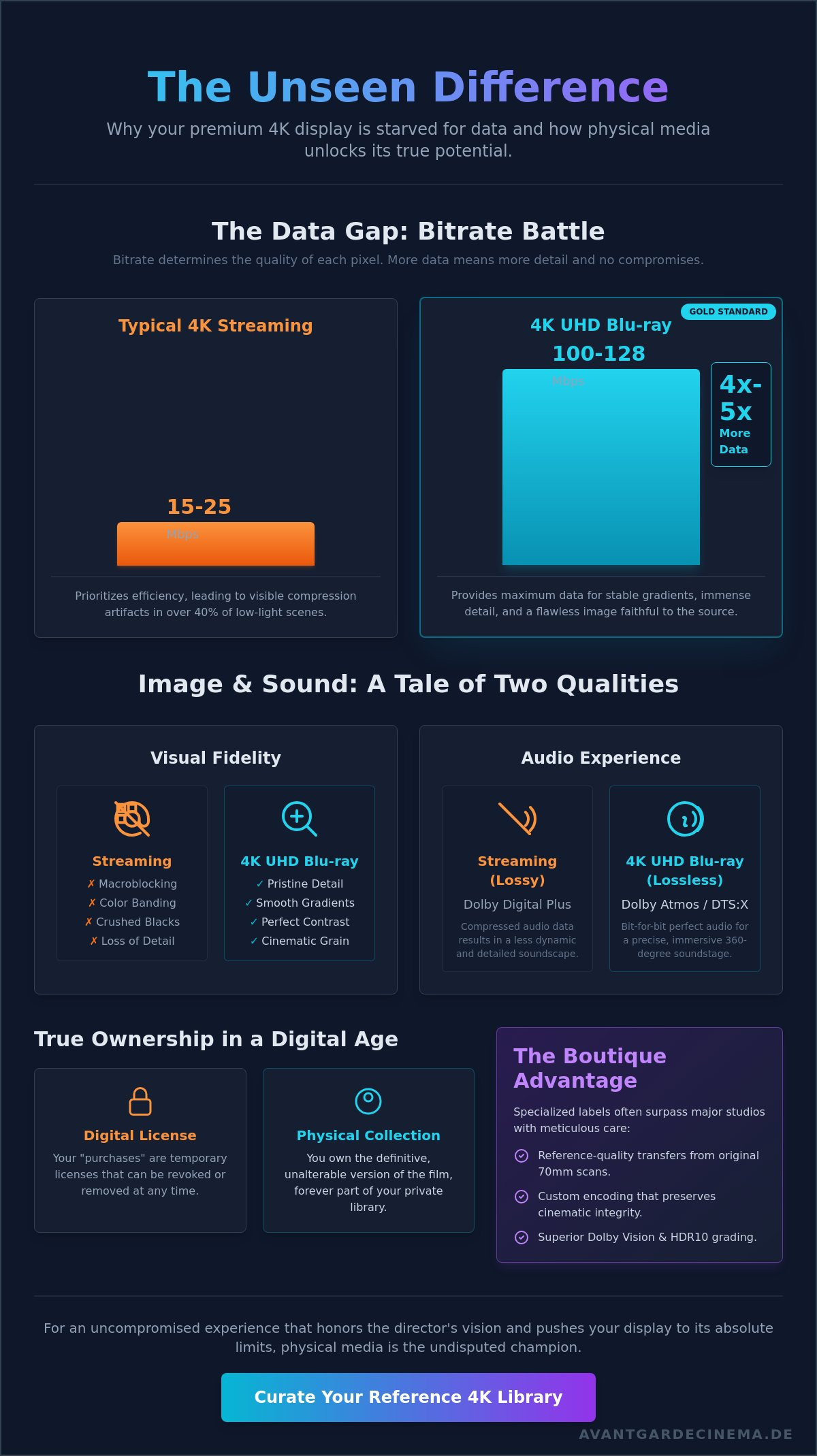
Even in 2026, the gap between digital convenience and cinematic purity remains vast. To find the best 4k movies to show off your tv, you must look beyond the "Play" button on a streaming app. Streaming providers prioritize efficiency over art. When you choose a stream, you're accepting a compromise that often results in crushed blacks and macroblocking in complex scenes. To truly experience the best 4k movies to show off your tv, the source must match the panel's potential. A standard 4K stream typically plateaus at 15 to 25 Mbps. In contrast, a physical disc leverages Ultra HD Blu-ray specifications to deliver bitrates between 80 and 100 Mbps. This fourfold increase in data isn't just a number; it manifests as stable gradients in dark scenes and a complete absence of the banding that plagues digital skies and shadows.
The Technical Superiority of 4K Ultra HD Discs
Resolution describes the number of pixels on your screen, but bitrate determines the quality of those pixels. Identifying the best 4k movies to show off your tv requires an understanding that pixels alone don't create beauty; the data behind them does. Triple-layer (100GB) discs are vital for long, visually dense films because they provide the necessary "breathing room" for complex grain structures and high-contrast HDR metadata. Digital ownership is often a mirage. Licensing removals can strip a film from your digital library overnight, whereas physical media ensures you own the definitive, unalterable version of a masterpiece forever.
Bitrate: Physical media offers up to 100 Mbps, while streaming averages 15-25 Mbps.
Disc Capacity: 100GB triple-layer discs prevent compression artifacts in long-form cinema.
Audio: Discs provide lossless Dolby TrueHD and DTS-HD Master Audio, which streaming cannot replicate.
Streaming vs. Physical: The Visual Evidence
The most glaring visual artifact in streaming is macroblocking, where the encoder fails to keep up with fast motion or complex textures, resulting in "boxy" clusters of pixels. You'll often see this in explosions, falling rain, or deep space nebulae. Reference Quality is the closest representation of the original 35mm or digital master, preserving the cinematographer's intent without digital compromise. When you compare a high-bitrate disc to a compressed stream, the difference in "depth" and "dimensionality" is immediate. This is why curators of fine cinema continue to advocate for a tangible collection. You can explore more about this philosophy in our guide on Why Physical Media Still Matters.
True immersion also demands sonic excellence. Streaming services use lossy Dolby Digital Plus, which discards a significant portion of audio data to save space. Physical 4K discs feature lossless Atmos and DTS:X tracks that provide a 360-degree soundstage with terrifying precision. Choosing physical media isn't just about avoiding artifacts; it's about honoring the craftsmanship of the filmmakers and the technological capabilities of your 2026 display.
The Technical Benchmarks of a Reference 4K Transfer
Achieving the status of a reference disc requires more than just a 2160p label. When you search for the best 4k movies to show off your tv, you're looking for a synergy between bit-depth, luminance, and grain structure. HDR10 provides a solid foundation, but Dolby Vision elevates the experience through dynamic metadata. This allows your display to adjust its tone mapping frame-by-frame, ensuring that a candlelit room in a period drama retains its atmospheric shadows without crushing the blacks. Understanding these technical benchmarks for 4K transfers is essential for anyone wanting to push their hardware to its absolute limit. Identifying the best 4k movies to show off your tv requires an eye for these technical nuances; it's the difference between a simple upgrade and a transformative cinematic event.
Dynamic Range and Peak Brightness
High Dynamic Range (HDR) isn't just about making the image brighter. It's about the contrast between the deepest voids and the most brilliant highlights. Modern OLED and Quantum Dot panels can hit peaks of 1,000 to 4,000 nits, creating realistic reflections on water or the glint of light on chrome. Shadow detail is equally vital. A high-end transfer maintains "near-black" performance, preventing the muddy pixelation often seen in low-bitrate streams. For the ultimate experience, check if your disc includes a Dolby Vision "Full Enhancement Layer" (FEL). This 12-bit signal provides additional data that smooths out color gradients, virtually eliminating the "banding" artifacts that can plague sky sequences or underwater shots.
Texture and Fine Detail
The debate between "Native 4K" and 2K upscales often dominates cinephile circles. Films shot on 35mm or 65mm stock benefit from new scans of the original camera negatives, capturing organic textures that digital intermediates finished at 2K resolution might miss. However, the Director of Photography’s (DP) vision is the ultimate guide. Natural sharpness should never be confused with artificial edge enhancement, which adds distracting halos around characters. Film grain is another critical factor. It's the soul of the celluloid; aggressive digital noise reduction (DNR) results in a "waxy" look that strips away the film's character. Utilizing high-quality 4K Ultra HD players ensures that these intricate details and wide P3 color spaces are preserved exactly as the filmmaker intended. You can explore our latest curated new releases to find your next reference-quality experience and witness this technical mastery firsthand.
Top 4K Movies to Show Off Your TV’s Visual Prowess
Selecting the best 4k movies to show off your tv requires an eye for both technical precision and artistic intent. Denis Villeneuve’s Dune: Part Two (2024) currently represents the pinnacle of modern HDR implementation. The film utilizes a massive contrast range to distinguish the blinding, high-nit highlights of the Arrakis desert from the oppressive, ink-black depths of the Harkonnen homeworld. It’s a masterclass in shadow detail that forces your display to balance extreme brightness without losing texture. If your screen can resolve the subtle gradations in the spice-heavy atmosphere, you’ve found a winner.
For those who prefer the organic texture of film, The Revenant (2015) remains a definitive benchmark. Captured by Emmanuel Lubezki using the Arri Alexa 65 system, the transfer highlights the raw power of natural light. You’ll see every bead of sweat and individual snowflake with startling clarity. If you want to test color volume, Spider-Man: Across the Spider-Verse (2023) pushes the wide color gamut to its absolute limits. Its neon-soaked palettes and varied art styles provide a rigorous workout for any panel’s saturation capabilities, ensuring your hardware is truly hitting its peak performance.
Even vintage cinema finds new life in this high-fidelity format. The Criterion restoration of The Red Shoes (1948) proves that Technicolor was essentially a precursor to modern HDR. The 4K transfer from the original three-strip negatives reveals a depth of red and blue that feels remarkably contemporary. It proves that high-end curation is vital for a true home cinema experience that honors the history of the medium.
Science Fiction and High-Contrast Scenarios
Roger Deakins’ cinematography in Blade Runner 2049 (2017) is the ultimate test for black levels. The atmospheric fog and silhouettes require a display that can handle subtle gradations without digital banding. For a historical perspective, 2001: A Space Odyssey (1968) stands as the gold standard for 65mm film-to-4K transfers. The clarity of the spaceship models against the void of space is breathtaking. Meanwhile, Christopher Nolan’s Interstellar (2014) utilizes IMAX-ratio transitions that expand the vertical scale, offering a sense of immersion that few other 4K UHD titles can match.
Vivid Colors and Stylized Cinematography
Mad Max: Fury Road (2015): This title tests peak brightness and EOTF tracking through its scorched orange landscapes and piercing blue skies. It’s a vibrant, high-octane visual feast.
Suspiria (1977): The Synapse Films restoration is legendary for its aggressive use of primary colors. It pushes the boundaries of what older film stock can achieve in the digital space.
Ran (1985): Akira Kurosawa’s epic, restored by StudioCanal, showcases incredible costume detail. The vibrant banners and intricate armor textures benefit immensely from the 4K resolution boost, making it one of the best 4k movies to show off your tv.
The Boutique Label Difference: Beyond the Studio Standard
Major studios often prioritize mass market appeal, which can lead to aggressive digital noise reduction to make older films look "clean" for modern audiences. Boutique labels operate with a different philosophy. They treat every frame as a preserved artifact. This commitment makes their discs the best 4k movies to show off your tv because they don't compromise on technical integrity. While a standard studio release might rely on automated encoding, boutique houses employ specialized compressionists who manage grain frame by frame. They ensure that 35mm film grain looks like organic silver halide crystals rather than digital noise. These labels frequently utilize BD-100 discs to maintain bitrates that often hover between 80 and 95 Mbps, providing a density of image that streaming services can't match.
The "Art of the Scan" is where these labels truly shine. They often fund new 4K restorations from the original camera negatives, correcting decades of color fading and damage. When you watch a boutique 4K restoration, you aren't just watching a movie; you're witnessing a historical document brought back to life with modern high dynamic range (HDR) tools. Beyond the disc, the physical presentation includes thick chipboard slipcases, extensive booklets, and hours of newly produced documentaries. It's a holistic experience designed for the serious collector.
Criterion and the Gold Standard of Curation
The meticulous nature of The Criterion Collection transfers sets a global benchmark for quality. Their 2021 4K release of David Lynch’s "Mulholland Dr." and the 2023 UHD debut of "The Seventh Seal" demonstrate their mastery of contrast and shadow detail. Each release undergoes a rigorous color grading process often supervised by the original cinematographers. For a deeper look at their philosophy, consult our Criterion Collection Guide.
Arrow Video and Second Sight: Visual Powerhouses
For those seeking visceral impact, Arrow Video excels at applying sophisticated HDR10+ and Dolby Vision grading to cult classics, breathing new life into vibrant genre cinema. Meanwhile, Second Sight has gained legendary status for their 2023 "The Texas Chain Saw Massacre" 4K restoration. This release proved that even gritty, low-budget films can become the best 4k movies to show off your tv when handled with technical reverence. For German collectors, these "import" labels are essential because they often secure the rights to provide the highest possible bitrates that domestic editions might miss.
Elevate your collection with the world's finest restorations by browsing our premium 4K UHD boutique releases.
Curating Your 4K Library with Avant-Garde-Cinema
Owning the best 4k movies to show off your tv requires more than just a casual purchase; it demands a strategic approach to physical media acquisition. By January 2026, the market for high-bitrate discs has shifted toward limited boutique runs that often vanish within 90 days of release. Identifying these reference-quality titles involves monitoring bitrates and HDR implementations like Dolby Vision or HDR10+. Reference discs from labels like Second Sight or Vinegar Syndrome serve as the gold standard for home theater enthusiasts who refuse to compromise on bit depth or grain structure. Supporting independent retailers is the only way to ensure these specialized imports remain viable for the cinephile community.
While the 4K UHD format remains natively region-free, the supplemental material on included standard Blu-ray discs often stays locked to specific territories. Collectors in 2026 must account for this when importing from North America or Asia. Supporting a specialized importer ensures you receive expert guidance on these technical nuances while keeping your library future-proof. It's essential to stay ahead of the curve by monitoring New Releases and Coming Soon announcements. This proactive approach allows you to secure titles before they enter the inflated "Out of Print" secondary market.
Building a Collection with Artistic Integrity
True curation focuses on quality over quantity. A shelf filled with 500 mediocre transfers can't compete with 50 masterfully restored films that redefine what your screen can do. Visionary collectors prioritize Limited Edition Box Sets, which often feature exclusive 4K restorations and comprehensive booklets that provide historical context. These sets transform a movie night into a gallery-level experience. Avant-Garde-Cinema acts as a dedicated curator for the visionary collector who seeks only the most profound visual statements.
The Collector’s Advantage in Germany
Acquiring worldwide boutique titles shouldn't involve the stress of international customs or exorbitant shipping fees. Based in Berlin, our specialized shop streamlines the process of sourcing the best 4k movies to show off your tv from global distributors. Many enthusiasts view Steelbooks as more than packaging; they're investment pieces that often retain 85% or more of their value over time due to their limited nature. By choosing a local partner with a global reach, you gain access to the finest cinematic craftsmanship without the logistical hurdles. Explore our curated 4K Ultra HD selection to find your next reference masterpiece.
Master the Art of the Home Cinematheque
Owning a high-end display is merely the first step toward visual excellence. To truly unlock the potential of 2026 display technology, physical media remains the gold standard, offering bitrates that often exceed 100 Mbps to ensure every pixel serves a specific purpose. By selecting titles from specialist boutique labels like Criterion, Arrow, and Second Sight, you ensure that every frame meets the rigorous standards of a reference transfer. These editions prioritize the director's original vision; they preserve delicate grain structures and peak brightness levels that digital compression often destroys. Curating the best 4k movies to show off your tv requires a discerning eye for these technical nuances. At Avantgarde Cinema, our Berlin-based team of cinephiles carefully selects every title to ensure your collection represents the pinnacle of home media. We provide worldwide shipping to collectors who refuse to compromise on aesthetic integrity. It's time to treat your screen to the masterwork it deserves.
Frequently Asked Questions
Is 4K Blu-ray really better than 4K streaming?
Yes, 4K Blu-ray provides a superior experience because it handles data at rates up to 100 Mbps. Streaming services like Netflix or Disney+ typically compress video to 15 or 25 Mbps, which leads to visible artifacts in dark scenes. This physical format preserves the director's original vision with lossless audio tracks that streaming simply can't replicate. It's the difference between a digital sketch and a gallery masterpiece.
What is the most visually stunning 4K movie ever released?
Christopher Nolan’s Oppenheimer (2023) stands as a pinnacle of visual storytelling. Shot on 65mm and 70mm IMAX film, this transfer offers unparalleled clarity and depth. It's widely considered one of the best 4k movies to show off your tv due to its organic texture and staggering contrast ratios. Every frame feels like a curated photograph, capturing the raw intensity of the performances with breathtaking precision.
Do I need a special player to watch 4K Ultra HD movies?
You'll need a dedicated 4K Ultra HD Blu-ray player or a modern gaming console like the PlayStation 5 to read these discs. Standard Blu-ray players lack the optical hardware to decode 66GB or 100GB triple-layer discs. Investing in a high-end player ensures you capture every nuance of the HDR metadata. This hardware acts as the bridge between the studio's master file and your home theater's display.
Are all 4K movies "Native 4K" or are some upscaled?
Not every 4K release is Native 4K; roughly 45% of modern blockbusters are upscaled from 2K digital intermediates. This happens because high-end visual effects are often rendered at lower resolutions to save processing time. However, the addition of High Dynamic Range (HDR) and Wide Color Gamut (WCG) often makes these upscaled versions look significantly better than their standard high-definition counterparts. The artistry remains intact despite the resolution shift.
Why are boutique 4K discs more expensive than standard releases?
Boutique labels like Second Sight or The Criterion Collection charge more because they invest in bespoke restorations. These companies often spend 200 to 300 hours meticulously cleaning film grain and correcting color shifts from aging negatives. You're paying for a curated artifact that includes exclusive essays, premium packaging, and technical encodes that prioritize artistic integrity over mass-market convenience. It's a commitment to preserving cinematic history in its purest form.
Does my TV need Dolby Vision to enjoy these movies?
Your TV doesn't require Dolby Vision to play these movies, but the format offers a more precise visual journey. While standard HDR10 uses static settings for the entire film, Dolby Vision adjusts brightness and contrast on a frame-by-frame basis. This dynamic optimization ensures that highlights remain crisp and shadows retain detail in every single shot. It's an essential tool for those seeking the ultimate level of immersion and accuracy.
How can I tell if a 4K transfer is "reference quality"?
A reference quality transfer is defined by its ability to replicate the theatrical experience without compromise. You should look for titles that utilize a 4K scan of the original camera negative and maintain bitrates above 85 Mbps. These releases are the best 4k movies to show off your tv because they eliminate compression noise and banding. When a disc achieves this level of technical excellence, the screen disappears, leaving only the filmmaker's intent.
Are 4K Ultra HD discs region-locked?
4K Ultra HD discs are almost universally region-free, a standard established by the Blu-ray Disc Association in 2016. This allows you to source rare editions from international markets without worrying about hardware compatibility. While the 4K disc itself won't be locked, be aware that the included standard Blu-ray or bonus discs in the package might still carry regional restrictions. This global accessibility empowers the modern cinephile to build a truly borderless collection.
Comments