


The Modern Cinephile’s Manifesto: How to Justify Buying Physical Media in 2026
- Martin Kolb
- Apr 22
- 13 min read

Your digital movie library is a ghost that could vanish at the whim of a corporate licensing agreement. In December 2023, over 1,300 Discovery titles were scheduled for removal from PlayStation libraries, proving that "purchase" is often just a fragile rental. It's heartbreaking to see a director's vision compromised by blocky artifacts in a dark scene because a streaming service throttled your data. You likely believe that cinema is an art form that demands respect, not just another piece of ephemeral content. Learning how to justify buying physical media in 2026 begins with the realization that true ownership is the only way to safeguard your cultural heritage.
This manifesto reveals why physical formats remain the pinnacle of aesthetic excellence for the modern cinephile. You'll learn how to achieve a superior sensory experience with bitrates reaching 100 Mbps, which provides nearly seven times the visual data of a standard 4K stream. We'll explore the security of a tangible collection and the profound pride that comes from a curated library that serves as a mirror to your soul. This guide prepares you to transition from a passive consumer to a dedicated guardian of the cinematic arts.
Key Takeaways
Understand the vital distinction between ephemeral digital licensing and the enduring sovereignty of physical ownership, ensuring your library remains immune to the fragility of the digital landscape.
Discover how to justify buying physical media by exploring the uncompromising technical superiority of 4K Ultra HD, where high bitrates protect the delicate textures of cinematic art from streaming degradation.
Appreciate the rise of boutique labels as modern curators, transforming the film disc into a tangible artifact that blends high-end craftsmanship with the soul of the moving image.
Learn how to transition from a passive viewer to a visionary curator, using your collection to fund vital film restorations and bypass the restrictive filters of mainstream algorithms.
Table of Contents The Vanishing Act: Why Digital Ownership Is a Fragile Illusion Uncompromising Technical Excellence: The 4K Ultra HD Advantage The Aesthetic of the Artifact: Boutique Labels as High Art Preservation and the Ethics of the Cinephile Curating Your Legacy with Avant-Garde-Cinema
The Vanishing Act: Why Digital Ownership Is a Fragile Illusion
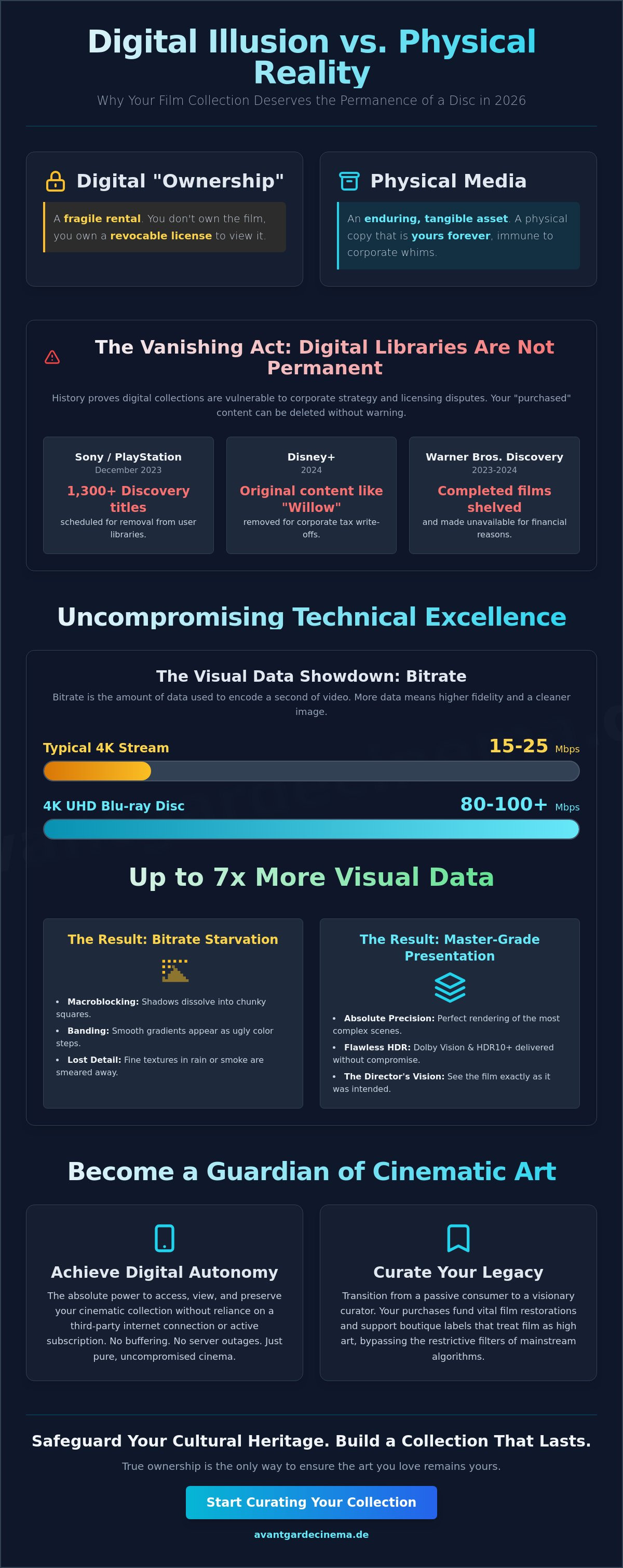
The digital era promised a library of infinite convenience, yet it stripped away the permanence once synonymous with a private collection. By 2026, the distinction between a permanent asset and a temporary rental has blurred into a legal gray area that many consumers ignore until it's too late. Understanding the debate over physical media is the first step for any collector who values artistic integrity over ephemeral access. When you click "buy" on a streaming platform, you aren't acquiring a film; you're securing a revocable license. This realization is a primary reason how to justify buying physical media in a world that favors corporate control over personal possession.
Digital Rights Management (DRM) acts as a silent gatekeeper, tethering your library to a server that you do not own. History proves this infrastructure is unstable. Consider these documented instances of digital erasure:
Sony/Discovery (December 2023): Over 1,300 titles were initially slated for deletion from user libraries due to licensing shifts, regardless of previous "purchase" status.
Disney+ (2024): The removal of original content like "Willow" demonstrated that even platform-exclusive films can disappear to satisfy corporate tax strategies.
Warner Bros. Discovery: The 2023-2024 era saw multiple completed projects shelved and removed from digital availability for financial write-offs.
Your library exists at the whim of licensing renewals and corporate mergers. A physical disc is the only way to ensure your collection remains a static, reliable archive of cinematic history.
The Licensing Trap: You Don’t Own What You Stream
The End User License Agreements (EULA) of 2026 have become increasingly complex, often granting platforms the right to modify or remove content without notice. If a studio enters a legal dispute with a distributor, your favorite masterpiece might vanish overnight. High-quality physical releases from boutique labels like Criterion or Arrow represent an "untouchable copy." These discs offer a psychological comfort that digital files can't match, providing a tangible manifestation of a director's vision that no server-side update can ever erase.
Reliability in an Always-On World
Streaming quality fluctuates based on bandwidth, and server maintenance can lock you out of your collection during the very hours you seek escapism. Physical media bypasses the frustration of buffering and complex, ad-heavy user interfaces. You simply insert the disc and press play. Digital Autonomy is the absolute power to access, view, and preserve your cinematic collection without reliance on a third-party internet connection or active subscription. This independence is a cornerstone of how to justify buying physical media as a serious cinephile who demands excellence without compromise.
Uncompromising Technical Excellence: The 4K Ultra HD Advantage
To understand the fundamental gap between a digital stream and a physical disc, you must look at the raw data flow. While streaming platforms often advertise "4K Quality," they operate under the heavy hand of bandwidth conservation. A typical 4K stream from a major service averages between 15 and 25 Mbps. In stark contrast, a triple-layer 100GB 4K UHD disc regularly sustains bitrates between 80 and 100 Mbps, peaking even higher during complex sequences. This isn't just a technical statistic; it's the difference between a compressed approximation and a master-grade presentation. When considering how to justify buying physical media, this four-fold increase in data density is the most objective argument for the enthusiast.
Low bitrates lead to a phenomenon known as "bitrate starvation." In dark, moody scenes or complex textures like falling rain or swirling smoke, streaming encoders struggle to keep up. The result is macroblocking, where shadows dissolve into chunky, digital squares, and fine details are smeared away. Physical media provides the necessary "headroom" to render these difficult gradients with absolute precision. This technical overhead also ensures that HDR10+ and Dolby Vision metadata are delivered without the fluctuations common in variable internet connections, maintaining consistent brightness and color accuracy throughout the entire runtime.
Visual Fidelity: Beyond the 4K Label
True cinematic texture relies on the preservation of film grain, which streaming algorithms frequently interpret as "noise" to be scrubbed away. This heavy-handed noise reduction results in a "waxy" appearance on faces and a loss of depth in the background. A 4K UHD disc treats grain as a vital aesthetic component, preserving the organic "film look" that directors intended. For those who demand this level of purity, understanding the nuances of the format is essential, as detailed in our 4K Ultra HD in 2026: The Definitive Guide.
The Sonic Landscape: Lossless Audio vs. Compressed Streams
Sound is half the experience, yet it's often the first casualty of streaming compression. Most digital services use Dolby Digital Plus, a lossy format that discards massive amounts of sonic data to save space. Physical discs utilize lossless codecs like Dolby TrueHD and DTS-HD Master Audio. These formats provide a bit-for-bit recreation of the studio master, offering a dynamic range that streaming simply cannot replicate.
Dynamic Impact: Explosions and sudden orchestral swells have a physical "thump" that compressed audio lacks.
Spatial Precision: In a Dolby Atmos or DTS:X environment, lossless audio allows for pinpoint accuracy in object-based sound placement.
Micro-detail: The subtle rustle of clothing or the distant echo in a hallway remains audible, creating a more immersive, three-dimensional soundstage.
The disc serves as a direct conduit to the mixing stage, ensuring the sound engineer’s vision reaches your ears without compromise. It’s a level of fidelity that honors the craftsmanship of modern sound design. If you're ready to elevate your home theater, you can find the most technically impressive new releases that push these formats to their absolute limit.
The Aesthetic of the Artifact: Boutique Labels as High Art
Owning a film in 2026 isn't a matter of convenience. It's an act of curation. When you hold a heavy box set, you aren't just holding a plastic case; you're holding a physical manifestation of cinematic intent. This tangible connection provides a primary way how to justify buying physical media when every title is theoretically available in the cloud. Boutique labels have transformed the home video market into a high-end gallery space where the disc serves as the canvas.
Boutique Editions: Curating Excellence
Labels like Criterion, Arrow, and Second Sight don't just distribute movies. They archive them. Since its inception in 1984, the Criterion Collection has released over 1,000 titles, treating each as a historical artifact. These editions often feature 4K restorations from original camera negatives, ensuring the film looks better than it did during its initial theatrical run. The investment value of limited edition box sets is undeniable. Many titles from Vinegar Syndrome or Second Sight sell out within months, turning a standard purchase into a collectible asset that appreciates over time.
The Joy of the Tactile Experience
The sensory experience of physical media begins long before the disc enters the player. It starts with the weight of a rigid slipcase and the texture of a matte-finish booklet. High-quality print materials and original commissioned cover art offer a visual depth that a low-resolution thumbnail can't replicate. Reading a 40-page essay by a renowned critic while the opening credits roll deepens your understanding of the director's vision. It's a ritual. You're stepping away from the mindless scroll of an algorithm and making a deliberate choice. Selecting a film from a shelf feels intentional, turning your living room into a curated sanctuary of personal taste.
Special features provide the ultimate educational toolkit for any dedicated cinephile. Commentary tracks, deleted scenes, and technical video essays reveal the craft behind the camera. These supplements are often exclusive to physical releases, making the disc the definitive version of the work. When critics ask how to justify buying physical media in a digital-first world, the answer lies in the permanence of the object. A digital license can be revoked or altered, but a physical artifact remains on your shelf as a permanent pillar of your collection.
Archival Quality: Restorations that respect the original grain and color timing of the film.
Educational Value: Hours of scholarly content that turn a movie night into a film school masterclass.
Personal Identity: A physical library acts as a visual autobiography of your artistic journey.
Market Scarcity: Limited print runs that ensure your collection remains unique and valuable.
Your collection is more than a stack of plastic. It's a testament to your commitment to artistic integrity and the preservation of culture. By choosing boutique labels, you support the artisans who spend hundreds of hours cleaning frames and sourcing lost footage. This relationship between the collector and the label is a collaborative effort to keep the history of cinema alive, one spine number at a time.
Preservation and the Ethics of the Cinephile
Owning a film is an act of cultural stewardship. It's a conscious decision to protect the medium from the volatile whims of licensing agreements and corporate server purges. When considering how to justify buying physical media, one must look beyond personal convenience and toward the survival of the art form itself. Collectors don't just consume content; they curate a legacy that resists the erosion of time and digital obsolescence.
Funding Film History
The transition from 35mm celluloid to 4K digital intermediates is a costly, meticulous endeavor. A high-end restoration can cost anywhere from $40,000 to over $100,000 depending on the state of the original negative and the complexity of the grain management. Boutique labels like Criterion and Arrow rely almost exclusively on disc sales to finance these archival projects. By purchasing a physical copy, you're directly subsidizing the labor of technicians who spend hundreds of hours removing scratches and stabilizing frames. It's a direct vote for the continued existence of a director's work. Without this revenue stream, obscure genre films and world cinema masterpieces would simply vanish into the vaults, deemed too niche for a streaming service's bottom line.
Escaping the Algorithm
Streaming platforms operate on a logic of mass appeal. Their algorithms are designed to keep you watching, not to challenge your perspective or introduce you to the radical edges of cinematic history. This creates a filter that effectively erases films that don't generate high engagement metrics. We face a growing risk of cultural amnesia where "problematic" or avant-garde works are quietly delisted to avoid controversy. Owning a disc bypasses this digital gatekeeping. It ensures that the original vision remains intact, free from the revisionist history often seen in digital updates where dialogue is censored or color palettes are modernized to fit current trends. Archival Integrity is the gold standard for film lovers, representing a commitment to seeing a film exactly as it was intended to be seen upon its release.
Collectors act as the final line of defense for the eccentric and the rare. Whether it's a limited edition box set from Vinegar Syndrome or a rare import, your shelf becomes a private archive that no corporation can delete. This is how to justify buying physical media in an era of ephemeral access; you're not just buying a movie, you're securing its future for the next generation of viewers.
Explore the masterpieces currently defining the medium in our
.
Curating Your Legacy with Avant-Garde-Cinema
Transitioning from a casual viewer to a visionary curator marks a pivotal moment in your cinematic journey. It's the point where you stop consuming content and start building a museum. When you consider how to justify buying physical media in an age of fleeting digital streams, the answer lies in the permanence of the object. A stream can vanish when a licensing agreement expires; a 4K UHD disc remains on your shelf, ready to be projected at the highest possible bitrate. This shift requires a commitment to quality over quantity, focusing on the directors, cinematographers, and boutique labels that treat film as high art rather than a disposable commodity.
The true curator understands that a library is a living reflection of their aesthetic values. You aren't just buying a movie; you're securing a specific restoration, a director's cut, or a limited edition slipcover that won't be produced again. By 2026, the scarcity of high-end physical releases has only increased their prestige. Owning a rare edition from a boutique label is a statement of intent. It shows you value the craft of filmmaking enough to own the definitive version of the vision.
Sourcing the Impossible
Global cinema shouldn't be restricted by digital borders or regional locks. Avant-Garde-Cinema acts as your specialized scout, sourcing the world’s most exclusive boutique labels from every corner of the globe. Whether it's a limited Japanese press or a restored European classic, we bridge the gap between the creator and your home theater. Utilizing region-free players allows you to bypass artificial constraints, granting access to international imports that never reach domestic streaming platforms. This technical freedom is essential for any serious collector who refuses to let a geographic code dictate their viewing habits. To see the pinnacle of what modern restorations can achieve, you can Explore our curated 4K UHD collection and witness the depth that only physical bits can provide.
Investing in Your Passion
A curated collection is more than a hobby; it's a legacy for future generations of film lovers. When you hand down a library of physical discs, you're passing on a curated history of visual storytelling that isn't dependent on an internet connection or a monthly subscription fee. This is the ultimate way how to justify buying physical media: you're protecting the art from digital decay. There's also a profound community aspect to this pursuit. Sharing a rare find with a fellow enthusiast or hosting a screening of a boutique restoration creates a tactile, social experience that streaming simply can't replicate.
Your library is an investment in your own history and the history of cinema itself. It won't expire, it won't be edited for "modern audiences" without your consent, and it won't disappear because a server went offline. It's yours, forever. To take the first step toward building your permanent archive, Begin your journey with our latest New Releases and secure your piece of cinematic history today.
Claiming Your Sanctuary of Cinematic Excellence
Digital convenience shouldn't come at the cost of artistic integrity. When you consider the 2023 Sony Discovery incident where 1,300 titles were slated for removal, the vulnerability of the cloud becomes undeniable. Choosing a physical 4K Ultra HD disc provides a 100 Mbps bitrate that dwarfs the 25 Mbps average of most streaming giants. This is how to justify buying physical media in a world that favors temporary access over permanent excellence. You're investing in the technical precision of the format and the curated artistry of boutique labels. Every limited edition release represents a commitment to preservation and a passion for the visual narrative. It's time to move beyond the stream and claim your place as a true guardian of film history.
We invite you to curate your cinematic legacy with Avant-Garde-Cinema. Explore our exclusive access to worldwide boutique labels like Criterion and Second Sight; we specialize in limited edition 4K Ultra HD and rare imports designed for the serious cinephile. Your collection is your legacy, so make it extraordinary.
Frequently Asked Questions
Is physical media really better than 4K streaming?
Physical media offers superior bitrates that reach 100 Mbps on a triple-layer UHD disc. Streaming services typically compress data to 15 or 25 Mbps; this drastic reduction sacrifices fine detail and color depth. A physical disc preserves the delicate grain and shadow nuances of a 35mm film scan. You won't see the digital artifacts or banding that often plague dark scenes in a compressed stream.
Will Blu-ray players become obsolete in the near future?
Blu-ray players remain essential for high-fidelity playback and won't vanish as long as a premium market for quality exists. High-end manufacturers like Magnetar released new reference players in 2024 to serve the growing enthusiast niche. While mass-market production has slowed, the secondary market and specialized hardware brands ensure your collection remains accessible. Owning the hardware is the only way to guarantee a bit-perfect cinematic experience at home.
How do I justify the cost of boutique Blu-rays?
You can understand how to justify buying physical media by viewing boutique releases as curated art pieces rather than mere plastic discs. Labels like The Criterion Collection or Second Sight invest in 4K restorations from original camera negatives. These editions include thick booklets, exclusive essays, and hours of scholarly supplements. You're paying for a definitive archival document that outlasts the shifting licenses of digital platforms.
What happens if a boutique label goes out of business?
Your physical discs continue to function perfectly even if the company that produced them ceases to exist. When the label Twilight Time closed its doors in 2020, their limited-edition titles became instant collector items. Some discs now command prices 300% higher than their original retail value on secondary markets. Your ownership is absolute; it's independent of any corporate server or licensing agreement.
Do physical discs actually last forever?
Modern Blu-ray discs have an estimated lifespan of 50 to 100 years when stored in a climate-controlled environment. Manufacturers use a protective hard-coat layer that resists scratches and chemical degradation better than old DVD technology. As long as you keep your collection away from direct sunlight and extreme humidity, these discs will outlive most digital storage formats. They represent a stable, long-term investment in your personal film library.
Can I play import Blu-rays from other countries?
You can play any 4K Ultra HD disc regardless of where it was purchased because the 4K format is globally region-free. Standard 1080p Blu-rays are still divided into three geographical zones. To enjoy a wider range of international cinema, many enthusiasts use modified region-free players. This hardware allows you to access rare restorations from British, French, or Japanese labels without technical restrictions.
Why are some films only available on physical media and not streaming?
Licensing complexities and music rights often prevent thousands of films from appearing on digital platforms. Industry data suggests that over 50% of films produced before 1950 lack a digital streaming home. Physical media remains the only gateway to these lost masterpieces and cult classics. By owning the disc, you bypass the legal purgatory that keeps many artistic visions hidden from the public eye.
How does physical media help with film preservation?
Physical media acts as a decentralized archive that protects cinematic history from corporate deletion. In 2022, digital storefronts demonstrated the fragility of ownership by removing purchased content from user libraries due to licensing shifts. When you hold a physical copy, you participate in a global network of preservationists. This ensures that a film’s original edit and aesthetic vision survive for the next generation of viewers.
Comments