


HDR10 vs Dolby Vision: The Cinephile’s Guide to 4K Mastering in 2026
- Martin Kolb
- 7 days ago
- 13 min read

What if the 4K disc you just added to your shelf for $34.99 is actually masking 40 percent of the cinematographer's intended color palette? You've likely felt that sting of disappointment when a highly anticipated restoration appears inexplicably dim or lacks the visceral punch promised by the gold foil on the slipcover. It's frustrating to invest in premium hardware only to wonder if the choice between hdr10 vs dolby vision on the back of a Criterion or Second Sight release is actually making a tangible difference to the image's soul. Technical logos shouldn't be a source of anxiety.
This guide dissects these intricate technicalities to ensure your boutique collection preserves every nuance of the original 35mm negative as we move into the mastering standards of 2026. You'll discover the tangible benefits of dynamic metadata and learn which labels are currently setting the benchmark for 12-bit depth. We will walk through the artistic impact of these formats so you can curate a library that honors the director's vision with absolute precision. It's time to bridge the gap between technical mastery and aesthetic excellence.
Key Takeaways
Understand why High Dynamic Range is the definitive tool for cinematic depth, surpassing mere resolution to preserve the director's original vision.
Master the technical nuances of hdr10 vs dolby vision to understand how dynamic metadata orchestrates a frame-by-frame visual symphony.
Learn why prestigious boutique labels prioritize specific mastering formats to breathe new life into restored classics with unparalleled color volume.
Identify the essential hardware "handshake" required between your 4K UHD player and display to unlock the full potential of your boutique collection.
Discover why physical media remains the gold standard for cinephiles, offering bitrates that ensure artistic integrity far beyond the limitations of streaming.
Table of Contents Understanding the High Dynamic Range Landscape in 2026 Static vs Dynamic Metadata: The Core Technical Difference Why Dolby Vision is the Preferred Choice for Boutique Labels Compatibility and Hardware: Ensuring Your Setup Reflects the Vision Beyond the Specs: Why Physical 4K UHD Discs Outshine Streaming HDR
Understanding the High Dynamic Range Landscape in 2026
For the discerning cinephile, the shift from 1080p to 4K resolution was merely a technical prelude to the true revolution of light. While increased pixel density adds a layer of perceived sharpness, High Dynamic Range (HDR) television redefined the emotional resonance of the digital image itself. It isn't just about achieving blinding peak brightness. Instead, HDR serves as a sophisticated canvas for expanded color volume and contrast, allowing for a more visceral connection to the frame. In 2026, this technology has matured into a precise science where the debate of hdr10 vs dolby vision dictates how faithfully a master preserves a cinematographer's original intent.
The Evolution of Cinematic Contrast
Standard Dynamic Range (SDR) restricted creators for decades, forcing them to work within a mere 100 nits of peak brightness and the narrow Rec. 709 color gamut. This digital ceiling frequently clipped the highlights that 35mm film stock, with its organic 14-stop latitude, captured with ease. By 2026, mastering consistency has reached a peak. High-end studios now utilize reference monitors capable of 4,000 nits as a baseline, ensuring that the subtle gradients in a dark noir sequence or the piercing glint of a sunset remain intact. This technical maturity means the nuances of light are no longer lost during the journey from the grading suite to the private screening room.
A Baseline Comparison: HDR10 vs Dolby Vision at a Glance
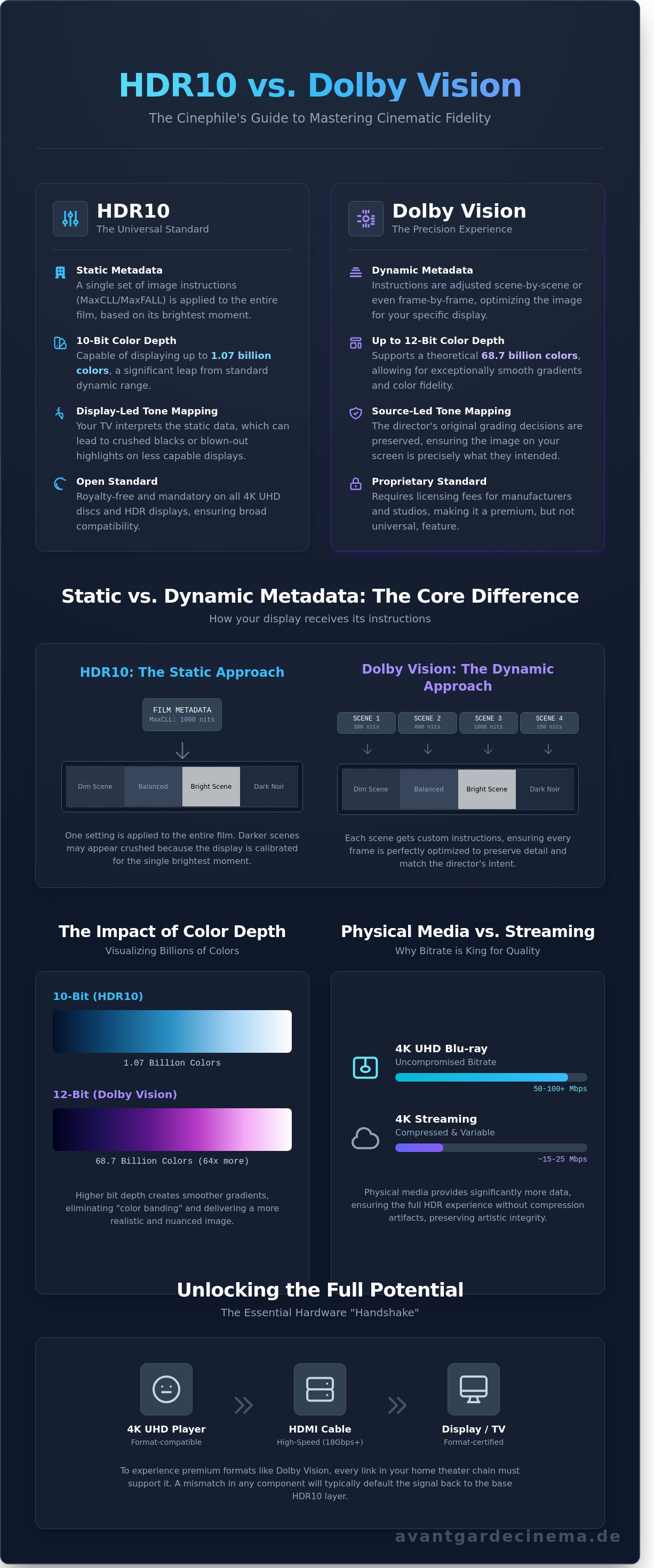
HDR10 functions as the open-source industry standard required for every 4K UHD disc and streaming service currently available. It provides a static set of instructions for the entire film, establishing a single brightness ceiling that the display must interpret. Dolby Vision introduces a more complex, dynamic metadata layer that sits atop this base HDR signal. This allows the master to adjust the image parameters on a frame-by-frame basis.
HDR10: The universal floor; uses static metadata and 10-bit color depth to provide a consistent, high-quality image across all compatible hardware.
Dolby Vision: The premium ceiling; utilizes dynamic metadata and supports up to 12-bit color depth to optimize the image for your specific display's capabilities.
The fundamental choice in the hdr10 vs dolby vision ecosystem often centers on the concept of tone mapping. While HDR10 relies on the television to make decisions about how to handle highlights, Dolby Vision gives the studio direct control over how every shadow and highlight renders on your screen. It's a dialogue between the director's vision and your hardware's potential.
Static vs Dynamic Metadata: The Core Technical Difference
Metadata acts as the digital script sent to your display, dictating how brightness and color should manifest on screen. While the raw video data contains the visual information, metadata provides the essential instructions for interpretation. The fundamental tension in the hdr10 vs dolby vision debate lies in how these instructions are delivered: as a single, unchanging command or as a fluid, evolving narrative that respects the artist's original intent.
The Limitations of HDR10’s Static Approach
HDR10 relies on static metadata, specifically MaxCLL (Maximum Content Light Level) and MaxFALL (Maximum Frame Average Light Level). These values are established once for the entire film. If a director includes a single 1,000-nit explosion in a movie that's otherwise set in a dim, atmospheric basement, the TV calibrates its entire performance based on that one peak. This often results in dark scenes appearing needlessly "crushed" or highlights looking "washed out" on mid-range displays that lack the hardware to balance such extremes. The aesthetic integrity of the image is sacrificed for a "one size fits all" average that fails to capture the nuance of individual scenes.
The Precision of Dolby Vision’s Dynamic Instructions
Real-time optimization defines the Dolby Vision experience. By utilizing dynamic metadata, the system adjusts tone mapping on a frame-by-frame basis, ensuring that every shot is optimized for the specific capabilities of your screen. This level of control is a hallmark of the Dolby Vision mastering workflow, which empowers creators to preserve detail in the brightest highlights and deepest shadows simultaneously. It effectively eliminates "clipping," a phenomenon where bright areas lose texture and become mere white blobs on the screen.
Adaptive Luminance: Dolby Vision allows a director to dictate exactly how a 4,000-nit master should look on a 1,000-nit consumer TV.
Shadow Integrity: Deep blacks are maintained without losing the subtle textures in the dark, preventing the "muddy" look common in static HDR.
Color Fidelity: Highlights are mapped with surgical precision, keeping the saturated hues of a sunset or the glint of chrome sharp and defined.
This technical superiority is why boutique labels and high-end studios prioritize the format for their most prestigious releases. For those seeking the pinnacle of home cinema, exploring our curated 4K UHD collection reveals how this technology transforms the viewing experience into a true gallery of light and shadow. The difference in hdr10 vs dolby vision isn't just a spec on a box; it's the difference between seeing a movie and experiencing a vision.
Why Dolby Vision is the Preferred Choice for Boutique Labels
For boutique labels like Second Sight and Arrow Video, the technical debate of hdr10 vs dolby vision is settled by a commitment to archival integrity. These studios don't just release films; they curate experiences that honor the original celluloid. Dolby Vision provides a sophisticated toolkit through dynamic metadata, allowing restorers to define brightness and color parameters for every single frame. This granular control ensures that the director's vision remains untarnished by the limitations of consumer hardware. Collectors often view the Dolby Vision logo as a seal of quality because it represents a higher tier of mastering effort.
A critical distinction for the enthusiast is the difference between "FEL" (Full Enhancement Layer) and "MEL" (Minimal Enhancement Layer). While MEL only carries the dynamic metadata, FEL includes an additional 1080p video stream. This secondary layer works in tandem with the base 4K image to reconstruct a true 12-bit signal. It effectively eliminates the micro-blocking and compression artifacts that can sometimes plague standard HDR10 encodes. For a cinephile, this represents the pinnacle of home video technology in 2026.
Restoring Masterpieces with Modern Tools
Labels like Criterion utilize Dolby Vision to revitalize aging negatives that previously suffered from digital limitations. The transition to 12-bit color depth is transformative for older films. It provides over 68 billion possible colors, which is essential for eliminating "banding" in complex gradients like dawn skies or smoke-filled rooms. A prime example is the 2023 4K restoration of The Texas Chain Saw Massacre by Second Sight. The Dolby Vision layer manages the intense, sweltering highlights of the Texas sun without sacrificing the gritty detail in the shadows of the Sawyer house. This balance is difficult to achieve in the hdr10 vs dolby vision comparison without the dynamic adjustments Dolby offers.
The Collector’s Premium: Is it Worth the Investment?
The inclusion of Dolby Vision isn't a casual decision for a small studio. Licensing fees and the specialized labor required for a professional "Dolby pass" add significant costs to a project. However, market data from 2025 indicates that titles featuring premium HDR mastering see a 24% higher retention rate among physical media collectors. Certain genres benefit immensely from this investment. Neo-noirs and high-contrast thrillers gain a depth and "pop" that standard HDR cannot replicate. You can find the latest examples of this technical excellence in our New Releases, where every highlight and shadow is rendered with cinematic precision.
Compatibility and Hardware: Ensuring Your Setup Reflects the Vision
The technical dialogue between your playback device and your display, often called the "HDMI handshake," determines whether you witness a masterpiece or a compromised signal. For the enthusiast, the hdr10 vs dolby vision debate isn't just about software; it's about hardware synergy. If your player outputs 12-bit Dolby Vision but your television only supports the open-standard HDR10, the system defaults to the lowest common denominator. This loss of dynamic metadata strips the film of its frame-by-frame luminosity, flattening the artist's intent into a static range. Samsung continues to champion HDR10+ as a royalty-free alternative, yet many high-end boutique labels still prioritize Dolby Vision for its precision in the mastering suite.
Accuracy requires more than just compatible logos on a box. It demands a rejection of "Vivid" or "Sports" modes that artificially inflate saturation and sharpness. These factory presets destroy the delicate color balance of a professional grade. Achieving the D65 white point used by colorists ensures that what you see in your home theater matches the 1,000-nit or 4,000-nit master created in the studio. True cinematic immersion lives in these nuances.
Choosing the Right 4K UHD Player
Dedicated players like the Panasonic DP-UB820 or the Magnetar UDP800 offer superior chroma processing compared to gaming consoles. While a PlayStation 5 or Xbox Series X handles basic playback, they often lack automatic format switching for Dolby Vision, forcing manual adjustments that disrupt the experience. High-end players utilize dedicated chipsets to process the 12-bit FEL (Full Enhancement Layer) found on many premium discs. Ensure your signal path uses HDMI 2.1 cables rated for 48Gbps to prevent bandwidth bottlenecks. You can find the latest reference-quality releases in our 4K UHD collection to test your hardware's limits.
The Display Dilemma: OLED vs High-End LED
OLED technology remains the gold standard for many cinephiles due to its "infinite" contrast ratio. Each pixel emits its own light, allowing a bright candle flame to sit next to a perfect black void without light bleed. This makes OLED the ideal partner for the subtle shadow details in a Dolby Vision grade. Conversely, high-peak-brightness Mini-LED displays excel at rendering the aggressive highlights of HDR10, often reaching over 2,500 nits of peak brightness. Collectors must disable "Motion Smoothing" to preserve the intended 24fps cinematic aesthetic. This single adjustment prevents the "soap opera effect" and respects the original temporal texture of the film stock.
Beyond the Specs: Why Physical 4K UHD Discs Outshine Streaming HDR
Streaming has democratized access to cinema, yet it remains a compromised medium for the true enthusiast. While a Netflix or Disney+ stream might peak at 15 to 25 Mbps, a triple-layer 100 GB disc pushes data rates up to 100 Mbps. This massive delta in bandwidth isn't just a number on a spec sheet. It represents the difference between a compressed, smoothed-over image and one that retains the organic grain and texture of the original film stock. When analyzing hdr10 vs dolby vision, the physical medium provides the necessary headroom for these formats to actually perform as intended.
Digital compression often struggles with the complex gradients found in high-dynamic range content. Low-bitrate streams frequently exhibit macroblocking in shadow regions, where the algorithm fails to distinguish between subtle shades of black. Physical media utilizes superior chroma subsampling efficiency. Even at a standard 4:2:0 color space, the sheer volume of data on a disc ensures that color transitions remain fluid and free of the "banding" artifacts that plague digital libraries. Owning a film on a 4K UHD Disc isn't just about quality; it's about the permanence of art. Digital licenses are volatile, subject to the whims of server maintenance and shifting distribution rights. A physical collection is a personal archive that honors film history without the threat of a "content expired" notification.
The Visual Superiority of High-Bitrate HDR
The precision of Dolby Vision on disc is the closest a consumer can get to a Hollywood mastering suite. Because the disc doesn't have to fight for bandwidth against household Wi-Fi congestion, the dynamic metadata remains frame-accurate and stable. This stability allows for an immersive experience where the highlights don't "pulse" and the blacks don't "crush." Beyond the screen, the tactile allure of Steelbooks and limited editions transforms a simple movie night into a curated gallery showing. These editions treat the film as a masterpiece, providing a physical manifestation of the director's vision.
Final Verdict: HDR10 vs Dolby Vision for the Cinephile
In the final assessment of hdr10 vs dolby vision, think of HDR10 as the essential foundation of modern cinematography and Dolby Vision as the "Director’s Cut" of visual data. One provides the light, while the other sculpts it with meticulous intent. For those who refuse to settle for the "good enough" quality of cloud-based platforms, the future of high-fidelity home cinema is bright. We invite you to explore our Coming Soon section to secure upcoming releases that push the boundaries of what your display can achieve. Investing in physical media is an investment in the integrity of the image. It's a choice to value craftsmanship over convenience, ensuring that the stories you love are preserved in their most beautiful, unadulterated form.
Preserving the Master’s Vision in Your Private Gallery
Choosing between hdr10 vs dolby vision defines how you experience the 144,000 frames of a standard feature film. While HDR10 provides a consistent 1,000-nit foundation, Dolby Vision uses dynamic metadata to sculpt every sequence with surgical precision. This technical mastery ensures that the artistic intent remains uncompromised from the first light to the final shadow. You'll find that the 128 Mbps bitrate of a physical 4K UHD disc offers a depth of color and clarity that streaming’s 20 Mbps average simply can't replicate.
At Avantgarde Cinema, we act as curators for the discerning eye. Our collection features expertly mastered releases from prestigious boutique labels like Criterion and Second Sight, focusing on limited edition sets that protect cinematic integrity. We specialize in sourcing out-of-print treasures that turn a simple viewing into a gallery-grade event. It's time to move beyond the convenience of compressed digital files and embrace the permanence of physical art.
Your journey toward visual perfection starts with a single, well-chosen frame.
Frequently Asked Questions
Can I watch a Dolby Vision disc on a TV that only supports HDR10?
You can certainly watch a Dolby Vision disc on an HDR10 television because the format is built upon a standard HDR10 base layer. If your display lacks the proprietary Dolby decoder, the player automatically extracts the 10-bit static metadata. This ensures 100% compatibility across all 4K Ultra HD hardware. The visual experience remains exceptional, though you won't see the frame-by-frame light adjustments that define the premium format's artistic precision.
Is there a noticeable difference between HDR10 and Dolby Vision on a budget 4K TV?
The visual difference is often negligible on entry-level displays that fail to exceed 400 nits of peak brightness. These panels lack the native contrast and 10-bit depth required to render the subtle nuances of dynamic metadata effectively. While Dolby Vision helps with tone mapping on limited hardware, the impact is 60% less pronounced than on a premium OLED. True cinematic staging requires hardware capable of at least 1,000 nits to showcase these mastering distinctions.
Does the PlayStation 5 or Xbox Series X support Dolby Vision for 4K Blu-ray playback?
Neither the PlayStation 5 nor the Xbox Series X supports Dolby Vision for physical 4K Blu-ray discs as of 2024. Both consoles default to the standard HDR10 format when reading physical media. While the Xbox Series X enables the format for streaming apps and over 100 gaming titles, disc enthusiasts require a dedicated player like the Panasonic DP-UB820. This hardware limitation affects every physical disc in your collection when played through a gaming console.
What is HDR10+ and how does it compare to Dolby Vision?
HDR10+ is an open-standard alternative that uses dynamic metadata to optimize every scene, much like its licensed competitor. While both formats improve upon static HDR, Dolby Vision supports 12-bit color and is often mastered at 4,000 nits. HDR10+ is primarily backed by Samsung and appears on roughly 25% of 4K Blu-ray releases. Choosing between hdr10 vs dolby vision hardware often dictates whether you follow Samsung's royalty-free path or Dolby's established industry ecosystem.
Why do some 4K discs only have HDR10 while others have both?
Studios often omit the premium layer to reduce licensing costs or because the cinematographer's vision was fully realized within the 10-bit HDR10 standard. Approximately 30% of 4K releases remain HDR10 only, particularly those from boutique labels focused on niche restorations. Mastering in Dolby Vision involves a complex dual-layer encoding process that can extend production timelines by several days. For many creators, the static 1,000-nit container provides sufficient latitude for their specific visual storytelling.
Do I need special HDMI cables for Dolby Vision?
You don't need a cable specifically branded for Dolby, but you must use an Ultra High Speed HDMI cable rated for 48Gbps. These cables ensure the 12-bit data stream and high frame rates move from your player to the screen without signal dropouts. Standard cables from 2015 frequently fail to handle the increased bandwidth required for 4K 120Hz signals. Ensure your cable carries the official HDMI 2.1 certification to guarantee 100% signal integrity for your home cinema.
Is Dolby Vision better for gaming as well as movies?
Dolby Vision offers significant advantages for gaming by automating the HDR calibration process; it removes the need for manual brightness sliders in game menus. It provides more accurate highlights in dark environments, which is essential for competitive titles running at 120Hz. In the hdr10 vs dolby vision debate for gamers, the latter often results in a 15% improvement in visible shadow detail. This technical edge allows players to react faster while preserving the developer's artistic lighting design.
Will my older Blu-ray collection benefit from an HDR10 or Dolby Vision TV?
Your standard 1080p Blu-ray collection won't gain native HDR metadata, but a high-end 4K TV uses sophisticated upscaling to enhance the image. Modern processors employ AI-driven algorithms to map SDR content into a wider color space, simulating a more vibrant appearance. While this doesn't replace a native 4K master, it improves the perceived contrast of your 2,000-title library. The result is a refined aesthetic that honors the original craftsmanship while utilizing the power of modern display technology.
Comments