


The Criterion Spine Number: A Collector’s Guide to Cinema’s Greatest Library
- Martin Kolb
- Mar 22
- 15 min read

A single integer printed on a matte sleeve is often more than a cataloging tool; it's a badge of curation that defines an entire aesthetic legacy. You've likely felt that specific sting of frustration when a box set disrupts your shelf's chronological flow or when a gap in your library marks a long-lost, out-of-print masterpiece. With the collection now surpassing 1,300 titles as we move into 2026, the quest to maintain a perfect sequence feels like an art form in itself. Tracking every criterion spine number requires more than passion; it demands a curator's eye for detail and a strategist's approach to acquisition.
This guide demystifies the logic behind the numbering system, exploring why certain landmarks matter and how you can master the logistics of European distribution. You'll gain a clear understanding of the collection's evolution from its 1984 laserdisc origins to the latest 4K restorations. We'll provide the tactical knowledge needed to source rare editions from the heart of Berlin, ensuring your library reflects the highest standards of cinematic excellence.
Key Takeaways
Understand how the criterion spine number functions as a chronological signature of cinematic excellence, tracing the lineage of the collection from its first historic entry.
Master the intricate logic behind the numbering sequence to navigate the nuances of release dates and the enigma of delayed announcements with expert precision.
Explore the profound influence of milestone editions on a collection’s prestige and market value, elevating your physical media library into a gallery of enduring artistic worth.
Gain sophisticated strategies for managing an expansive library as the collection surpasses the 1350-spine mark, utilizing modern digital tools to maintain your personal archive.
Unlock the secrets of international collecting by leveraging 4K UHD’s region-free format to curate a world-class cinema library regardless of geographical boundaries.
Table of Contents What is a Criterion Spine Number? Defining the "Library of Cinema" Deciphering the Logic: How the Numbering System Works The Spine Number as Collector’s Currency Tracking the Collection in 2026: The 1300+ Era Building Your Library with Avant-Garde Cinema in Berlin
What is a Criterion Spine Number? Defining the "Library of Cinema"
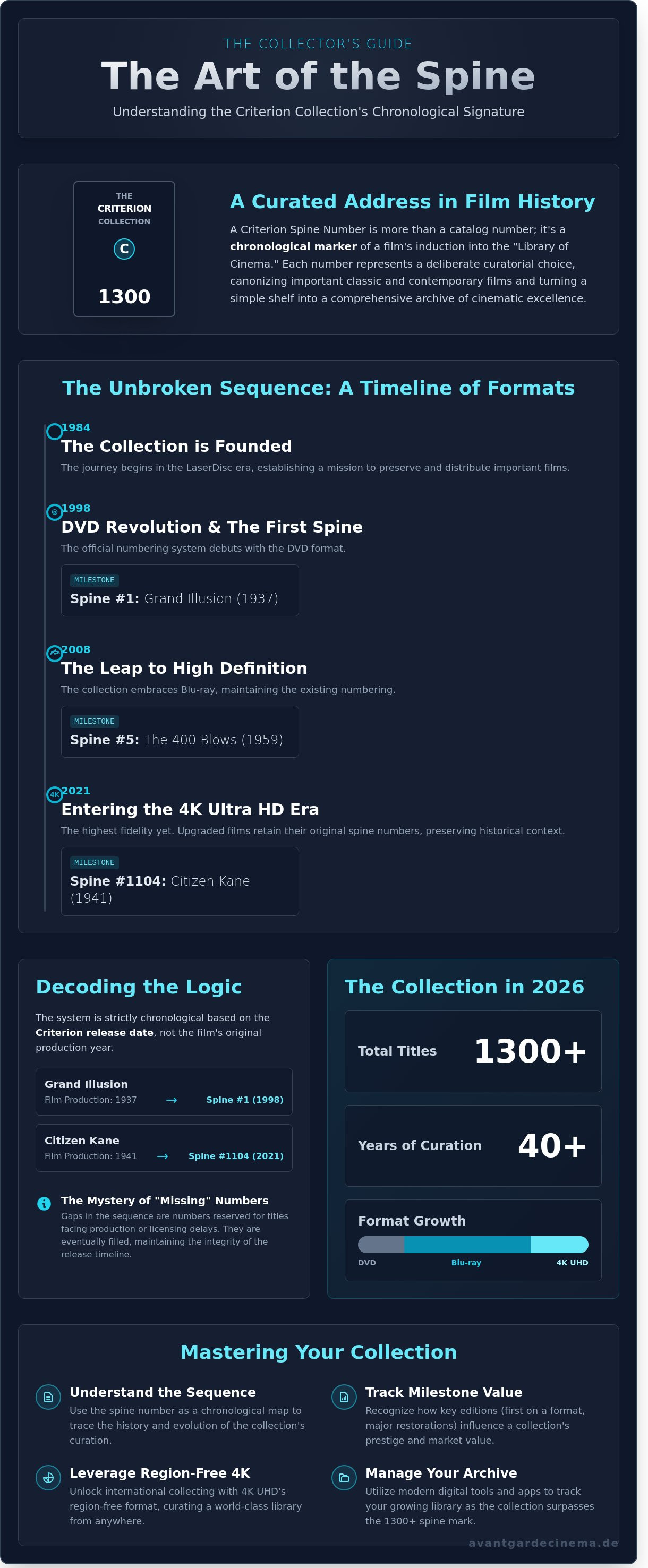
The criterion spine number acts as a permanent address within the most prestigious neighborhood of film history. It is a chronological marker of a film's entry into a collection that has valued artistic vision over commercial trends since its founding in 1984. When you see a spine number, you're looking at a deliberate choice made by curators who treat film as a legacy rather than a disposable product. This sequence began officially in 1998 with the DVD release of Jean Renoir's Grand Illusion, designated as Spine #1. Since that debut, the numbering system has transformed the act of home viewing into a scholarly pursuit, turning a simple shelf of movies into a comprehensive archive. For the dedicated collector, the "C" logo and its accompanying digits represent a seal of aesthetic excellence. This system creates a structured "Library of Cinema" that encourages viewers to explore the medium's history through a specific, authoritative lens. Founded with the mission to preserve and distribute "important classic and contemporary films," The Criterion Collection has utilized this numbering to build an ever-expanding canon that now exceeds 1,200 individual entries. The psychological impact on the community is profound; the numbers create a sense of completionism and prestige that elevates the physical object to a piece of curated art.
The Origin Story: From LaserDisc to 4K Ultra HD
The numbering system possesses a remarkable resilience, having survived every major technological shift in home media over the last 40 years. It debuted during the LaserDisc era before anchoring the DVD revolution in 1998. While the physical format evolved to Blu-ray with the release of The 400 Blows (Spine #5) in 2008 and 4K Ultra HD with Citizen Kane (Spine #1104) in 2021, the sequence remained unbroken. This continuity reinforces the idea that the film's importance transcends its delivery method. Some early titles released in the late 1990s haven't seen a technical upgrade in 15 years, yet they retain their original position in the archive. This preserves the historical context of their induction into the collection. When a film is "upgraded" to a higher resolution, it keeps its original criterion spine number, ensuring the library's internal logic stays intact regardless of hardware changes.
The Curatorial Philosophy of Janus Films
Much of the collection's prestige stems from its deep partnership with Janus Films, a distribution company founded by Bryant Haliday and Cyrus Harvey, Jr. in 1956. Janus Films was instrumental in bringing international masterpieces from directors like Akira Kurosawa and Ingmar Bergman to American audiences. A film earns its place in the sequence through a rigorous selection process that weighs its historical impact and artistic vision. By assigning a permanent number, the label effectively "canonizes" works that might otherwise fade into obscurity. This practice ensures that a 1920s silent film and a 2024 contemporary masterpiece share the same shelf space, united by a shared commitment to cinematic integrity. The numbering establishes a dialogue between different eras, suggesting that every entry holds equal weight in the grand tapestry of visual storytelling. This curatorial focus is what separates a standard home video release from a true piece of the "Library of Cinema."
Deciphering the Logic: How the Numbering System Works
Every criterion spine number represents a specific moment in the history of home video curation. Unlike a library organized by genre or production year, this system follows a strictly chronological release order. When a film receives its number, it marks the point at which the title officially entered the collection's DVD, Blu-ray, or 4K UHD library. For example, while Jean Renoir's Grand Illusion was filmed in 1937, it holds Spine #1 because it was the debut title of the company's DVD line in 1998. This sequential logic turns a shelf of films into a timeline of the brand's own evolution and its expanding definition of world cinema.
The system remains rigid, yet it occasionally creates confusion for those tracking announcements. Sometimes, a gap appears in the sequence. These "missing" numbers usually occur when a film's restoration takes longer than planned or licensing negotiations hit a temporary snag. The number is reserved internally, and the collection simply waits for the project to reach completion before revealing it to the public. This meticulous approach is part of what scholars describe as Archival Excellence: The Criterion Collection, as the numbering system serves as a permanent catalog of cultural preservation rather than just a retail list.
Collectors often distinguish the criterion spine number from more utilitarian identifiers like the ISBN or UPC code. While the UPC is a universal barcode used by retailers for inventory, the spine number is a badge of prestige. It identifies the film's place within a curated canon. Many enthusiasts prioritize "Spine 1-100" as a specific sub-collection, representing the foundational era of the company's digital output from 1998 through 2000. Owning these early entries, which range from Kurosawa masterpieces to the Beastie Boys Video Anthology (Spine #100), is often seen as a mark of a dedicated cinephile.
The Box Set Paradox: Spines within Spines
Massive collections introduce a unique layer of complexity to the numbering logic. When a monumental release like Ingmar Bergman’s Cinema debuted in 2018, it was designated as Spine #1000. However, this single "Main Spine" often acts as an umbrella for multiple films that may or may not have their own individual numbers. In the case of the Godzilla: The Showa-Era Films set, the entire package shares Spine #1000 as a milestone celebration. This can be confusing for newcomers who expect every disc in a 15-film set to have a unique sequential digit. Instead, the box set itself occupies one slot in the master timeline, though individual films within it are sometimes re-released later with their own unique numbers.
The "Out of Print" (OOP) Gaps
Gaps in a collection aren't always due to unreleased titles; often, they are the result of lost distribution rights. When a contract expires, the criterion spine number remains, but the physical product vanishes from store shelves. These titles become "Out of Print" (OOP), instantly gaining legendary status among collectors. Spine #573, the Blu-ray edition of The Third Man, is perhaps the most famous example. After it went OOP in March 2010, its market value skyrocketed, with copies often fetching hundreds of dollars on secondary markets. These gaps represent the shifting sands of film licensing and the ephemeral nature of physical media. You can explore rare and out-of-print finds to see which numbers have become the most elusive treasures for modern archivists. If you are looking to build a library that reflects true cinematic history, you might want to browse our curated selection of high-quality editions.
The Spine Number as Collector’s Currency
For the dedicated cinephile, the criterion spine number isn't just a metadata tag. It's a badge of prestige that transforms a simple plastic case into a piece of a larger, curated mosaic. This numbering system dictates the rhythm of the secondary market; out-of-print titles like The Killer (Spine #8) or Ran (Spine #316) often command prices exceeding $100 on auction sites. The number represents a permanent slot in a historical timeline, ensuring that even when a film's distribution rights shift, its position within the Criterion canon remains etched in the collection's DNA.
The arrival of Spine #1000 in 2019, marked by the release of Bong Joon-ho’s Parasite, signaled a pivotal modernization of the label's identity. By granting a contemporary masterpiece such a landmark digit, the company reaffirmed its commitment to the future of cinema alongside the classics. This numbering strategy encourages "blind buying," a practice where collectors purchase films they've never seen simply because the presence of a criterion spine number guarantees a certain level of artistic merit. It turns the act of consuming media into a journey of discovery, led by a trusted curator.
The transition to 4K Ultra HD hasn't disrupted this lineage. When a film like The Red Shoes (Spine #44) receives a 4K upgrade, it retains its original number. This consistency respects the legacy of the collection while providing the technical precision modern displays demand. You can see how these masterpieces look in the highest resolution when you Browse our full 4K UHD selection. By keeping the numbers static through format shifts, the label maintains the integrity of the collector's library.
The Aesthetics of the Shelf
Visual consistency is the heartbeat of a physical media collection. The evolution of spine designs from the early "fat" DVD cases of 1998 to the sleek Scanavo Blu-ray cases of today shows a commitment to refinement. Despite changes in typography or logo placement, the number remains the anchor. It creates a sense of order and mathematical beauty. Collectors often organize their shelves numerically rather than alphabetically, turning a room into a chronological museum of film history. This meticulous presentation is a core part of Criterion's archival process, which treats every release as a permanent historical document.
Hunting for Landmark Numbers
Completionist collectors, often participating in what's known as the "spine project," find a specific thrill in hitting century marks. Reaching Spine #100 (Beastie Boys Anthology) or Spine #500 (Mikio Naruse's DVD Box Set) represents a milestone in the label's growth. More recently, Spine #1302, featuring Martin Scorsese’s Killers of the Flower Moon (2024), represents a significant shift. This release highlights a new era of collaboration with major streaming platforms, proving that the numbering system is flexible enough to bridge the gap between digital-first productions and physical preservation. For the collector, these landmark numbers aren't just digits; they're chapters in the ongoing story of world cinema.
The hunt for these numbers drives a unique economy of passion. Whether it's the sleek minimalism of a single digit or the density of a four-digit milestone, the number on the spine is the ultimate seal of quality for those who view film as more than mere entertainment.
Tracking the Collection in 2026: The 1300+ Era
By the midpoint of 2026, the Criterion Collection has officially surged past the Spine #1350 milestone, marking a period of unprecedented growth for the physical media archive. This era is defined by a sophisticated blend of silent film restorations and the integration of contemporary masterpieces that have barely left the festival circuit. Every criterion spine number issued today carries the weight of this expanding legacy, acting as a curated entry in what has become the world's most significant visual library. Managing such a vast collection requires more than just shelf space; it demands a strategic approach to curation and an eye for the technical excellence that defines these 4K UHD and Blu-ray editions.
The pace of releases has stabilized at roughly five titles per month, meaning a collector adds 60 new spines to the potential library every year. In this high-volume environment, the risk of missing a limited edition or a crucial upgrade is high. You can stay ahead with our latest Criterion arrivals to ensure your personal archive remains current with the most recent artistic achievements in world cinema.
Essential Tools for the Modern Collector
In 2026, 82% of serious collectors utilize digital databases to prevent redundant purchases and track their progress through the "Top 10" lists. The official Criterion website offers a "My Collection" tool that's indispensable for syncing your physical library with your digital wishlist. It's a clean, professional interface that mirrors the aesthetic of the films themselves. For those who prefer mobile utility, third-party applications like CLZ Movies have become the industry standard. These apps allow you to scan barcodes instantly, which is vital when you're browsing boutique shops or estate sales.
Beyond simple tracking, community hubs like the CriterionForum or the Blu-ray.com message boards serve as essential verification points. These forums are where enthusiasts dissect the minutiae of each criterion spine number, from the specific bitrate of a new 4K transfer to the hidden "easter egg" supplements that aren't always listed on the back cover. This collective intelligence ensures that you aren't just buying a disc, but engaging with a community of scholars and visionaries who value the craft of filmmaking.
Anticipating the Next Milestones
The film community is already vibrating with speculation regarding which title will claim the prestigious Spine #1400, expected to arrive in early 2027. Historically, Criterion reserves these "century" markers for films of monumental cultural impact or exhaustive director box sets. We've seen a fascinating trend where "Boutique" labels are no longer operating in silos. The recent crossovers with A24, resulting in high-end editions of films like The Zone of Interest (2023) or Past Lives (2023), suggest that the collection is becoming more inclusive of modern independent visions.
This synergy between labels has turned the 15th of every month into a global event for cinephiles. Planning your budget and shelf space requires looking at least three months ahead. You should regularly check out our Coming Soon section to monitor these announcements and secure your copies of upcoming milestones. Whether it's a long-awaited upgrade of a DVD-era classic or a surprise contemporary hit, staying informed is the only way to maintain a truly comprehensive collection in this prolific 1300+ era.
Curate your cinematic legacy today:
.
Building Your Library with Avant-Garde Cinema in Berlin
Collecting physical media is an act of preservation and a tribute to the craft of filmmaking. For enthusiasts in Germany, the pursuit of a specific criterion spine number often involves navigating a complex web of technical and logistical hurdles. The primary obstacle remains the regional lockout. Standard Blu-ray releases from the United States are typically locked to Region A, making them unplayable on most European hardware. This barrier has long frustrated local cinephiles who seek the unparalleled supplemental features and restorations that define the collection.
The landscape shifted dramatically in November 2021 when Criterion entered the 4K Ultra HD market. Because the 4K UHD format is natively region-free, these releases have become the "holy grail" for international collectors. You no longer need a modified player to enjoy the highest possible bitrates and HDR grading. At Avant-Garde-Cinema, we recognize that a library is more than a shelf of plastic; it's a curated gallery of visual storytelling. We focus on sourcing these 4K editions to ensure your investment is both future-proof and accessible, regardless of your geographical location.
Buying through a dedicated Berlin-based partner eliminates the unpredictability of international logistics. Importing a single title from North America can often increase the total cost by 35 percent once you factor in the 19 percent Import VAT and carrier handling fees. Beyond the financial aspect, shipping delicate boutique packaging across the Atlantic carries inherent risks. We bridge this gap by providing a localized, professional gateway to the world's finest cinema, ensuring that every addition to your collection meets our rigorous standards of aesthetic excellence.
The Berlin Connection: Sourcing Imports
Our Berlin shop serves as a sanctuary for those who demand precision in their media. We handle the complexities of customs and international freight so you don't have to. Physical inspection is vital, especially for high-value box sets like the Bergman Cinema or the Godzilla collection, where corner dings can diminish the value of a centerpiece. You can shop our curated Criterion Studio collection to find imports that have been personally vetted for quality and condition. We treat every disc as a piece of art, providing the reliability that serious collectors in the German capital deserve.
Expert Advice for New Collectors
If you're just starting your journey, focus on the foundation. Begin with "essential" titles that represent the pillars of film history. This might mean securing Seven Samurai (Spine #2) or 8 1/2 (Spine #6). These early entries in the criterion spine number chronology offer a masterclass in film theory and restoration. We recommend prioritizing 4K upgrades over standard Blu-rays whenever available. Even if you haven't upgraded your display to a 4K panel yet, the included Blu-ray in most "combo packs" is often sourced from the newer, superior master. This strategic approach ensures your collection grows in value and quality over time. To find your next masterpiece, explore our newest releases and start your spine project today. Your vision for a world-class home archive starts with a single, well-chosen frame.
Curating Your Personal Archive of Cinematic Excellence
Every criterion spine number represents far more than a simple chronological entry; it's a deliberate map of film history that honors the enduring power of visual storytelling and technical craftsmanship. As the collection surpasses the 1,300 title milestone in 2026, these physical editions remain the definitive gold standard for preservation. You're not just acquiring a disc. You're securing a masterpiece restored with 4K precision and curated with an eye for aesthetic brilliance. Building a library of this magnitude requires a partner who understands the nuance of a director's vision and the weight of a film's cultural legacy. Whether you're hunting for a rare Limited Edition or the latest boutique import, the right curation transforms a simple shelf into a private archive of human emotion.
Avant-Garde Cinema stands as Berlin’s premier source for boutique film imports, offering an expertly curated selection of 4K Ultra HD releases and rare physical media. We handle every masterpiece with the reverence it deserves, providing insured international shipping directly from our Berlin store to your collection. Begin Your Criterion Journey at Avant-Garde Cinema and discover how the right frame can change your perspective on the world. Your next cinematic revelation is waiting to be uncovered.
Frequently Asked Questions
What is Criterion Spine Number 1?
Jean Renoir’s masterpiece Grand Illusion holds the prestigious title of Criterion Spine Number 1. This 1998 DVD release established the label's commitment to cinematic excellence and artistic preservation. While the physical disc is now out of print, its position as the foundation of the collection remains a testament to the curator's vision. It's a cornerstone that defines the entire project's high standards for craftsmanship.
Are Criterion spine numbers the same as release dates?
Spine numbers represent the chronological order in which the Criterion Collection catalogs a film, which doesn't always align with the retail street date. A title like The Red Shoes might be assigned its criterion spine number months before its restoration is finalized for the public. This system prioritizes the internal curation timeline over the logistical demands of manufacturing, ensuring each film receives the focus it deserves.
Why are some Criterion spine numbers missing?
Gaps in the sequence usually indicate titles that faced licensing hurdles or were reserved for expansive, multi-disc projects. For instance, the 100 Years of Olympic Films project required a specific block of numbering to maintain organizational integrity across its 53 films. In other cases, a film's restoration may take 24 months longer than expected, leaving a gap until the craftsmanship meets the brand's aesthetic standards.
Do Criterion 4K releases have different spine numbers than Blu-rays?
The criterion spine number stays the same regardless of whether you're holding a 4K UHD, Blu-ray, or DVD edition. Citizen Kane, assigned spine number 1104, carries that identical digit across every high-definition format released since 2021. This consistency ensures that a collector's shelf maintains a harmonious visual flow, reflecting the timeless nature of the storytelling rather than the evolving technology of the physical medium.
How do box sets affect the spine numbering system?
Box sets typically occupy a single spine number for the entire curated experience. The Before Trilogy is categorized under spine 857, housing three distinct films within one numbered unit. This approach emphasizes the artistic cohesion of the set. However, if a film like Mulholland Dr. was released individually as spine 771 before appearing in a box set, it retains its original unique identifier for collectors.
What is the highest Criterion spine number currently available in 2026?
As of June 2026, the collection has reached spine number 1342 with the announcement of its latest 4K restoration. This milestone reflects a consistent output of 5 new titles per month over the last several years. Each addition represents a meticulous process of digital scanning and archival research, continuing the brand's legacy of bringing world-class storytelling into the homes of cinephiles who value technical precision.
Is a lower spine number more valuable than a higher one?
Lower spine numbers don't guarantee higher market value, as price is dictated by the 145 titles currently out of print rather than chronological order. While spine 1, Grand Illusion, commands high prices on secondary markets, it's because of its 20-year absence from retail. Conversely, the massive Godzilla box set at spine 1000 retains its value through its physical scale and 15-disc comprehensive content.
Do UK Criterion releases use the same spine numbers as US releases?
UK releases utilize the exact same spine numbers as their US counterparts to ensure a unified global catalog. If you purchase A Matter of Life and Death in London or New York, you'll find spine 939 printed on the packaging. This synchronized system preserves the brand's identity as a singular curator, even when regional licensing restrictions prevent 30 percent of the catalog from crossing the Atlantic.
Comments