


4K Ultra HD in 2026: The Definitive Guide for Modern Film Collectors
- Martin Kolb
- Mar 11
- 14 min read

Updated: Mar 15
Your digital movie collection is an illusion of ownership that can be revoked by a licensing shift at any moment. While 85% of viewers settle for the convenience of streaming, they inadvertently sacrifice the artistic intent of the director to aggressive compression algorithms. Investing in 4k ultra hd physical media isn't just a nostalgic choice; it's a commitment to preserving the visual soul of cinema. You deserve to see every nuance of light and shadow exactly as the cinematographer envisioned it during the 2026 mastering process.
You understand that true aesthetic excellence requires more than just a high resolution. It demands the peak bitrates and frame-by-frame precision that only a physical disc provides. This guide will show you how to curate a world-class archive by identifying the most prestigious boutique labels and mastering the nuances of Dolby Vision and HDR10+. You'll gain the technical knowledge to transform your Berlin-based home cinema into a sanctuary of uncompromising quality and timeless storytelling. We'll explore the essential steps to ensure your collection remains a definitive benchmark for cinematic preservation.
Key Takeaways
Understand why 2026 represents the pinnacle of home exhibition, where perfected restoration techniques finally match the original cinematic vision.
Decode the technical mastery of HDR and bit depth to appreciate the nuanced color gradients that define high-end visual storytelling.
Explore why the superior bitrate of 4k ultra hd discs remains essential for collectors who refuse to compromise on the fine details lost to streaming compression.
Learn to navigate the world of boutique labels and international imports to build a curated library that transcends mainstream availability.
Discover how to evaluate and select only the most exquisite film transfers to ensure your personal collection reflects true aesthetic excellence.
Table of Contents What is 4K Ultra HD? Beyond the Resolution Hype The Technical Mastery: HDR, Dolby Vision, and Bit Depth 4K Ultra HD Disc vs. Streaming: The Bitrate Reality Curating a 4K Library: Boutique Labels and Berlin Imports Avant-Garde-Cinema: Your Partner in Aesthetic Excellence
What is 4K Ultra HD? Beyond the Resolution Hype
The cinematic experience isn't merely about the size of the screen. It's about the depth of the soul within the image. At its core, 4k ultra hd represents a resolution of 3840 x 2160 pixels, offering four times the detail of standard high definition. By the year 2026, this format has reached its absolute maturity. We've moved beyond the initial growing pains of the early 2010s into an era where restoration techniques can finally match the original intent of the masters. This isn't just a technical upgrade; it's a preservation of history. Physical media ensures that the subtle nuances of a performance aren't lost to the aggressive compression algorithms of the digital cloud.
To understand the technical foundation of this medium, one must look at What is 4K resolution? and how it bridges the gap between digital exhibition and the organic texture of celluloid. While 1080p was a revolutionary step, it often smoothed over the very details that give film its character. Modern cinematography has shifted its focus. We no longer chase "more pixels" for the sake of a spec sheet. Instead, we demand "better pixels" that capture the subtle interplay of light and shadow that defines a director's vision. This shift prioritizes the integrity of the image over the quantity of the data.
The Three Pillars of Ultra High Definition
The brilliance of 4k ultra hd rests on three distinct technological advancements that work in concert to create a lifelike image. First is Resolution. With 8.3 million individual pixels, the screen achieves a density that makes digital grids invisible to the human eye. Second is High Dynamic Range (HDR). This technology expands the contrast ratio, allowing for specular highlights that reach 1,000 nits or more, mimicking the way our eyes perceive natural light. Third is Wide Color Gamut (WCG). It unlocks a palette covering up to 90 percent of the DCI-P3 color space, revealing hues that were previously lost in the limitations of the Rec. 709 standard.
Why 4K Matters for Classic Film Preservation
For the cinephile, the true value of 4K lies in its ability to rescue deteriorating film negatives from the ravages of time. Physical media remains the only way to truly preserve the 35mm grain and texture that define classic cinema. Boutique labels now use 16-bit 4K scans to honor the original cinematography, ensuring that every frame reflects the director's aesthetic choices rather than a digital approximation. This process requires an artisan's touch to balance modern clarity with historical accuracy.
Consider the difference between a standard 1080p upscale and a native 4K scan. An upscale merely guesses at missing data, often resulting in a "waxy" look where skin textures disappear. In contrast, a native 4K scan from a 35mm negative captures the silver halide crystals themselves. This results in a 300 percent increase in visible fine detail. When you watch a restored masterpiece on 4K, you aren't just watching a movie. You're witnessing a digital negative that is, for the first time, as close to the theatrical premiere as technology allows. It's an act of cultural curation that brings the past into the present with breathtaking clarity.
The Technical Mastery: HDR, Dolby Vision, and Bit Depth
Resolution provides the structural skeleton of an image, but the soul of a 4k ultra hd presentation lives within its bit depth and dynamic range. While standard high definition relies on 8-bit color, offering a mere 16.7 million colors, the leap to 10-bit depth expands the palette to 1.07 billion shades. This technical evolution eliminates the distracting "banding" often seen in gradients like a sunset or a dimly lit hallway. For the most demanding displays, 12-bit color takes this further with 68.7 billion possible colors, ensuring that every nuance of light and shadow is rendered with painterly precision.
The true power of these colors is unlocked through High Dynamic Range (HDR). HDR10 serves as the industry baseline, utilizing static metadata to set a single brightness level for the entire film. This often leads to compromises where dark scenes lack shadow detail or bright highlights appear blown out. In contrast, dynamic formats like Dolby Vision and HDR10+ optimize the image frame by frame. Peak brightness plays a critical role here; a display capable of 1,000 to 4,000 nits provides the necessary headroom to replicate the searing glint of sun on chrome or the subtle glow of a candle without losing the surrounding textures. In a controlled dark room environment, these specular highlights create a sense of depth that feels tangible rather than merely projected.
Dolby Vision: The Cinephile’s Choice
Dolby Vision is widely regarded as the gold standard for home cinema because it carries instructions that guide the TV's processor in real time. By utilizing Dolby Vision technology, boutique labels can preserve the specific aesthetic choices made by the cinematographer during the grading process. While most consumer panels are natively 10-bit, the system uses sophisticated dithering to simulate 12-bit depth, providing a level of texture that matches the original film negative. This meticulous control ensures the viewer sees exactly what was approved in the mastering suite.
Wide Color Gamut and the Rec. 2020 Standard
The transition to 4k ultra hd also marks a departure from the aging Rec. 709 color space, which covers only about 35.9% of the colors the human eye can perceive. The Rec. 2020 standard expands this reach to 75.8%, allowing for the reproduction of saturated hues that were previously impossible to display. This is particularly transformative for specific genres. The neon, blood-red aesthetics of a 1970s Giallo thriller or the deep, ink-like shadows of a classic Noir film gain a psychological weight when the colors are accurate. When a viewer sees a shade of emerald green or deep crimson that feels "real," the barrier between the screen and the observer dissolves.
Achieving this level of immersion requires a deep understanding of how light interacts with the lens and the sensor. If you are looking to bring this level of technical sophistication to your own visual storytelling, consider exploring visionary film production services that prioritize these exacting standards. Digital precision, when guided by an artistic hand, transforms a simple recording into a lasting piece of cinematic art.
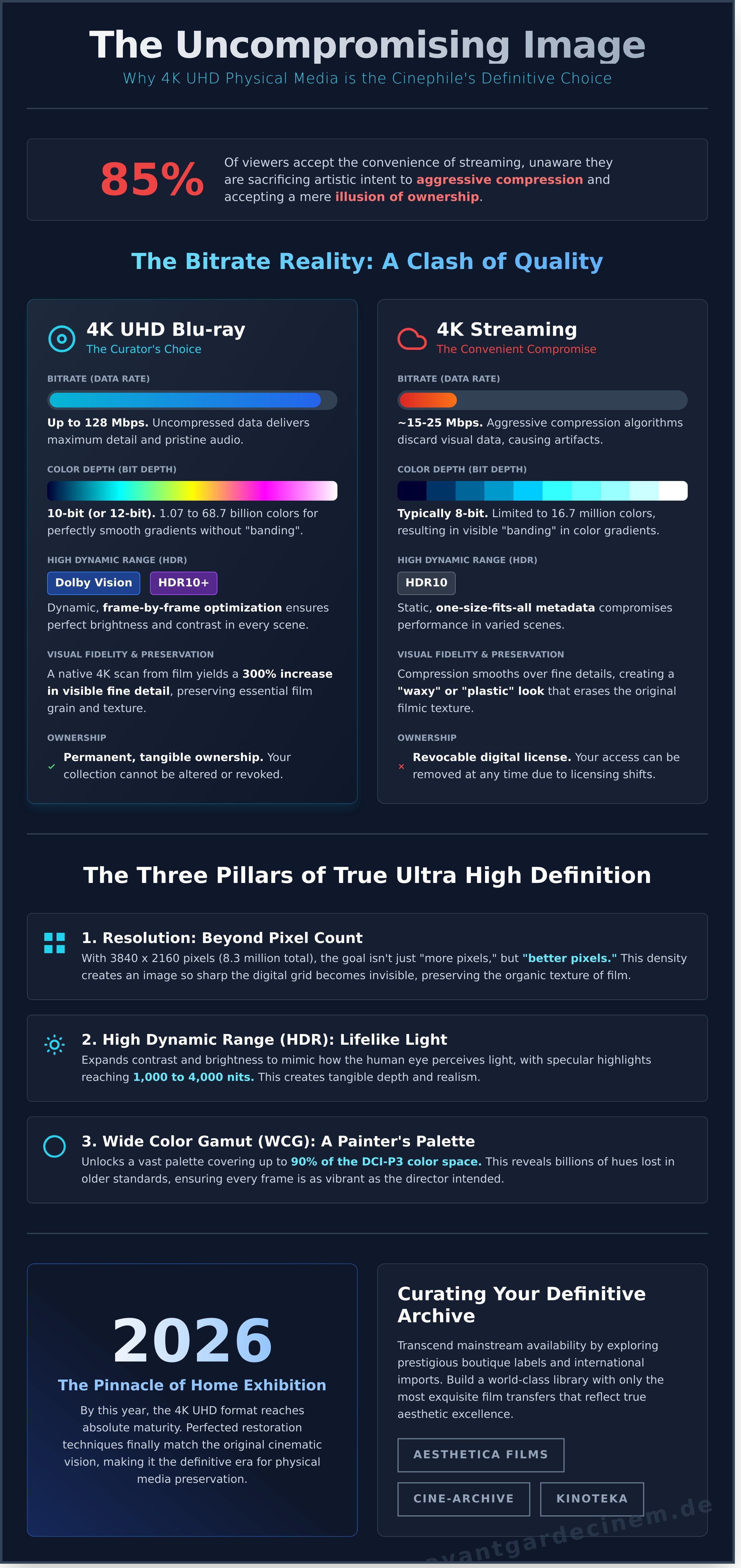
4K Ultra HD Disc vs. Streaming: The Bitrate Reality
Streaming services offer an immediate gateway to vast cinematic libraries, yet this accessibility demands a silent sacrifice of visual integrity. The hidden cost of convenience is compression. When you watch a film via a cloud-based server, the provider must squeeze massive amounts of data through narrow digital pipelines. This process prioritizes speed over the 4k ultra hd experience, stripping away the very textures that define a director's vision. To the discerning eye, a stream is merely a shadow of the original master, sculpted to fit the limitations of a home internet connection.
The distinction becomes undeniable when we analyze the 'Bitrate Gap.' A standard 4K stream from platforms like Netflix or Disney+ typically operates at a bitrate of 15 to 25 Mbps. In stark contrast, a triple-layer physical disc delivers data at rates up to 100 Mbps. This massive increase in information allows the 4K Ultra HD resolution to breathe, capturing the subtle nuances of light and shadow that streaming algorithms simply discard. Beyond the technical specs, there is the matter of permanence. In December 2023, Sony demonstrated the fragility of digital libraries by announcing the removal of over 1,200 purchased Discovery titles from user accounts. Physical media ensures you own the art, protecting your collection from the whims of licensing disputes and sudden server shutdowns.
Compression Artifacts and Visual Noise
Streaming algorithms struggle most in complex, low-light environments. You've likely noticed macroblocking or banding in dark scenes, where shadows break into blocky, pixelated squares instead of smooth, velvety gradients. High bitrates on physical discs preserve natural film grain, treating it as an essential cinematic texture rather than digital noise to be smoothed away. A high-bitrate 1080p Blu-ray often surpasses 4K streaming because its superior data density prevents the aggressive compression that strips away the fine textures and depth of the original image.
The Sonic Advantage of Physical Media
Sound completes the cinematic canvas, yet streaming platforms heavily compromise audio fidelity to save bandwidth. Most services utilize lossy formats like Dolby Digital Plus, which core the audio by removing frequencies the human ear supposedly can't hear. This results in a flattened soundstage where subtle atmospheric details and environmental cues vanish. Physical media champions lossless Dolby Atmos and DTS:X, allowing your ceiling speakers to earn their keep with precision-placed, object-based audio that moves through the room with surgical accuracy.
For purists and collectors of classic cinema, the inclusion of uncompressed linear PCM audio is equally vital. It ensures that the original recordings remain untouched by modern filters, preserving the raw emotional power of the orchestral score. True 4k ultra hd isn't just about the density of pixels on the screen; it's about the visceral impact of a soundscape that envelops you without the digital thinning inherent to the stream. By choosing physical media, you're not just buying a disc; you're preserving the artistic intent of the creators in its most potent form.
Curating a 4K Library: Boutique Labels and Berlin Imports
Building a physical library is an act of preservation. In an era where digital licenses can vanish overnight, boutique labels have emerged as the true guardians of cinematic history. These organizations treat the 4k ultra hd format as a canvas for technical excellence. They don't just transfer film to digital; they engage in painstaking frame-by-frame restorations that often surpass the original theatrical presentation. For the discerning collector, the physical object becomes a tangible connection to the director's vision. It's a rejection of the ephemeral nature of streaming in favor of something permanent and perfect.
The Titans of Boutique 4K
Pioneering boutique labels have established benchmarks for excellence, often prioritizing color accuracy and historical context, with new 4K digital restorations frequently approved by original cinematographers. These dedicated distributors meticulously craft special editions, elevating both celebrated classics and overlooked gems. They demonstrate that even gritty cult films benefit immensely from the high bitrates and advanced enhancements of the 4k ultra hd format, ensuring every frame delivers unparalleled visual fidelity. Through rigorous 4K scans of original camera negatives and painstaking restoration processes, these labels transform once-obscure titles into high-art artifacts, proving that every piece of film history is worth preserving for future generations of collectors.
Building a Collection in Berlin
Berlin serves as a unique crossroads for European and international film imports. While global marketplaces offer convenience, local specialized retailers provide the expertise needed to identify definitive pressings. Collectors should prioritize BD-100 triple-layer discs over standard BD-66 versions to ensure the highest possible video bitrates. Importing from the US or UK involves navigating the 19% German VAT and additional customs handling fees; these costs can increase the price of a single limited edition by 15 Euros or more. Local shops often absorb these logistics, offering "Day 1" access to rare steelbooks and hardcase box sets that include 80-page scholarly booklets and exclusive art cards.
The technical freedom of the format is a major victory for the global film community. By 2026, the standard remains that 4K discs are region-free. You can purchase a limited edition from a boutique label in Melbourne and play it on a German console without hardware modifications. This lack of digital borders allows Berlin collectors to source the finest transfers from across the globe, ensuring their library represents the pinnacle of global filmmaking. Every spine on the shelf represents a commitment to quality that streaming simply can't replicate. The weight of a premium box set and the texture of a high-quality booklet offer a sensory experience that begins long before the disc starts spinning.
Experience how we translate this same dedication to visual perfection into every frame of our professional productions.
Avant-Garde-Cinema: Your Partner in Aesthetic Excellence
At Avant-Garde-Cinema, we refuse to accept the compromise of digital compression. We treat every film as a curated artifact; a physical manifestation of a director's intent. Our Berlin-based philosophy centers on the belief that home cinema should be an immersive gallery experience. When you hold a 4k ultra hd release from our collection, you aren't just holding a disc. You're holding the result of hundreds of hours of restoration work, captured in 3840 x 2160 pixels of raw, unadulterated beauty. We serve the dedicated 2 percent of cinephiles who understand that a film's soul lives in its grain, its shadow detail, and its color accuracy.
Our shop serves as a sanctuary for those who find streaming bitrates of 15 Mbps insulting to the craft of cinematography. We focus on the tangible. The weight of a premium slipcase and the clarity of a 100 Mbps video stream offer a sensory satisfaction that no digital cloud can replicate. By joining our network, you enter a community of collectors who value longevity over convenience. We foster a culture where technical specifications meet artistic passion, ensuring your private library becomes a testament to the history of moving images.
The Avant-Garde Selection Process
We don't stock every title that hits the market. Instead, our team vets each transfer for technical accuracy, focusing on 10-bit color depth and the precise application of HDR10+ or Dolby Vision metadata. We prioritize rare 2024 imports from prestigious US and UK labels like Criterion, Arrow Video, and Second Sight, ensuring our Berlin shop offers editions you won't find in standard retail outlets. Whether you're a seasoned collector seeking a specific 1.85:1 aspect ratio restoration or a beginner looking for your first reference-quality disc, we provide personalized consultations to elevate your viewing experience.
Experience Cinema as it Was Intended
True cinematic immersion requires hardware and software working in perfect harmony. You can visit our eBay store or our specialized Berlin-based webshop to find exclusive limited editions that often sell out within 48 hours of release. We don't just sell products; we provide context through deep-dive reviews that analyze the grain structure and audio encoding of every boutique restoration we carry. Our goal is to ensure your home theater setup finally reaches its true potential. Explore our latest 4K Ultra HD arrivals at Avant-Garde-Cinema and secure a piece of film history that belongs to you, not a subscription service.
The journey toward visual perfection is a collaborative one. We invite you to engage with our curators and fellow enthusiasts to discuss the nuances of 4,000-nit peak brightness or the historical significance of a newly discovered 35mm negative. Your collection is an evolving gallery. Let us help you curate it with the precision and elegance it deserves. Start your journey today by browsing our hand-picked selection, where every 4k ultra hd title is chosen with a visionary's eye for detail.
This philosophy of curating a personal sanctuary with uncompromising quality need not be limited to your media collection. For those in Switzerland looking to extend this level of bespoke excellence into personal wellness, the artisans at SpaCulture GmbH specialize in creating custom sauna and spa environments that reflect a similar commitment to precision and sensory immersion.
Mastering the Art of the Permanent Collection
The future of cinematic appreciation lies in the tangible mastery of physical media. While digital streams often fluctuate between 15 and 25 Mbps, a dedicated 4k ultra hd disc delivers a consistent 100 Mbps stream of data, preserving the intricate grain of a 35mm negative. This technical superiority ensures that 12-bit color depths and Dolby Vision metadata reach your screen exactly as the cinematographer intended. Curating a library isn't just about storage; it's about securing a legacy of aesthetic excellence that won't vanish when a licensing agreement expires in 2026.
We invite you to elevate your viewing experience through our specialized Berlin-based boutique curation. Our team applies expert knowledge to every selection, focusing on the definitive restorations from Criterion, Arrow, and Second Sight. Every order includes insured international shipping, ensuring your rare editions arrive in pristine condition. You're not just buying a film; you're investing in a piece of history that demands the highest standard of presentation.
Discover the world's finest 4K Ultra HD editions at Avant-Garde-Cinema. Let's transform your home into a private gallery of motion picture history.
Frequently Asked Questions
Is 4K Ultra HD really better than 4K streaming?
Physical media offers a vastly superior experience because 4K Ultra HD discs deliver bitrates up to 128 Mbps. Streaming services like Netflix or Disney+ typically compress their signals to 15 or 25 Mbps. This 5x data advantage eliminates digital artifacts and preserves the director's original grain structure. You'll experience uncompressed Dolby Atmos audio that streaming platforms simply can't replicate due to bandwidth limitations.
Do I need a new HDMI cable for 4K Ultra HD in 2026?
You must use an Ultra High Speed HDMI 2.1 cable to ensure your system handles the full 48Gbps bandwidth required for modern displays. Older HDMI 2.0 cables cap at 18Gbps, which limits your ability to view 4K content at 120Hz or utilize Enhanced Audio Return Channel (eARC) features. Investing in a certified 2.1 cable prevents signal dropouts and maintains the artistic integrity of high-frame-rate cinematography.
Are all 4K Ultra HD discs region-free?
Approximately 99% of all 4K Ultra HD discs are region-free according to the official specifications set by the Blu-ray Disc Association in 2016. This global standard allows you to curate an international library of cinema without worrying about playback compatibility. While a few boutique labels released region-locked discs in 2020, the vast majority of titles play on any player from Tokyo to Berlin without restriction.
Can I play 4K Ultra HD discs on a standard Blu-ray player?
Standard Blu-ray players can't read 4K discs because they lack the triple-layer optical sensors and HEVC (H.265) decoding hardware required for the format. You'll need a dedicated UHD player or a modern gaming console like the PlayStation 5, which was released in November 2020. These advanced machines possess the processing power to translate the dense clusters of data into the breathtaking imagery your 4K television demands.
What is the difference between native 4K and upscaled 4K?
Native 4K content is captured and finished at a true resolution of 3840 x 2160 pixels for absolute clarity. Upscaled 4K starts as a 2K Digital Intermediate, often used in 2023 blockbusters, and uses sophisticated AI algorithms to fill in the missing pixels. While upscaling has improved, native 4K preserves the finest textures and subtle nuances of the actor's performance that artificial interpolation can't fully mirror.
Is Dolby Vision worth the extra cost for a 4K setup?
Dolby Vision is essential for cinephiles because it utilizes 12-bit color depth and dynamic metadata to optimize every single frame. Unlike standard HDR10, which uses one setting for the entire film, Dolby Vision adjusts brightness levels scene-by-scene up to 10,000 nits. This precision ensures that the deepest shadows and most luminous highlights coexist in perfect harmony, reflecting the true aesthetic vision of the cinematographer.
Why are some 4K movies black and white?
Filmmakers release monochrome versions in 4K to exploit the format's ability to render infinite shades of gray and high contrast ratios. The 2020 4K release of "Parasite: Black & White Edition" demonstrates how increased resolution heightens the physical textures of the production design. These editions aren't mere filters; they're meticulous restorations that honor the timeless elegance of silver-screen aesthetics through modern technical precision.
How do I clean and maintain my 4K Ultra HD collection?
Clean your discs using a lint-free microfiber cloth by wiping in straight lines from the center hub to the outer rim. Don't use circular motions, as these can create concentric scratches that interfere with the laser's path. Since 4K discs feature a protective "hard-coat" layer developed by TDK, they're resistant to minor fingerprints, but keeping them in their original cases prevents the 0.1mm surface scratches that cause playback errors.
While this guide focuses on preserving cinematic quality with physical media, accessing a wide variety of live global broadcasts presents a different challenge. For those interested in exploring international television, news, and sports alongside their curated film collection, IPTV services have become a popular solution. If you'd like to explore this avenue, you can learn more about Good IPTV Services and what they offer.
Comments