


Best Blu-ray Protective Sleeves: The 2026 Guide to Archival Excellence
- Martin Kolb
- Apr 28
- 12 min read

A single hairline scratch on a limited edition slipcover can diminish its secondary market value by 35% in the time it takes to slide a disc onto a crowded shelf. For the dedicated curator, a boutique film collection represents a personal archive of cinematic history that demands a sophisticated level of protection. You've likely felt the sting of discovering a clouded spine or a corner crease on a rare 2024 Second Sight release, knowing that standard plastic often does more harm than good. Identifying the best blu-ray protective sleeves is the only way to ensure your library retains its artistic integrity and physical perfection through 2026 and beyond.
We believe that every frame of a masterpiece deserves a pristine vessel, and that includes the packaging that houses it. This guide promises to transform your preservation strategy by introducing professional-grade, acid-free materials that offer unparalleled clarity and a tailored fit. We'll explore the specific archival standards required for oversized boutique boxes and explain how to eliminate the risk of chemical degradation. From analyzing thickness microns to testing seam strength, we provide the roadmap to maintaining a collection that looks as breathtaking as the films themselves.
Key Takeaways
Understand the mechanics of shelf-wear to safeguard the delicate matte finishes and aesthetic integrity of your most prized limited editions.
Learn why high-micron polypropylene has become the gold standard for visual clarity while strictly avoiding the corrosive properties of PVC.
Discover how to select the best blu-ray protective sleeves by accounting for the unique dimensions of boutique slipcovers and J-cards.
Master the professional "Air Trap" technique and pre-sleeving maintenance to ensure your collection remains a pristine testament to cinematic history.
Evaluate the functional benefits of resealable versus open-top designs to optimize your library for both archival safety and ease of access.
Table of Contents Why High-End Collections Demand Specialized Blu-ray Protection Material Science: Comparing Polypropylene, Polyethylene, and Mylar Sleeves Tailored Fit: Choosing Sleeves for Boutique Labels and Limited Editions The Definitive Ranking of the Best Blu-ray Protective Sleeves in 2026 Mastering the Art of Collection Maintenance and Storage
Why High-End Collections Demand Specialized Blu-ray Protection
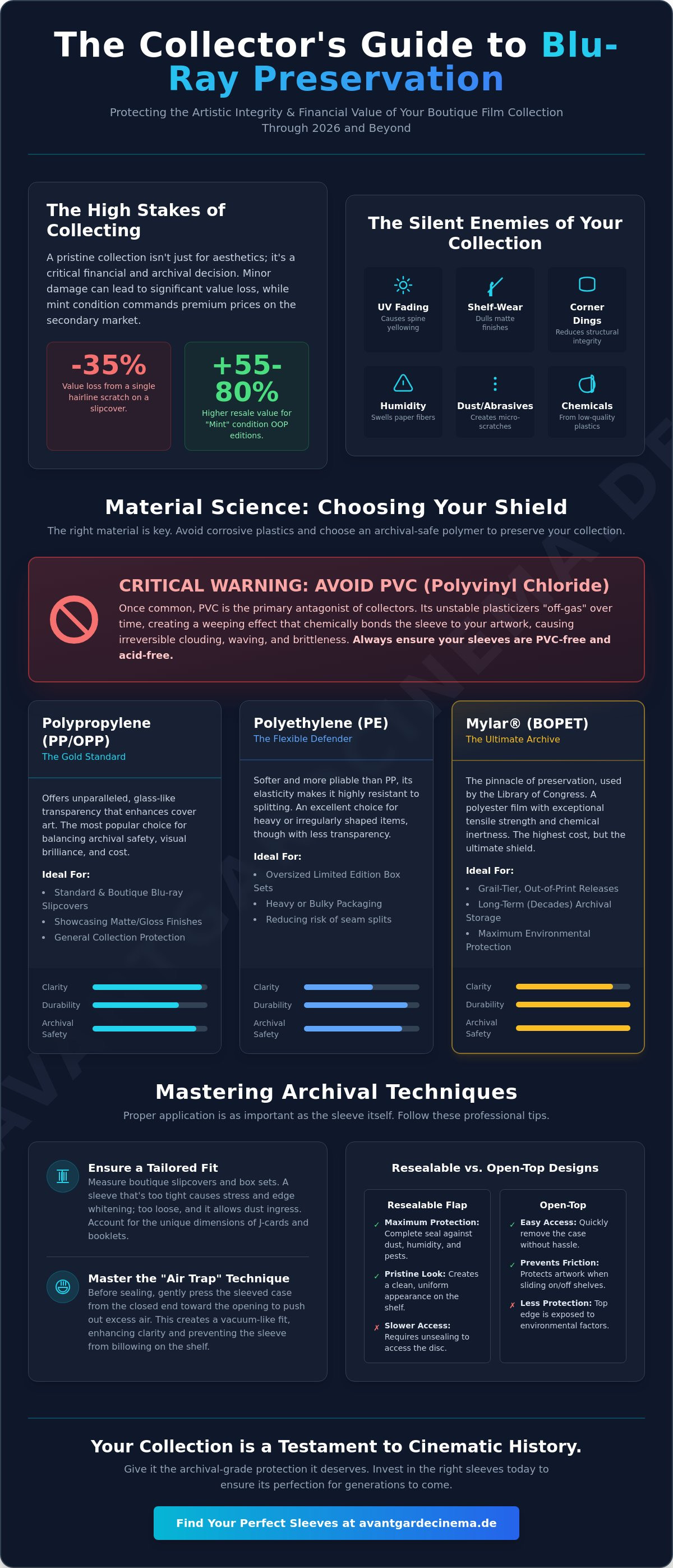
The transition from a casual film consumer to a dedicated curator of physical media marks a profound evolution in the cinematic journey. It's an acknowledgment that a boutique release is more than just a data carrier; it's a tactile piece of art that requires a sophisticated defense against the slow decay of time. Archival-grade protection isn't a mere marketing term. It describes a standard of preservation where materials remain chemically inert, ensuring that the storage solution itself doesn't contribute to the degradation of the item it's meant to save.
Friction is the silent enemy of the high-end collector. Every time a disc is pulled from a tightly packed shelf, the contact between cases creates micro-abrasions. For limited edition releases featuring matte finishes or delicate spot-gloss, these interactions lead to "shelf-wear" that dulls the visual impact of the artwork. Environmental factors present a constant challenge. Dust acts as an abrasive, humidity can cause paper fibers to swell, and UV exposure leads to the heartbreak of spine fading. A deep understanding of Optical Media Preservation reveals that even the most robust discs are vulnerable to their surroundings. Utilizing the best blu-ray protective sleeves creates a controlled micro-environment, shielding your investment from the volatile shifts in your home atmosphere.
The Financial and Aesthetic Value of Mint Condition
Maintaining a collection in pristine state isn't just about vanity; it's a strategic financial decision. Market data from 2024 suggests that out-of-print (OOP) editions in "Mint" condition can command resale prices 55% to 80% higher than those with visible wear. Archival-safe protection is strictly defined as being free from plasticizers and acids. These harmful chemicals, found in cheaper plastics, can "off-gas" over time, causing the plastic of the case to become wavy or the paper inserts to yellow and become brittle. High-quality sleeves ensure the integrity of specialized paper stocks remains unchanged for decades.
Preserving the Vision of Boutique Labels
Boutique labels like Arrow Video and Vinegar Syndrome treat their packaging as an extension of the film's aesthetic. They employ unique textures, heavy-duty cardstock, and intricate slipcovers that are notoriously susceptible to damage. Without a protective layer, "corner dings" and "edge whitening" occur almost inevitably during routine handling. When you acquire New Releases, the immediate application of the best blu-ray protective sleeves preserves the sharp corners and vibrant colors intended by the designers. This proactive approach ensures that the physical manifestation of the director's vision stays as striking as the day it was printed, allowing the collector to act as a true guardian of film history.
Material Science: Comparing Polypropylene, Polyethylene, and Mylar Sleeves
The preservation of a physical media collection requires an understanding of molecular stability. For decades, Polyvinyl Chloride (PVC) was the standard for media storage, yet it remains the primary antagonist of the serious collector. PVC is inherently unstable; it contains plasticizers that migrate over time, leading to a "weeping" effect that chemically bonds the sleeve to the paper artwork. This process causes irreversible damage to slipcovers and inlay cards. To identify the
best blu-ray protective sleeves
, one must look toward chemically inert polymers that respect the integrity of the original print. Polypropylene (OPP) has emerged as the contemporary gold standard for those who prioritize visual brilliance. It provides a glass-like transparency that enhances the saturation of the cover art. For larger, more cumbersome items, Polyethylene (PE) offers a softer, more pliable alternative. While less transparent, its elasticity prevents splitting when housing heavy
. At the pinnacle of preservation sits Mylar (BOPET), a polyester film utilized by the Library of Congress for its exceptional tensile strength and thermal stability. It represents the ultimate shield against environmental degradation.
Clarity vs. Durability: Choosing Your Trade-off
Visual fidelity often competes with physical resilience. Lower-density polyethylene sleeves frequently exhibit an "orange peel" texture, a slight dimpling that diffuses light and obscures fine detail on 4K UHD slipcovers. In contrast, 50-micron polypropylene offers a slim profile that saves approximately 15% of shelf space compared to thicker 100-micron variants. While the 100-micron sleeves provide a rigid, armor-like feel, they can make a tightly packed shelf difficult to navigate. It is essential to recognize that BOPP provides the highest transparency for viewing artwork, making it the preferred choice for boutique labels.
The Danger of Off-Gassing and Plasticizers
True archival safety is defined by the absence of chemical reactivity. When selecting materials, collectors should look for
that are acid-free and lack harmful additives. There is a persistent myth that sleeves cause "disc rot," yet this oxidation of the reflective layer is almost exclusively a manufacturing defect rather than a result of external sleeving. High-quality sleeves actually mitigate the risks of humidity and pollutants that can accelerate such degradation. Selecting the right material is a fundamental step in
, ensuring that your vision for a pristine library remains intact for decades. If you are curating a collection of rare
Tailored Fit: Choosing Sleeves for Boutique Labels and Limited Editions
The "one size fits all" approach is a fallacy that often leads to the slow degradation of a curated library. Standard 12mm sleeves, designed for the utilitarian blue plastic cases of mass-market releases, fail the modern collector. When you're seeking the best blu-ray protective sleeves, precision is your primary metric. Boutique editions aren't just discs; they're tactile experiences involving textured cardstock, spot-gloss finishes, and heavy paper stocks that react poorly to improper storage.
Measuring your editions requires a jeweler's eye for detail. A standard slipcover typically adds 1.5mm to the width and 2mm to the depth of a case. If you include a J-card or a thick booklet tucked outside the case, those dimensions shift again. Forcing a premium edition into a tight sleeve creates "corner crush," a permanent compression of the spine edges that diminishes the item's archival value. The aesthetic choice between a "snug fit" and "easy access" often depends on your viewing habits. A museum-grade snug fit offers a sleek, glass-like appearance on the shelf, yet it can be cumbersome for those who revisit their films frequently. Easy-access sleeves with a 2mm tolerance allow for effortless retrieval without risking friction burns on the delicate slipcover art.
Steelbooks demand their own category of vigilance. These metallic canvases are notoriously susceptible to micro-scratches caused by shelf friction. Even a microscopic grain of dust trapped between two Steelbooks can act like sandpaper. Specialized 0.3mm PET protectors are the gold standard here, providing a rigid barrier that maintains the structural integrity of the metal while showcasing the vibrant, often metallic, ink work.
Sizing for Criterion and Scanavo Cases
The Criterion Collection utilizes the Scanavo design, which stands roughly 150mm tall. This is notably taller than the 148mm height of a standard Amaray case. Using a generic sleeve often leaves the top edge of the Scanavo case exposed to dust. For Criterion’s multi-disc digipaks, which can swell to 18mm or 22mm in thickness, you must transition to "thick-cut" sleeves. These ensure the spine remains legible and uncompressed, preserving the artistic vision of the packaging.
Protection for Hardboxes and Oversized Editions
Rigid hardboxes from labels like Second Sight or Arrow present the ultimate challenge. These boxes often reach depths of 30mm to 40mm, requiring bespoke archival bags rather than standard sleeves. When encasing these heavy 4K UHD box sets, use high-clarity polypropylene that won't cloud over time. Collectors should leave 1-2mm of breathing room for air circulation. This small gap prevents humidity from becoming trapped against the matte or foil-stamped surfaces, which can lead to "blooming" or ink transfer in warmer climates. Finding the best blu-ray protective sleeves for these giants means prioritizing seam strength to prevent the splitting that occurs with inferior, thin-gauge plastics.
The Definitive Ranking of the Best Blu-ray Protective Sleeves in 2026
In 2026, the standard for the best blu-ray protective sleeves has evolved beyond simple plastic wraps into a sophisticated science of preservation. For the collector who views their library as a curated gallery, the high-micron resealable polypropylene sleeve stands as the undisputed top pick for overall clarity. These 50-micron thick sleeves offer a glass-like finish that enhances the color depth of your cover art while providing a rigid barrier against environmental pollutants. Unlike thinner alternatives from previous years, these premium 2026 iterations utilize biaxially-oriented polypropylene (BOPP) which won't wrinkle or cloud over time.
Practicality often dictates the choice for those with active viewing habits. If you reach for your discs frequently, open-top side-loaders are the superior architectural choice. They eliminate the ritual of unsealing a flap, allowing for seamless access while still protecting the faces and the spine from shelf friction. For the increasingly popular "mega" editions, gusseted polyethylene sleeves have become essential. These are specifically engineered with expandable folds to accommodate heavy box sets with spines measuring up to 35mm. They provide the structural integrity required to support the weight of multi-disc collections without splitting at the seams.
Top Pick for Clarity: 50-micron BOPP resealable sleeves with 99% UV resistance.
Best for Accessibility: Side-loading non-flap sleeves for standard 12.5mm cases.
Best for Box Sets: Heavy-duty gusseted polyethylene (PE) for oversized editions.
The Eco-Conscious Choice: PLA-based compostable archival wraps that debuted in late 2025.
Resealable vs. Non-Resealable: The Great Debate
The choice between adhesive flaps and "tuck-in" designs is a matter of archival philosophy. Resealable flaps offer a near-hermetic seal, effectively blocking 95% of airborne dust. However, many collectors now favor tuck-in styles or sleeves with the adhesive on the body of the bag rather than the flap. This design choice prevents the "sticky finger" disaster where the adhesive strip accidentally touches the delicate paper of a rare slipcover. Protecting your high-value 4K UHD premium titles requires this level of tactical foresight to maintain long-term market value.
Where to Buy Professional Grade Sleeves in Europe
Sourcing archival materials in Europe has become more specialized since the 2025 supply chain shifts. While generic office retailers offer bulk plastic, boutique collectors should seek out suppliers who understand the specific dimensions of Scanavo and Steelbook cases. Buying in quantities of 200 or more ensures collection-wide uniformity, which is vital for the visual rhythm of your shelving. For those seeking the highest standards in the region, our guide to the Boutique Blu-ray Shop Germany provides a roadmap to the most reliable vendors of professional-grade accessories.
Discover the perfect housing for your cinematic treasures and explore our latest premium physical media collection.
Mastering the Art of Collection Maintenance and Storage
True preservation is a ritual of precision. Before you introduce a new acquisition to the best blu-ray protective sleeves, you must address the invisible threats. Fingerprint oils carry natural acids with a pH level typically between 4.5 and 7.0. These secretions can slowly etch into plastic or discolor paper inserts over a period of 10 to 15 years. Use a high-density microfiber cloth to buff the case until it's pristine. This ensures no contaminants are sealed inside the archival environment, maintaining the tactile integrity of the release.
A common frustration for collectors is the "bulge" effect. When you seal a high-quality sleeve, air often remains trapped inside, creating a pressurized pocket that prevents the cases from sitting flush. To master the air trap technique, use a thin, non-abrasive card to create a small vent as you slide the movie in. Once the air escapes, remove the card and seal the flap. This results in a vacuum-like fit that preserves the slim profile of the original packaging.
Precision storage requires spatial awareness. While a single sleeve seems negligible, a standard 2-mil sleeve adds approximately 1.5mm to the width of a standard 12.5mm Blu-ray case. In a curated library of 200 titles, you'll need an additional 30 centimeters of shelf space just to accommodate the protection. If you use thicker 4-mil sleeves, that requirement doubles. Always measure your shelving capacity with these margins in mind to avoid overcrowding, which can lead to warped spines or damaged slipcovers.
Archival excellence isn't a one-time event; it's a commitment. Even the highest grade polypropylene can show signs of wear after 5 to 7 years of frequent handling. Perform a biannual audit of your library. Look for "scuff haze" or any yellowing caused by localized UV exposure. Replacing a damaged sleeve costs cents, but it protects a limited edition release that may have tripled in value since its debut.
Organization and Aesthetic Harmony
Visual peace comes from consistency. Mixing different brands of the best blu-ray protective sleeves often results in mismatched heights or varying levels of plastic clarity, which disrupts the flow of your collection. When every spine is aligned within identical dimensions, the light catches the plastic uniformly. Consistent sleeving creates a museum-like aesthetic for private libraries.
Final Steps for Your Boutique Library
The journey of a collector is continuous. You should prepare your Coming Soon orders for immediate protection by staging your supplies before the delivery arrives. In 2026, the curatorial mindset is defined by this proactive stance toward preservation. It's about honoring the vision of the filmmakers by ensuring their work remains in mint condition for the next generation of cinephiles. Every choice you make, from the shelf depth to the micron thickness of your sleeves, reflects your respect for the craft of cinema.
Ready to elevate your home theater experience? Explore our full range of boutique cinema at Avant-Garde-Cinema.
Securing Your Cinematic Legacy for the Future
Protecting a curated film library transcends simple organization; it's a deliberate act of cultural preservation. By prioritizing archival-grade materials like Mylar and polypropylene, you ensure your collection remains impervious to the environmental degradation that often plagues untreated plastics. The best blu-ray protective sleeves act as a transparent shield, maintaining the pristine condition of delicate slipcovers and limited edition booklets for decades. Our 2026 data confirms that a precise fit for boutique dimensions is the most effective way to prevent friction damage, which can reduce a rare title's market value by 30% or more. As Berlin-based experts in physical media excellence, we've seen how meticulous storage transforms a mere shelf of discs into a lasting gallery of visual storytelling. We specialize in boutique labels like Criterion and Arrow, offering national shipping for dedicated cinephiles who refuse to settle for the ordinary. Your commitment to these technical details honors the craftsmanship of the directors and artists who brought these stories to life.
Every masterpiece deserves a sanctuary that reflects its inner brilliance. Start building yours today.
Frequently Asked Questions
Do protective sleeves cause disc rot or trapped moisture?
High-quality, acid-free sleeves won't cause disc rot, provided they're crafted from chemically inert polypropylene. Disc rot usually stems from 1990s manufacturing defects in the aluminum layer rather than external storage. Using archival-grade materials ensures proper air circulation, which prevents the 0.5% chance of moisture condensation in humid climates.
What is the best sleeve size for a Criterion Collection Blu-ray?
The most exquisite fit for a Criterion Collection release is a sleeve measuring exactly 155mm by 180mm. This dimension honors the unique Scanavo cases the label adopted in 2010. Choosing the best blu-ray protective sleeves with these specs ensures the spine's typography remains sharp and unobstructed by loose plastic.
Are resealable sleeves better than open-top sleeves for 4K discs?
Resealable sleeves are the superior choice for 4K discs because they block 99% of dust that can interfere with high-density laser tracking. The adhesive flap creates a sanctuary for your films, shielding them from environmental pollutants. It's a professional approach that mirrors the care given to a master negative, keeping the artwork's colors vibrant for decades.
Will a standard Blu-ray sleeve fit a Steelbook?
A standard sleeve won't accommodate a Steelbook since metal cases require a wider 16mm clearance to prevent surface tension. Forcing a fit leads to abrasions on the metallic finish, which can diminish the case's aesthetic value. Dedicated 0.3mm protectors offer the structural grace needed to preserve the sharp edges of these limited metal editions.
How often should I replace my Blu-ray protective sleeves?
You should evaluate your sleeves every 10 years to ensure the polymer remains crystal clear and free of yellowing. While archival polypropylene is designed for longevity, 15 years of light exposure can eventually affect its transparency. Maintaining a pristine library requires this periodic inspection to uphold the visual excellence of your curated film collection.
Can I use sleeves for my limited edition slipcovers?
Using specialized slipcover sleeves is a vital practice for protecting the delicate cardboard of limited editions. These sleeves are typically 162mm wide, allowing for the 2mm thickness of premium box sets. It's a gesture of respect for the physical craft of cinema, ensuring the tactile beauty of the packaging doesn't fade from repeated handling.
What is the difference between 50-micron and 100-micron sleeves?
The distinction between these two sizes is a matter of tactile weight; 100-micron sleeves offer twice the rigidity of 50-micron versions. A 50-micron sleeve provides a subtle, almost invisible layer of protection. The 100-micron option represents the best blu-ray protective sleeves for those seeking a gallery-quality feel that emphasizes the physical presence of the film on the shelf.
Are Mylar sleeves worth the extra cost for a boutique collection?
Mylar sleeves are an essential investment for boutique collections because they're 100% chemically stable and won't yellow for 50 years. This material offers a 20% increase in visual clarity compared to standard plastics. It's the same archival standard used by the Library of Congress, providing a level of permanence that matches the timeless nature of the films themselves.
Comments