


Giallo Films: A Collector’s Guide to the Art of Italian Mystery
- Martin Kolb
- Mar 24
- 12 min read

A razor's edge isn't just a weapon; in the hands of an Italian master, it's a brushstroke across a canvas of saturated technicolor. While many view giallo films as mere precursors to the American slasher, this perspective ignores a sophisticated visual revolution that peaked between 1963 and 1978. With over 300 titles released during this golden era, it's natural to feel overwhelmed by the sheer volume of obscure productions. You've likely felt the sting of disappointment when a sought-after title arrives in a low-quality transfer that obscures the director's original vision.
This guide serves as your personal curator, offering a refined look at the history and stylistic hallmarks of this essential genre. We'll explore the artistic rules that separate masterpieces from imitators and identify the key directors who shaped the movement. You'll also discover which boutique labels, such as Arrow Video and Vinegar Syndrome, provide the definitive 4K restorations your collection demands. Let's move beyond the surface and uncover the technical precision behind the art of Italian mystery.
Key Takeaways
Trace the evolution of the genre from its pulp literary origins to its emergence as a sophisticated cinematic language defined by mystery and suspense.
Decode the visual and auditory hallmarks of the movement, where bold primary colors and unconventional camera angles create an immersive psychological experience.
Gain insight into the legacies of visionary masters like Mario Bava and Dario Argento, who elevated giallo films into a global phenomenon of artistic excellence.
Identify the essential masterpieces for a foundational collection, specifically curated for their cultural impact and the high quality of their preservation.
Understand the vital role of boutique labels and physical media in maintaining the uncompressed aesthetic integrity and sensory richness of these cult classics.
Table of Contents What is Giallo? Decoding the "Yellow" Mystery of Italian Cinema The Visual and Auditory Syntax of the Giallo Film The Masters of the Macabre: From Mario Bava to Dario Argento The Essential Giallo Watchlist: Where to Begin Your Investigation Collecting the Giallo: Why Physical Media is the Ultimate Experience
What is Giallo? Decoding the "Yellow" Mystery of Italian Cinema
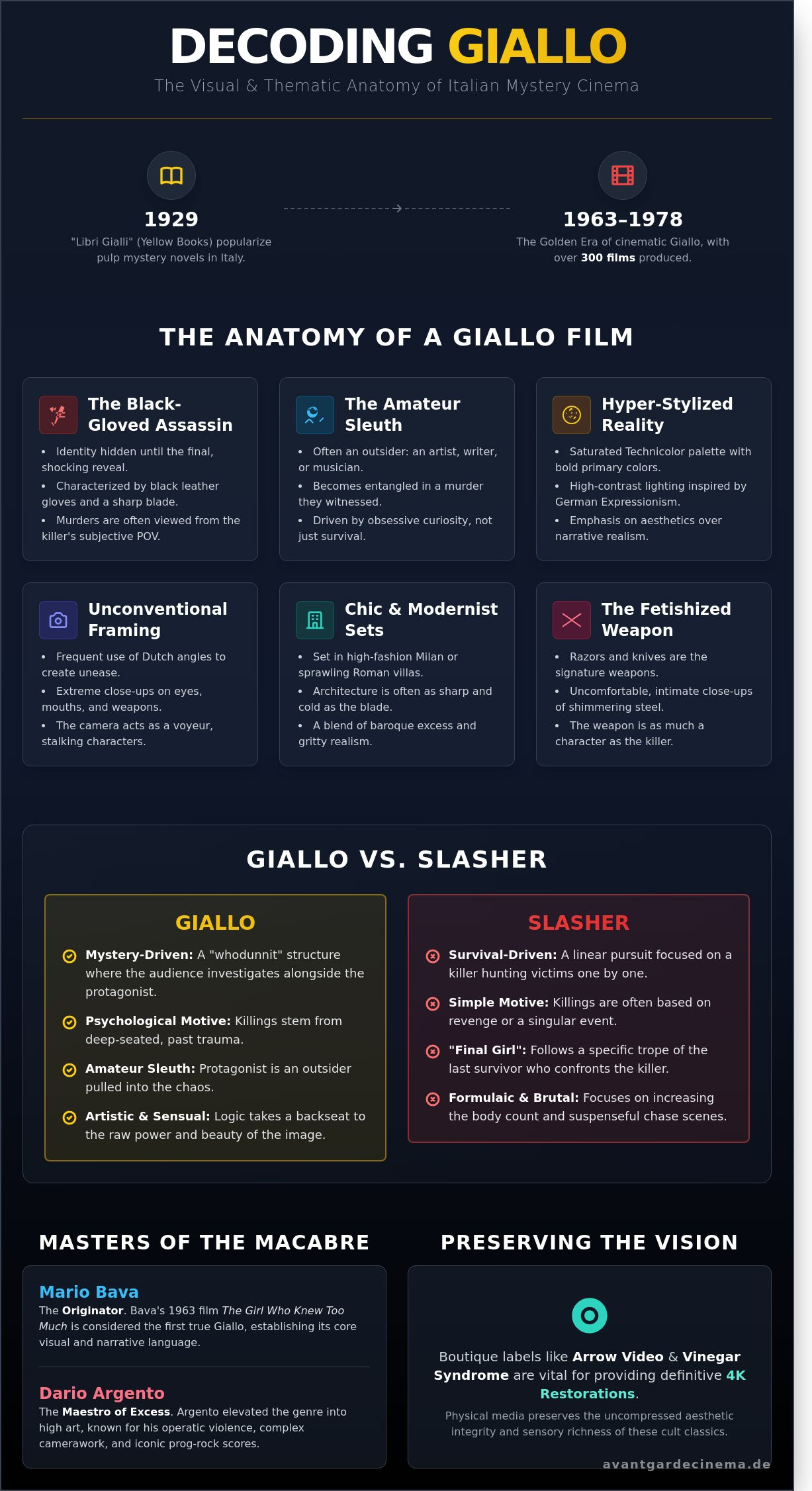
Giallo isn't merely a subgenre of horror; it's a meticulously crafted visual symphony that prioritizes aesthetic excellence over traditional narrative logic. The term itself translates to "yellow," a reference to the cheap, pulp mystery novels that dominated Italian newsstands starting in 1929. These books, published by Mondadori, featured bright yellow covers and introduced a generation to tales of crime and suspense. By the time director Mario Bava released The Girl Who Knew Too Much in 1963, this literary obsession had transformed into a cinematic movement. To understand What is Giallo?, one must look past the blood and see the artistry in the staging of every frame.
The genre reached its creative zenith in the 1970s, characterized by the presence of a mysterious, black-gloved killer whose identity remains hidden until a shocking finale. In these giallo films, the camera acts as a voyeur, leading the audience through a labyrinth of red herrings and stylish set pieces. Directors like Dario Argento and Lucio Fulci elevated the detective story into a high-art experience where the vibrant saturation of primary colors often speaks louder than the dialogue.
The Literary Origins of the Genre
In June 1929, the first "Libri Gialli" appeared in Italy, forever changing the nation's cultural landscape. These editions featured translated works from masters like Agatha Christie and Edgar Wallace, yet they were reimagined with a darker, more visceral Mediterranean edge. This transition from the printed page to the silver screen in the early 1960s allowed filmmakers to experiment with the tension between high-brow mystery and low-brow exploitation. The result was a unique hybrid that blended British detective tropes with Italian operatic flair.
Giallo vs. Slasher: Key Differences
While American slashers like 1978's Halloween rely on the "final girl" trope and a linear pursuit, giallo films focus on an amateur sleuth, often an outsider like an American musician or an English writer, who becomes obsessed with a crime they witnessed. The motive is rarely simple survival; it's usually a deep-seated, trauma-induced psychological fracture. This genre emphasizes the visual fetishization of the murder weapon, using extreme close-ups of shimmering blades and leather textures to create an atmosphere of uncomfortable intimacy. Logic takes a backseat to the raw power of the image.
The legacy of this movement persists in modern cinema, influencing the "neo-Giallo" revival seen in works like 2012's Berberian Sound Studio. It's a testament to the enduring power of Italian visual storytelling that these films continue to inspire designers and directors who value artistic integrity and bold, uncompromising visions. Giallo remains a masterclass in how to turn a simple mystery into a haunting piece of avant-garde art.
The Visual and Auditory Syntax of the Giallo Film
The allure of giallo films lies in their rejection of narrative restraint in favor of sensory overload. This genre transformed the act of watching into a voyeuristic exercise where the camera functions as a stalking protagonist. Directors like Mario Bava and Dario Argento moved away from the documentary-style realism of the 1940s, choosing instead to craft a hyper-stylized reality. Every frame is a curated composition, often utilizing Dutch angles and extreme close-ups of eyes or gloved hands to build an atmosphere of inescapable dread.
Set design and high-end Italian costume choices reflect a 1970s obsession with fashion and fetishism. These films often take place in the chic boutiques of Milan or the sprawling villas of Rome, where the architecture is as sharp and cold as the killer's blade. The visual grammar of Giallo is a blend of baroque excess and gritty realism. This aesthetic choice ensures that even the most gruesome sequences possess a haunting, painterly beauty that elevates the material above standard exploitation fare.
Cinematography and the Art of the Kill
The lighting in these productions draws heavily from 1920s German Expressionism, using deep shadows and high-contrast chiaroscuro to hide the killer's identity. Directors frequently employ subjective POV shots, forcing the audience to occupy the perspective of the murderer. This technique creates a disturbing intimacy between the viewer and the violence on screen. To understand how these visual techniques evolved across the genre's peak years, you can explore The Essential Giallo Watchlist for a breakdown of definitive stylistic benchmarks.
Technicolour Nightmares: Use of saturated gels (vibrant reds and cold blues) to represent psychological fracturing.
The Unblinking Eye: Frequent use of zoom lenses to heighten the feeling of being watched.
Spatial Disorientation: Unconventional framing that makes familiar domestic spaces feel alien and threatening.
Ennio Morricone and Goblin: The Sound of Terror
Soundscapes in giallo films are as essential as the cinematography. The genre witnessed a radical shift from traditional 19th-century orchestral scores to experimental jazz fusion and progressive rock. Ennio Morricone’s work on the 1970 film The Bird with the Crystal Plumage introduced dissonant, breathy vocals that signaled the killer's presence before they even appeared on screen. This auditory branding created a visceral reaction in the audience, turning music into a predatory narrative device.
By 1975, the band Goblin redefined the genre’s pulse with their synthesizer-heavy score for Deep Red. Their use of repetitive, driving rhythms and eerie electronic textures created a modern, urban anxiety that traditional instruments couldn't capture. These iconic scores have outlived the films themselves, influencing modern electronic artists and horror composers for over 40 years. For those looking to translate such powerful visual storytelling into modern contexts, the Giallo era remains the ultimate masterclass in technical precision and artistic free spirit.
The Masters of the Macabre: From Mario Bava to Dario Argento
The evolution of giallo films rests on the shoulders of visionaries who treated the camera as a surgical instrument. These directors didn't just film stories; they sculpted atmosphere through a radical use of light and shadow. They transformed the pulp origins of the genre into a sophisticated cinematic language that challenged traditional narrative structures. Each master brought a unique aesthetic signature to the screen, ensuring the genre remained both commercially viable and artistically daring.
Mario Bava and the Birth of the Aesthetic
Mario Bava initiated the cinematic movement in 1963 with The Girl Who Knew Too Much. This film established the "paranoid tourist" trope that became a genre staple. He refined the visual blueprint in 1964 with Blood and Black Lace. This masterpiece introduced the iconic faceless, trench-coated killer and prioritized style over logic. This Columbia University analysis of Giallo highlights how Bava’s background as a cinematographer allowed him to create lush, neon-drenched sets on micro-budgets. His legacy lives in the saturated primaries and creative staging that defined Italian horror for decades.
Dario Argento: The Golden Era
Dario Argento elevated the genre to global acclaim during the 1970s. He burst onto the scene with his "Animal Trilogy," beginning with The Bird with the Crystal Plumage in 1970. These films focused on the fallibility of human memory and the obsession of the witness. He reached a creative zenith in 1975 with Deep Red. This production blended intricate mystery with baroque violence and a driving progressive rock score by Goblin. It remains the pinnacle of technical achievement in giallo films. By the late 1970s, Argento began weaving supernatural elements into his work, signaling a shift toward the phantasmagoric style seen in Suspiria.
If Bava was the architect and Argento the visionary, Lucio Fulci was the provocateur. His 1972 film Don’t Torture a Duckling remains a bleak masterpiece of social commentary and rural dread. Fulci transitioned the genre from structured mysteries into visceral, dream-like experiences where logic dissolved into pure sensation. His work bridged the gap between the classic Giallo and the graphic gore films of the 1980s.
Prolific craftsmen like Sergio Martino and Umberto Lenzi sustained the genre's golden age through sheer industry. Martino’s Your Vice Is a Locked Room and Only I Have the Key (1972) exemplifies the era's stylistic density and psychological complexity. These directors delivered high-quality thrillers at a rapid pace, ensuring that the Giallo remained a dominant force in European cinema for over 15 years. Their collective output solidified a legacy of uncompromising artistic integrity and bold visual experimentation.
The Essential Giallo Watchlist: Where to Begin Your Investigation
Curating a definitive collection of giallo films demands an appreciation for both meticulous staging and visceral storytelling. These titles aren't merely movies; they're artifacts of a specific artistic vision that dominated Italian screens between 1963 and 1982. To truly capture the atmosphere, you must experience these works in their original Italian audio tracks. The melodic quality of the language contrasts sharply with the jagged, violent imagery, creating a sensory experience that dubbing often flattens. Recent 4K restorations from 2021 and 2022 have elevated these titles to "must-own" status for any serious curator of avant-garde cinema.
The "Holy Trinity" of Giallo
These three films represent the genre's foundation and its peak artistic expression. They're the essential starting point for any investigation into the movement's history.
Deep Red (Profondo Rosso, 1975): Dario Argento’s masterpiece serves as the ultimate entry point. Its 127-minute runtime is a masterclass in tension, featuring a haunting score by Goblin and some of the most inventive cinematography in the genre's history.
Blood and Black Lace (1964): Mario Bava established the visual vocabulary of the genre here. The use of saturated primary colors and deep shadows creates a dreamlike, almost operatic environment for its sequence of stylish murders.
The Strange Vice of Mrs. Wardh (1971): This film represents the peak of the psychosexual thriller. Sergio Martino’s direction weaves a complex narrative web that keeps the viewer guessing until the final frame.
Hidden Gems for the Advanced Collector
Once you've mastered the basics, these titles offer deeper thematic resonance and experimental techniques that pushed the boundaries of giallo films.
Don’t Torture a Duckling (1972): Lucio Fulci provides a scathing social commentary on rural superstition and religious hypocrisy. It’s a gritty, sun-drenched nightmare that stands apart from the typical urban setting.
Your Vice Is a Locked Room and Only I Have the Key (1972): This Poe-inspired work explores decadence and domestic rot. Its intricate plot and gothic undertones offer a more literary, sophisticated approach to the genre's tropes.
Short Night of Glass Dolls (1971): Aldo Lado delivers a surrealist masterpiece. The story, told from the perspective of a paralyzed man presumed dead, challenges traditional narrative structures with its haunting atmosphere.
Discover how to elevate your own visual storytelling by exploring our
today.
Collecting the Giallo: Why Physical Media is the Ultimate Experience
Streaming services offer convenience, but they often fail the visual complexity of giallo films. A standard 4K stream rarely exceeds a 25 Mbps bitrate, which leads to digital artifacts in dark scenes. This compression destroys the organic film grain and the deep, saturated shadows that directors like Mario Bava or Dario Argento perfected. In contrast, a physical 4K Ultra HD disc provides a bitrate up to 100 Mbps. This technical overhead ensures that every drop of vibrant red blood and every intricate leather texture remains sharp. Collecting physical media isn't just about ownership; it's about preserving a specific artistic vision that digital algorithms dilute.
The joy of the limited edition lies in its tactile nature. These releases serve as a museum in a box, offering a level of depth that a digital file cannot replicate. When you hold a high-end edition, you're engaging with the film’s history through physical artifacts. Most premium releases now include:
80-page perfect-bound booklets featuring new academic essays.
Reversible sleeves that showcase original Italian theatrical poster art.
Fold-out posters and art cards that celebrate the genre's unique graphic design.
Restored original mono soundtracks that preserve the haunting scores of Ennio Morricone or Goblin.
Boutique Labels to Watch
Curating a library requires knowing the masters of restoration. Arrow Video stands as the gold standard, often sourcing original 35mm camera negatives for their definitive box sets. For those seeking the fringe of the genre, Vinegar Syndrome excels at unearthing obscure, forgotten titles that haven't been seen since their 1970s theatrical runs. Labels like Second Sight and Eureka! elevate the genre by providing scholarly context and world-class encodes that respect the director's original intent.
Building Your Library at Avant-Garde-Cinema
At Avant-Garde-Cinema, we understand that the bold colour palettes of giallo films require the highest technical standards. A 2024 restoration in 4K UHD brings out the neon hues and stylistic lighting that defined the genre's golden age. Berlin collectors rely on our expertise because we treat every title as a piece of cinematic history. You can explore our latest curated imports in the New Releases section. We focus on editions that offer more than just a movie; they provide an immersive, tactile connection to the avant-garde spirit of Italian horror. Our selection reflects a commitment to quality, ensuring your collection remains a testament to aesthetic excellence.
Embark on Your Journey into the Heart of Italian Mystery
The allure of giallo films transcends mere genre conventions; it represents a pinnacle of 1960s and 70s stylistic audacity that continues to influence modern directors. You've explored the foundational brilliance of Mario Bava's 1963 debut and the baroque complexity of Dario Argento's visionary staging. These masterpieces demand a presentation that respects their intricate visual and auditory syntax. Streaming platforms often fail to capture the deep shadows and vibrant primary colors that define this era of Italian cinema. True connoisseurs know that only high-bitrate physical media can deliver the 4K Ultra HD clarity these works deserve. It's the only way to see every detail of the killer's black leather gloves.
As Berlin-based experts in cinematic preservation, we specialize in sourcing the finest limited edition boutique releases from around the globe. Our catalog features 100% authentic imports from industry leaders like Arrow Video and Vinegar Syndrome, focusing on rare 4K restorations that breathe new life into classic macabre tales. We take pride in being a dedicated partner for collectors who value artistic integrity and technical precision in their home cinema. Don't settle for the ephemeral nature of digital files when you can own a permanent piece of film history. It's time to move beyond the digital surface and embrace the tactile beauty of a curated library.
Explore our curated collection of Giallo masterpieces on Blu-ray and 4K and start building your definitive archive of Italian suspense today.
Frequently Asked Questions
What is the literal meaning of "Giallo" in Italian?
The word "Giallo" translates literally to "Yellow" in Italian. This name originates from a series of inexpensive mystery novels published by Mondadori in 1929, which featured iconic yellow covers. These literary roots provided the thematic blueprint for giallo films, blending pulp detective stories with a sophisticated visual elegance that defines the movement’s artistic identity.
Are Giallo films considered horror or mystery?
Giallo films exist as a deliberate hybrid of the whodunit mystery and the visceral horror thriller. Mario Bava’s 1963 film "The Girl Who Knew Too Much" established this unique structure by combining procedural investigation with stylized suspense. While the plots follow a traditional mystery arc, the operatic violence and psychological dread place them firmly within the broader horror landscape.
Who is the most famous Giallo director?
Dario Argento is the most celebrated visionary within this cinematic tradition. His 1975 masterpiece, "Deep Red," remains a definitive benchmark for the genre’s technical precision and aesthetic excellence. Argento’s work is characterized by intricate camera movements and a bold use of primary colors. He elevated these productions from mere exploitation to a respected form of high-art storytelling.
What is the best Giallo film for a beginner to watch first?
Dario Argento’s directorial debut, "The Bird with the Crystal Plumage" (1970), serves as the ideal introduction for new viewers. It establishes essential tropes like the amateur sleuth and the mysterious, black-gloved killer. The film achieved massive commercial success, earning over 1 billion lire at the Italian box office. Its rhythmic pacing and striking visual compositions offer a clear window into the genre’s soul.
Why do characters in Giallo films often have their voices dubbed?
Italian productions utilized post-synchronization because cameras used during the 1960s and 1970s were often too loud to record clean audio on set. Directors frequently employed international casts who spoke different languages, which made a unified live audio track impossible. This technical necessity creates a dreamlike, slightly detached atmosphere. It’s a signature style that enhances the surrealist quality of the viewing experience.
Are Giallo films available in 4K Ultra HD?
Yes, many essential giallo films have received meticulous 4K Ultra HD restorations that preserve their visual integrity. Arrow Video released a stunning 4K edition of "Deep Red" in 2021, sourced from the original camera negative. These high-resolution transfers allow you to appreciate the vivid color palettes and complex lighting designs. You’ll see the artistic vision of the original cinematographers with unprecedented clarity.
What is a "Neo-Giallo" film?
Neo-Giallo refers to contemporary films that pay homage to the aesthetic and thematic hallmarks of the original 1970s movement. Hélène Cattet and Bruno Forzani’s 2009 film "Amer" is a primary example, focusing on sensory experience rather than a linear narrative. These modern interpretations often emphasize fetishistic details and bold soundscapes. They keep the spirit of the genre alive for a 21st-century audience.
Which boutique labels specialize in Giallo releases?
Specialized distributors like Arrow Video and Vinegar Syndrome act as the primary curators for high-quality genre releases. Arrow Video has published more than 30 titles in this category, often featuring scholarly commentaries and restored footage. 88 Films and Severin Films also provide premium editions for serious collectors. These labels ensure that the artistic craftsmanship of each production is preserved through rigorous archival research.
Comments