


How to Start a Film Collection: The 2026 Guide for the Modern Cinephile
- Martin Kolb
- Apr 19
- 13 min read

Your digital movie library is a sophisticated long-term rental that can be revoked without notice. In December 2023, the sudden removal of 1,317 titles from a major digital service reminded us that digital ownership is often a legal fiction. You deserve more than a fragile license; you deserve the permanence of art. If you appreciate the organic grain of a 35mm scan or the meticulous color grading of a master director, you likely feel the limitations of compressed streaming. Low bitrates and shifting licensing deals compromise the visual integrity of the stories you love. Learning how to start a film collection is the only way to reclaim your autonomy as a viewer and build a library that truly belongs to you.
This guide provides the technical expertise and aesthetic vision required to curate a high-fidelity cinematic archive. You'll discover how to navigate the intricacies of region codes and boutique labels like Criterion, Second Sight, or Radiance. We'll examine the specific hardware required for a future-proof 4K setup in 2026. This journey moves from the initial selection of essential titles to the mastery of physical media preservation and the creation of a truly personal home cinema.
Key Takeaways
Transcend the fragility of digital streaming by embracing the intentional curation of physical media as a vital act of cinematic preservation.
Master the technical hierarchy of formats to ensure your library achieves the gold standard of 4K Ultra HD and high-dynamic range excellence.
Explore the prestigious world of boutique labels where film is elevated to fine art through meticulous restoration and artisanal packaging.
Discover a sophisticated blueprint on how to start a film collection by defining an artistic "North Star" to guide your unique curation.
Implement professional preservation and display strategies to safeguard your cinematic legacy against environmental factors for generations to come.
Table of Contents The Philosophy of the Modern Cinephile: Why Start a Film Collection in 2026? Technical Foundations: Choosing Your Formats and Hardware Navigating Boutique Labels: Arrow, Criterion, and Beyond The Art of Curation: Building Your Library with Intention Preservation and Display: Caring for Your Cinematic Legacy
The Philosophy of the Modern Cinephile: Why Start a Film Collection in 2026?
To understand how to start a film collection in 2026 is to embrace the role of a cinematic archivist. It's no longer about mere consumption; it's about intentional curation. While the masses chase the fleeting convenience of the cloud, the modern cinephile recognizes that true ownership requires a physical anchor. Collecting represents a commitment to preservation and the pursuit of a visual fidelity that digital streams simply cannot replicate. Learning how to start a film collection begins with a fundamental shift in perspective: you're moving from a temporary consumer to a permanent curator of the moving image.
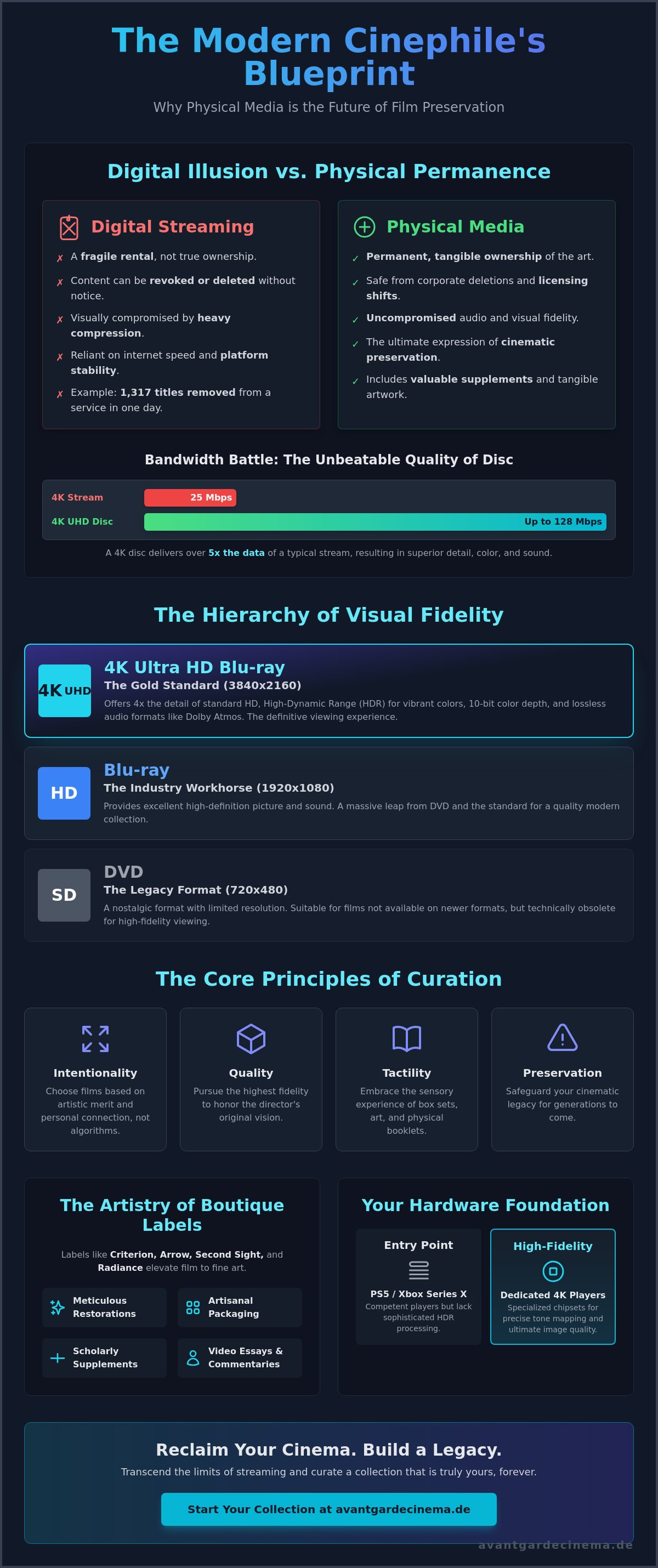
Technical superiority remains the most compelling argument for the disc. A standard 4K streaming signal typically peaks at 25 Mbps, while a 4K Ultra HD disc delivers data at rates up to 128 Mbps. This massive gap in bandwidth manifests in the depth of black levels, the nuance of film grain, and the absence of compression artifacts that plague digital platforms. A quick look at the history of home video formats reveals a constant struggle between convenience and quality, yet in 2026, the physical disc remains the undisputed king of bitrates.
The Death of Digital Permanence
Digital ownership is an illusion sustained by licensing agreements. In the last 24 months, we've witnessed major streaming platforms erase entire libraries of original content for tax write-offs, leaving "owners" with empty digital lockers. Your physical shelf is a private sanctuary beyond the reach of corporate deletion or rights shifts. Physical media is the only guaranteed way to own cinema in 2026.
The Aesthetic of the Boutique Edition
The modern collection thrives on the artistry of boutique labels. Curators like Criterion and Arrow treat films as artifacts, providing restored cuts and scholarly supplements that transform a movie into a masterclass. These editions offer tactile satisfaction through heavy cardstock slips, original commissioned cover art, and detailed booklets that provide historical context. You can explore the deeper philosophy of these objects in The Art of Physical Media Collecting. These supplements, including audio commentaries and video essays, ensure that the film's legacy is preserved alongside the feature itself.
Intentionality: Choosing what to own based on artistic merit rather than algorithm suggestions.
Quality: Accessing 10-bit color depth and lossless audio tracks like Dolby Atmos without internet throttling.
Tactility: The sensory experience of unboxing a limited edition box set or reading a physical essay.
By building a library, you create a personal history of your relationship with cinema. It's an investment in a vision that doesn't expire when a subscription ends or a server goes offline. This is the foundation of the modern cinephile's journey.
Technical Foundations: Choosing Your Formats and Hardware
The transition from a casual viewer to a dedicated collector begins with an appreciation for the medium itself. When you research how to start a film collection, you quickly realize that the physical disc is more than a storage device; it's a vessel for artistic intent. The current hierarchy of quality places 4K Ultra HD at the summit, offering a 3840x2160 resolution that provides four times the detail of standard high definition. Below it, the reliable Blu-ray remains the industry workhorse, while the DVD persists as a nostalgic, though technically limited, legacy format. Choosing the right foundation ensures that your library isn't just a list of titles, but a gallery of high-fidelity experiences.
Hardware is the bridge between the disc and your senses. While game consoles like the PlayStation 5 or Xbox Series X serve as competent entry points, they often lack the sophisticated tone mapping found in dedicated players. High-end decks, such as those released by Panasonic or Magnetar in late 2024 and 2025, utilize specialized chipsets to process HDR metadata with surgical precision. This technical nuance is a vital pillar for anyone discovering how to start a film collection with longevity in mind, as the player determines how faithfully the director's vision is translated to your screen.
4K Ultra HD vs. Standard Blu-ray
4K Ultra HD is the definitive gold standard for the modern cinephile. Its primary advantage isn't just the pixel count, but the implementation of High Dynamic Range (HDR). Technologies like HDR10+ and Dolby Vision allow for 10-bit or even 12-bit color depth, reaching brightness levels and shadow details that standard Blu-ray cannot replicate. However, the standard 1080p Blu-ray remains a sophisticated choice for independent films or older titles where a 4K scan might not exist. It offers a cost-effective way to build depth in your library without sacrificing significant visual integrity. You can explore our format comparison to see which editions best suit your aesthetic standards.
The Multi-Region Dilemma
Serious curation often requires looking beyond domestic borders. Standard Blu-rays are frequently locked into three geographical zones: Region A (Americas/East Asia), Region B (Europe/Africa/Australia), and Region C (China/Central Asia). To bypass these digital borders, many collectors invest in a region-free player, which allows the playback of exclusive boutique releases from around the globe. Fortunately, the 4K UHD format is almost entirely region-free, a standard established to simplify global distribution. Before purchasing, always check the small hexagonal logo on the back cover to identify the encoded region. For a deeper look at global sourcing, consult our guide on Import Blu-rays.
As you refine your technical setup, remember that the beauty of a collection lies in its presentation. Explore our curated selection of limited edition Steelbooks to find a centerpiece for your new library.
Navigating Boutique Labels: Arrow, Criterion, and Beyond
To understand how to start a film collection with true artistic depth, you must look beyond mass-market retail. Boutique labels act as the curators of our cinematic history, treating every frame as a piece of fine art rather than a mere commodity. These companies often spend years on a single restoration, ensuring that the grain, color timing, and sound design match the director's original intent. For the modern cinephile, these labels aren't just manufacturers; they're visionaries who preserve the soul of the moving image through technical precision.
The 'Big Three' for Every Collection
Establishing a foundation requires an appreciation for the pioneers who set the standard for home media. These three labels are an essential step for anyone learning how to start a film collection that doubles as a curated archive of excellence.
The Criterion Collection: Since their first LaserDisc release in 1984, Criterion has remained the gold standard. They're famous for director-approved 4K transfers and academic supplements that provide a deep dive into film theory. You can explore their legacy through this Criterion Collection selection.
Arrow Video: They've mastered the art of the cult classic. Arrow is known for incredible limited edition box sets that include thick booklets and exclusive artwork. Their 2024 restoration of The Chronicles of Riddick highlights their commitment to high-bitrate encoding in genre cinema.
Second Sight: This label is celebrated for producing the industry's most high-end 4K restorations. Their 2023 release of The Texas Chain Saw Massacre set a new bar for modern masterpieces, offering a level of detail that surpasses all previous editions.
Beyond these giants, genre specialists offer niche excellence. Vinegar Syndrome focuses on the meticulous restoration of exploitation and lost American independent films. Meanwhile, Radiance Films, founded in 2022, has quickly gained a following for its sophisticated curation of world cinema and rare arthouse titles that were previously unavailable in high definition.
Sourcing Rare and Out-of-Print (OOP) Titles
The secondary market for physical media is driven by scarcity. Editions become Out Of Print (OOP) when a studio's licensing agreement expires or a limited run of 3,000 units sells out. Once a title is no longer in production, its value can skyrocket, sometimes tripling in price on collector forums within six months. It's a common reality that limited editions often sell out before their official release date due to high demand among enthusiasts.
The thrill of the hunt involves more than just luck; it requires a strategic approach. You should regularly monitor New Releases to secure your copies at MSRP before they fall into the hands of third-party scalpers. By staying ahead of the release calendar, you ensure your collection grows in both artistic significance and financial value without overpaying for essential titles.
The Art of Curation: Building Your Library with Intention
Understanding how to start a film collection requires a shift in perspective from passive consumer to active curator. A library isn't just a shelf of plastic cases; it's a curated archive of visual history that reflects your personal aesthetic and cinematic values. Your journey in learning how to start a film collection truly begins when you choose a North Star to guide your acquisitions, ensuring every purchase serves a larger narrative purpose.
Defining Your Curatorial Focus
Success in this hobby depends on discipline. Without a focus, your shelves quickly become cluttered with impulse buys that don't resonate with your vision. Consider these three common paths:
The Director-Led Approach: This involves deep-diving into the filmographies of masters. You might start by securing the definitive 4K restorations of Alfred Hitchcock, tracing his evolution from British thrillers to Hollywood masterpieces.
The Label-Led Approach: Many cinephiles find satisfaction in spine-chasing. Collecting every release from a specific boutique label like Criterion or Arrow ensures a consistent level of quality in both transfers and supplemental features.
Genre-Specific Libraries: You may choose to build the ultimate resource for a specific movement, such as 1940s Film Noir or Italian Giallo, creating a specialized museum of a particular cinematic mood.
Where to Buy and How to Save
Authentic curation rewards patience. While mass-market retailers offer convenience, supporting specialist shops is vital for the health of the physical media ecosystem. These specialists often provide better packaging protection and exclusive slipcovers that hold significant value. Timing your purchases is equally critical. For example, the bi-annual Criterion 50% off sales in July and November are legendary for a reason. Arrow Video typically runs their Shocktober sale every October, offering deep discounts on horror and cult titles. To keep your budget healthy, check the Deals section for introductory pricing on high-end boutique releases.
Building a foundation requires 10 to 20 essentials, titles like Seven Samurai, 2001: A Space Odyssey, or The Godfather, that represent the pinnacle of the craft. Once these anchors are set, use cataloging tools like CLZ Movies or MyMovies to track your inventory. These apps allow you to scan barcodes, manage your "to-watch" pile, and avoid accidental duplicate purchases. By treating your collection as a living project rather than a shopping list, you create a legacy of storytelling that lasts a lifetime.
Ready to secure the foundational pieces of your archive? Explore our latest new releases to find your next essential masterpiece.
Preservation and Display: Caring for Your Cinematic Legacy
Acquiring a masterpiece is only the first movement in the symphony of curation. Once you understand how to start a film collection, the focus shifts toward the longevity of your physical archive. Your library isn't just a shelf of plastic; it's a preserved history of visual storytelling that requires meticulous care to withstand the passage of time. Protecting these artifacts ensures that the director's vision remains as vivid decades from now as it was on the day of its release.
Organization is a deeply personal expression of a collector's aesthetic vision. While some cinephiles prefer the rigid logic of alphabetical order, others treat their shelves as a gallery, grouping releases by boutique labels to maintain a unified visual language. Some even organize by spine color to create a striking gradient across the room. Regardless of your method, protecting the integrity of the packaging is paramount. High-quality, acid-free protector sleeves are essential for rare Steelbooks and limited edition box sets. These clear shields prevent the "shelf wear" and micro-scratches that can diminish both the beauty and the resale value of your most prized acquisitions.
Optimal Storage Conditions
The phenomenon of "disc rot" occurs when the reflective layer of a disc oxidizes due to poor environmental sealing. To prevent this chemical degradation, keep your library in a climate-controlled environment where temperatures remain below 21 degrees Celsius and humidity levels stay under 40 percent. Always store your cases vertically. Horizontal stacking creates uneven pressure that can lead to disc warping or cracked center hubs over time. Collectors should strictly avoid storing their films in basements or attics, as these areas are prone to the extreme temperature fluctuations and dampness that ruin paper inserts and delicate disc layers.
Joining the Collector Community
Physical media thrives through its vibrant, global community of enthusiasts. Engaging with specialized forums and the "unboxing" culture on digital platforms provides vital intelligence on transfer quality and hidden disc features. These spaces help you refine your taste and avoid inferior pressings. To manage your acquisitions effectively, you should regularly track Coming Soon titles to plan your monthly budget around high-profile restoration projects. Being a modern cinephile means being an active participant in this cultural preservation effort. Your journey as you learn how to start a film collection doesn't end with a single purchase; it evolves into a lifelong pursuit of cinematic excellence. Explore our full catalog of boutique cinema to find the next cornerstone of your growing legacy.
Curate Your Visionary Library
Building a library isn't just about accumulation; it's an act of cultural preservation. As streaming services removed over 500 legacy titles from their digital catalogs throughout 2024, the physical disc remains the only guarantee of permanent access. You've learned that mastering how to start a film collection requires a balance of technical precision and artistic vision. By prioritizing 4K UHD formats and focusing on limited editions from prestigious labels, you ensure your home theater rivals the highest theatrical standards of the modern era.
We act as your dedicated partner in this pursuit of aesthetic excellence. Avantgarde Cinema is a specialist in global boutique labels, offering a meticulously curated selection of 4K UHD and rare Limited Editions that celebrate the craft of storytelling. We provide reliable national shipping across Germany to ensure every masterpiece arrives in pristine condition. Your collection is more than a hobby; it's a living testament to your unique perspective. Begin your collection with our curated New Releases and transform your viewing space into a gallery of cinematic history. Your journey into the world of high-end physical media begins today.
Frequently Asked Questions
Is it worth starting a film collection in the age of 4K streaming?
Physical media remains the gold standard for quality because 4K Ultra HD discs deliver bitrates up to 128 Mbps. Streaming platforms often compress data to 15 or 25 Mbps, which compromises the visual texture and depth of the image. When you learn how to start a film collection, you secure permanent access to your favorite works. Digital licenses can vanish due to rights shifts, but a physical disc ensures your cinematic vision stays intact.
What is the difference between a standard Blu-ray and a Boutique Blu-ray?
Boutique Blu-rays focus on artistic preservation and curated extras that standard studio releases often ignore. Labels like The Criterion Collection or Second Sight commission 4K digital restorations from original camera negatives to ensure aesthetic excellence. These editions feature commissioned cover art and thick booklets that celebrate the film's history. Standard releases provide the movie alone; boutique versions offer a deep dive into the director's vision through scholarly essays and rare archives.
Do I need a special player to watch imported movies from other countries?
You need a region-free player to watch imported standard Blu-rays from different geographic zones like Region B or C. The world is divided into specific codes to control distribution, which prevents a disc from London from playing on a standard New York player. However, the 4K Ultra HD format, established in 2016, is almost entirely region-free. This shift allows cinephiles to source rare titles from global distributors without worrying about hardware compatibility or technical barriers.
How many movies should I buy to start a 'real' collection?
A collection isn't defined by a specific number but by the intentionality behind your selections. Starting with 10 to 15 titles that represent your personal aesthetic is more meaningful than owning 500 random discs. Understanding how to start a film collection involves curating a library that reflects your soul and cinematic values. Every addition should be a deliberate choice that contributes to a cohesive, personal archive of visual storytelling rather than just filling shelf space.
What is the best way to clean a 4K Ultra HD or Blu-ray disc?
Use a clean, dry microfiber cloth to gently wipe the disc in a straight line from the center hole to the outer edge. Never use circular motions. These can create scratches that follow the data track and cause permanent playback errors. Blu-ray discs have a Durabis coating, developed by TDK, which makes them more scratch-resistant than older DVDs. If a dry cloth fails, a tiny drop of distilled water is usually sufficient for stubborn fingerprints.
Why are some Blu-rays so expensive compared to others?
High prices usually reflect the scarcity of a release and the immense cost of high-end restorations. Boutique labels often produce limited editions of only 2,000 or 3,000 units, which increases production costs per item. The price covers the licensing fees paid to studios and the labor of film historians. When a release includes a rigid slipcase and a 100-page hardbound book, the physical craftsmanship and artistic integrity justify the premium investment.
Should I keep the 'J-cards' and original stickers on my movie boxes?
Collectors usually keep J-cards and stickers because they preserve the item's original integrity and market value. These paper backings contain technical specifications and barcodes that aren't printed on the actual box art. If you decide to trade a rare edition later, having the original stickers can increase the resale value by 20 percent or more. Store them inside the case or behind the cover art to keep your display looking clean and professional.
How do I know if a movie is 'Out of Print' (OOP)?
A movie is considered Out of Print when the distributor no longer holds the rights or has exhausted the initial production run. You can verify this by checking the "Last Chance" sections on label websites or tracking price spikes on third-party marketplaces. Sites like Blu-ray.com provide database updates on the status of specific editions. When a title's status changes to OOP, it often disappears from major retailers like Amazon within 14 days.
Comments