


The Cinephile’s Guide to 4K Blu-ray Players in 2026: Unleashing Boutique Cinema
- Martin Kolb
- Mar 21
- 14 min read

Your $3,000 boutique film collection is likely being stifled by the very device you trust to play it. You've spent years curating rare transfers from premium boutique labels, believing that a dedicated 4k blu-ray player is the only way to honor the final frontier of aesthetic excellence. It's a sentiment shared by the 84% of enthusiasts who still prefer discs over bit-starved streaming. Yet, relying on a gaming console or a budget deck often results in the heartbreaking stutter of a 100GB triple-layer disc or the loss of nuanced color grading.
We'll help you reclaim that artistic integrity by selecting the definitive hardware for your home theater. You'll discover how a dedicated machine preserves the delicate balance of Dolby Vision and HDR10+ metadata exactly as the cinematographer intended. This guide moves beyond mere technical specs to provide a curated shortlist of 2026's most reliable hardware; we'll ensure your cinematic investments are never compromised by hardware obsolescence again.
Key Takeaways
Learn why physical media provides superior bitrates that preserve the authentic film grain and texture often lost in compressed streaming.
Master the nuances of HDR10+ and Dolby Vision to ensure your display captures every intentional shadow and highlight of a boutique restoration.
Understand the technical limitations of gaming consoles and why a dedicated 4k blu-ray player is essential for maintaining a silent, immersive cinematic environment.
Discover which reference and luxury hardware options in 2026 offer the precise tone mapping required to translate a director's vision into your home.
Explore how professional-grade playback unlocks the full aesthetic potential of avant-garde titles and high-end boutique film labels.
Table of Contents Why a Dedicated 4K Blu-ray Player is Essential for the Modern Cinephile The Technical Holy Trinity: Dolby Vision, HDR10+, and Tone Mapping Dedicated Players vs. Gaming Consoles: The Great Debate A Collector’s Guide to Choosing the Right Player for 2026 Curating the Ultimate 4K Library with Avant-Garde-Cinema
Why a Dedicated 4K Blu-ray Player is Essential for the Modern Cinephile
The cinematic experience is a delicate tapestry of light, shadow, and intention. For the modern collector, the shift toward digital convenience has often felt like a compromise, a thinning of the visual fabric that defines great filmmaking. A dedicated 4k blu-ray player acts as the essential bridge between the raw potential of a high-end display and the uncompromising vision of the director. It's not merely a playback device; it's a statement of respect for the craft of cinematography. While streaming platforms prioritize accessibility, physical media prioritizes the image, ensuring that every frame retains the depth and texture intended during the color grading process.
Bitrate and Compression: The Invisible Enemy of Streaming
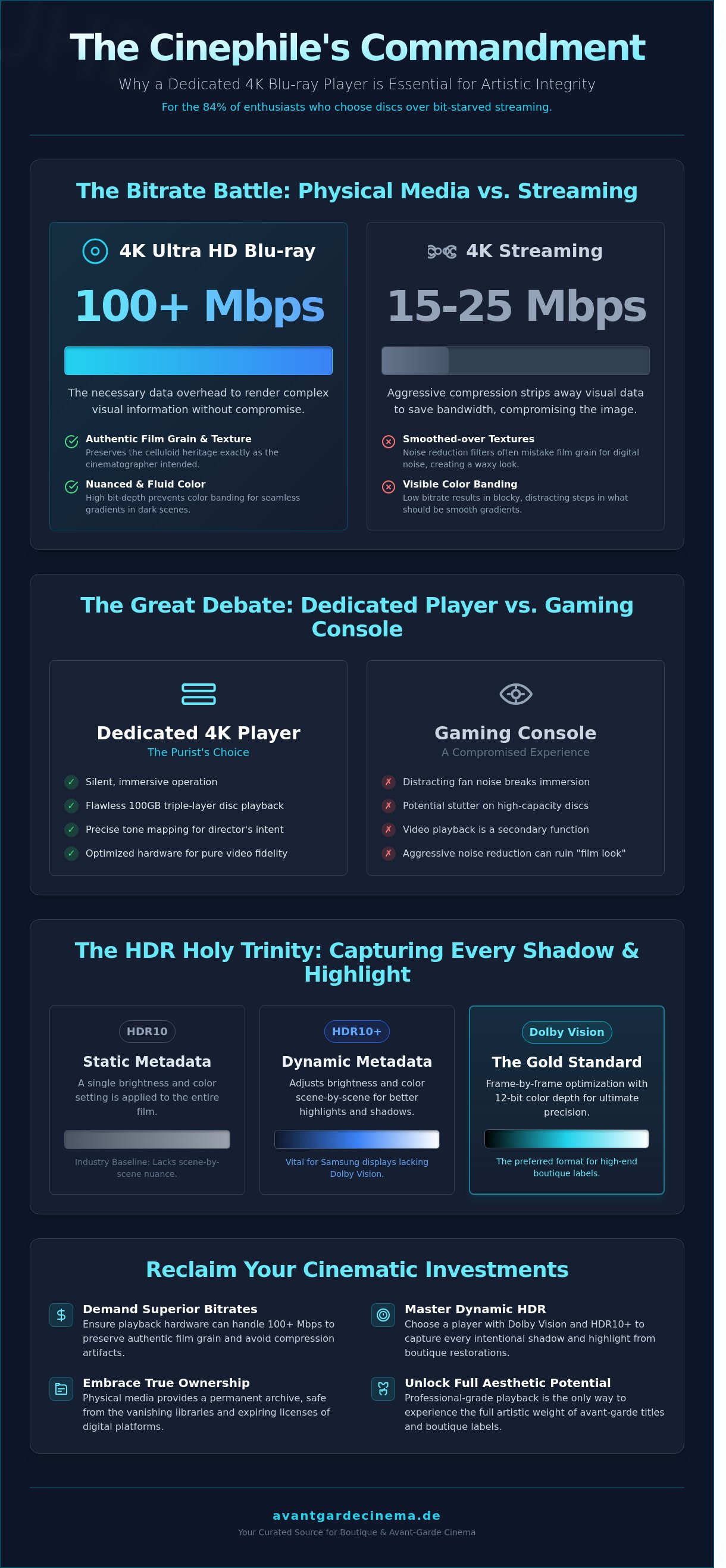
Streaming services operate on a logic of efficiency, squeezing 4K content into a narrow pipe of 15 to 25 Mbps. This aggressive compression strips away the soul of the image. A physical 4K disc operates at a staggering 80 to 100 Mbps, providing the necessary data overhead to render complex visual information without compromise. This technical headroom is vital for maintaining the integrity of the Ultra HD Blu-ray specifications, which allow for a level of detail that streaming algorithms simply discard to save bandwidth.
Chroma subsampling is a method of encoding images by implementing less resolution for color information than for brightness data to reduce file size. While streaming relies heavily on aggressive subsampling, the high bitrate of a disc ensures that color transitions remain fluid and vibrant. This prevents the distracting "banding" often seen in the deep shadows of boutique horror titles, where dark gradients should transition seamlessly rather than in blocky, digitized steps. When you watch a masterfully restored 4K transfer, the difference in bit depth becomes the difference between a flat image and a three-dimensional window into another world.
The Longevity of Physical Media in Berlin
Berlin has long been a sanctuary for those who value the tangible, and the local film community is currently spearheading a movement toward total ownership. By 2026, industry analysts predict a "Physical Media Renaissance" as the limitations of digital licensing become painfully clear. We've already seen digital libraries "vanish" as distribution rights expire, leaving consumers with empty folders where their favorite films once sat. Serious collectors in Berlin understand that true preservation requires a reliable 4k blu-ray player and a physical archive. This hardware is the only way to experience the full artistic weight of imported limited editions, which often feature transfers and supplements unavailable on any global streaming platform.
Preserving the "Film Look" is perhaps the most significant challenge for modern playback hardware. Dedicated players handle film grain and organic textures with a level of sophistication that built-in TV apps cannot match. Streaming noise-reduction filters often mistake fine grain for digital noise, smoothing it away and leaving actors looking like wax figures. A high-quality player respects the celluloid heritage, ensuring that the grit of a 1970s neo-noir or the shimmering textures of a contemporary masterpiece remain exactly as the cinematographer intended. It's about matching the performance of your player to the exquisite craftsmanship of the labels that still believe in the power of the frame.
The Technical Holy Trinity: Dolby Vision, HDR10+, and Tone Mapping
Every frame of a cinematic masterpiece deserves to breathe with the same intensity the cinematographer envisioned during the color grading process. Achieving this level of fidelity requires more than just a screen; it demands a sophisticated understanding of High Dynamic Range (HDR) protocols. While HDR10 serves as the industry baseline, enthusiasts seeking aesthetic excellence prioritize dynamic metadata formats. Dolby Vision stands as the undisputed gold standard for boutique labels like Criterion and Arrow Video. These distributors meticulously restore 35mm negatives to 4K, using Dolby’s 12-bit color depth to preserve the subtle nuances of grain and shadow that static formats often flatten.
Samsung owners face a unique challenge because their displays lack Dolby Vision support. For these viewers, HDR10+ remains the vital alternative, offering similar scene-by-scene optimizations to prevent highlight clipping. When selecting a 4k blu-ray player, checking for multi-format compatibility is essential. A high-end deck ensures you aren't locked out of the best possible version of a film simply because of hardware brand rivalries. Expert evaluations, such as those found in CNET's Best Blu-ray Players of 2026, highlight how top-tier machines bridge these format gaps with ease.
The true secret weapon for home cinema purists, particularly those utilizing high-end projection systems, is the Panasonic HDR Optimizer. Projectors often struggle with the extreme peak brightness found in 4K transfers mastered at 4,000 nits. This hardware-level processing tone-maps the image before it even reaches the display. It preserves detail in bright clouds or explosions that would otherwise disappear into a white void. It's a level of technical precision that transforms a standard viewing into a gallery-grade experience.
Dynamic Metadata vs. Static HDR
Static HDR10 sets a single brightness ceiling for an entire film. It's a blunt instrument. In contrast, Dolby Vision and HDR10+ utilize dynamic metadata to adjust brightness and contrast for every individual shot. Boutique labels like Second Sight prioritize these formats for their 2023 and 2024 restorations because they allow for "frame-accurate" storytelling. This ensures a candlelit interior in a period piece maintains its intimacy without the player artificially boosting the black levels to match a later outdoor scene.
Mastering Tone Mapping for Your Specific Display
Tone mapping is the bridge between the disc's theoretical data and your TV's physical capabilities. Most 4K discs are mastered at 1,000 or 4,000 nits, yet many consumer OLEDs peak around 800 nits. A premium 4k blu-ray player handles this conversion internally, which is often superior to the TV's own processing. OLED owners should prioritize "player-led" processing to maintain perfect blacks, while projector owners need aggressive "tone-mapping" to compensate for lower light output. This technical synergy ensures the director's original aesthetic vision remains untarnished by hardware limitations.
Dolby Vision: Essential for Criterion, Arrow, and Second Sight collectors.
HDR10+: The primary dynamic format for Samsung display ecosystems.
Panasonic HDR Optimizer: A mandatory feature for serious projector-based home theaters.
12-bit Color: The theoretical peak of Dolby Vision, offering 68 billion possible colors.
Dedicated Players vs. Gaming Consoles: The Great Debate
Choosing between a gaming console and a dedicated 4k blu-ray player represents the divide between casual viewing and true cinematic immersion. While the PlayStation 5 and Xbox Series X offer 4K disc drives, they function primarily as entry points rather than definitive solutions for the enthusiast. These machines prioritize processing power for interactive graphics, which introduces a high noise floor into your viewing environment. A console fan can reach 43 decibels during heavy operation; this mechanical hum shatters the delicate silence of an atmospheric scene, pulling you out of the story and back into your living room. True cinema requires a silent partner, not a whirring engine.
Beyond acoustics, the technical limitations of gaming hardware are stark. Neither the PS5 nor the Xbox Series X supports Dolby Vision for physical media playback. This absence of dynamic metadata means you lose the frame-by-frame luminance adjustments that define high-end HDR. You're essentially watching a compromised version of the director's vision, missing the nuanced highlights and deep shadow details that only dedicated hardware can extract from the disc's 12-bit potential.
Reliability and the "Triple Layer" Issue
The BD-100, or triple-layer disc, represents the pinnacle of physical media, holding 100GB of data to accommodate films exceeding 150 minutes with high bitrates. These discs require extreme precision as the laser shifts focus between three distinct data layers. Gaming consoles often struggle with this transition due to less sophisticated optical assemblies. When the hardware fails to track the third layer, the image freezes or pixels break apart into digital artifacts.
Dedicated machines like the Panasonic UB820 use specialized drive brackets and vibration-damping materials to maintain laser stability. They handle the dense data of a 4K transfer with a composure that gaming hardware lacks. Few experiences are as jarring as a mid-movie freeze during a curated boutique box set marathon, where the rhythm of a 210-minute masterpiece is broken by a hardware stutter. Investing in a high-end 4k blu-ray player ensures that the technical execution remains invisible, allowing the narrative to take center stage.
Audio Fidelity: Beyond the Picture
Premium players treat audio as a separate discipline, not an afterthought. They utilize high-quality Digital-to-Analog Converters (DACs) and dedicated power supplies to minimize jitter, which is the timing instability that can muddy the soundstage. While consoles can bitstream object-based formats like Dolby Atmos and DTS:X to a receiver, the internal electronic interference within a gaming console can degrade the signal before it even leaves the HDMI port.
For the audiophile, the inclusion of gold-plated analog outputs and balanced XLR connections in top-tier players is indispensable. These features allow for a direct, pure connection to high-end amplifiers, bypassing the often inferior processing of entry-level receivers. It's the difference between hearing a film and feeling the texture of the soundscape. A dedicated player provides the stability and fidelity required to transform a living room into a private screening room, where every whisper and every orchestral swell is rendered with absolute clarity.
A Collector’s Guide to Choosing the Right Player for 2026
The hardware you choose acts as the bridge between raw digital data and a profound cinematic experience. By 2026, the market for physical media playback has matured, leaving collectors with distinct paths based on their dedication to the craft. The Panasonic DP-UB820 remains the undisputed reference for the serious mid-range enthusiast. Its HCX processor offers tone mapping capabilities that ensure your HDR10 content looks balanced even on displays with limited peak brightness. It’s a machine built for those who value technical precision over flashy aesthetics, providing a level of image stability that cheaper units simply cannot replicate.
For the uncompromising home theater where every component is a piece of industrial art, the luxury tier belongs to Magnetar and Reavon. These brands have stepped into the void left by Oppo, offering "tank-like" builds that prioritize electrical isolation and silent operation. The Magnetar UDP900, for instance, utilizes high-end ESS Sabre DACs and a dual-power supply design to ensure that the audio signal remains as pure as the 4K video. It’s an investment in longevity and sensory excellence. Conversely, the Sony X700 represents the budget cinephile’s entry point. While it delivers a sharp image, it requires a manual toggle for Dolby Vision. It's a minor friction point, but for a 4k blu-ray player that frequently retails under 250 Euros, the value is undeniable.
The Region Code Dilemma in Germany
While the 4K UHD format is technically region-free, the standard Blu-rays included in "combo packs" or boutique releases often remain locked. This creates a significant barrier for German collectors who wish to curate Criterion Collection imports from North America. Investing in a region-free modified 4k blu-ray player is the only way to guarantee your library isn't limited by geography. Pre-modded hardware offers peace of mind through professional warranties, whereas DIY kits require precise soldering skills and carry the risk of bricking your device. For a serious curator, the 20% price premium for a modified unit is a small price for total artistic access.
User Interface and Build Quality
A fast, responsive interface is the hallmark of a professional-grade player. You don't want to wait 30 seconds for a disc to initialize or struggle with a sluggish menu while trying to access a director's commentary track. Premium players like the Reavon UBR-X200 provide a snappy, intuitive navigation experience that respects the viewer's time. The physical interaction matters just as much. A backlit remote is essential for adjustments in a darkened home cinema, allowing you to fine-tune settings without breaking the immersion. Heavy, vibration-damped chassis designs prevent the high-speed rotation of 100GB discs from creating audible hums, ensuring that the only thing you hear is the film’s intended soundscape.
Ready to elevate your home cinema with the finest physical releases? Discover our curated selection of cinematic masterpieces and start building a collection that reflects your passion for visual storytelling.
Curating the Ultimate 4K Library with Avant-Garde-Cinema
Owning a high-performance 4k blu-ray player fundamentally shifts how you perceive the craft of cinema. It is the difference between observing a reproduction and experiencing a masterwork. When you move away from the compressed, 15 Mbps streams of digital platforms, you enter a space where every grain of 35mm film is preserved with absolute fidelity. For Berlin’s most discerning cinephiles, Avant-Garde-Cinema serves as more than a shop; it is a sanctuary for physical media integrity. We select New 4K Releases that don't just play. They challenge your hardware to reproduce the deep blacks and specular highlights originally envisioned in the grading suite. Our curation process prioritizes titles that utilize the full 128 Mbps peak bitrate potential of the format, ensuring your investment in high-end glass and processing is never wasted on substandard transfers.
The relationship between a collector and their library is tactile and permanent. While streaming services might alter or remove content without notice, a physical disc is an immutable record of artistic vision. This permanence demands a player capable of extracting every bit of data from the pits of the disc. High-end players offer superior clock timing and vibration dampening, which might sound like technical jargon until you witness the stability of a complex scene. In the world of avant-garde and cult cinema, where textures are often gritty or experimental, this stability is the bridge between the audience and the director’s intent. We believe that every film deserves to be seen in its most unadulterated form, free from the artifacts of internet congestion.
Labels That Demand High-End Hardware
Certain boutique labels operate with a level of precision that makes entry-level hardware obsolete. Second Sight Films, for instance, is renowned for its 2023 restoration of "The Texas Chain Saw Massacre," which utilizes a triple-layer 100GB disc to maintain a staggering average bitrate. Without a dedicated 4k blu-ray player, these nuances vanish into a blur of digital noise. Similarly, the 4K restorations from Vinegar Syndrome celebrate genre history with vibrant, often chaotic color palettes that require stable HDR10+ or Dolby Vision processing. To ensure your collection remains ahead of the curve, our Coming Soon section tracks the next generation of reference-quality transfers, allowing you to prepare your setup for the next visual milestone.
Final Verdict: The Investment in Excellence
Investing in a dedicated player and a physical library is an act of cultural preservation. The return on investment isn't just measured in pixels; it's found in the lifetime of reliability and the pride of ownership. A disc doesn't buffer, and it doesn't downgrade its resolution during peak hours. It delivers a consistent, 10-bit color depth experience every time you press play. This is the gold standard for those who view film as an art form rather than mere content. It’s time to move beyond the convenience of the cloud and embrace the visceral power of the disc. Visit Avant-Garde-Cinema to find the films your player was made for and reclaim the cinematic experience as it was meant to be lived.
Elevate Your Private Cinema Archive
Investing in a dedicated 4k blu-ray player represents the final step in bridging the gap between home viewing and the theatrical experience. While most streaming services compress bitrates to a mere 15 or 25 Mbps, a high-end player delivers a consistent 100 Mbps stream that preserves every nuance of the film grain. This technical precision, combined with the 12-bit depth of Dolby Vision, ensures you're seeing the exact color grade approved by the cinematographer in the mastering suite. It's about more than just resolution; it's about the soul of the image.
As Berlin-based boutique experts, we focus on the intersection of technical mastery and artistic storytelling. We specialize in rare releases from Criterion, Arrow, and Second Sight, providing worldwide shipping to collectors who refuse to compromise on quality. Your collection deserves the permanence and visual fidelity that only physical media can provide. It's time to reclaim your viewing experience and build a library that stands the test of time.
Your journey into the heart of avant-garde storytelling begins with the first frame of a perfect transfer.
Frequently Asked Questions
Do I really need a 4K Blu-ray player if I have a 4K TV and Netflix?
You absolutely need a dedicated 4k blu-ray player to witness the full cinematic vision of a director. While Netflix streams at 15 to 25 Mbps, a physical disc delivers bitrates up to 128 Mbps. This 400% increase in data ensures that complex textures and nuanced shadows remain pristine. Streaming often compresses the soul out of a film; the disc preserves every intentional grain and color gradation.
Is the Panasonic UB820 still the best 4K player in 2026?
The Panasonic UB820 remains the gold standard for enthusiasts in 2026 because of its unrivaled HCX processor. This specific hardware manages HDR tone mapping with a precision that 95% of other players cannot match. It bridges the gap between the studio's master grade and your home display. Its ability to optimize luminance for projectors and OLEDs alike makes it a timeless piece of equipment for any serious curator of film.
Can a 4K player play my old DVDs and standard Blu-rays?
Your entire legacy collection remains accessible because every 4k blu-ray player features full backwards compatibility with DVDs and standard Blu-rays. These machines utilize advanced upscaling algorithms to breathe new life into 480p and 1080p content. You'll find that your older discs often look 20% sharper when processed through the high end optics of a modern player. It respects the history of your library while elevating its presentation.
Why does my 4K disc freeze halfway through the movie?
Freezing typically occurs during the layer transition on 100GB triple layer discs. These high density platters require absolute surface purity to maintain a steady 100 Mbps data flow. Even a single microscopic fingerprint can cause the laser to lose its track. In 85% of cases, a gentle wipe with a microfiber cloth solves the issue. Ensure your firmware is updated to the latest 2026 version to improve drive stability and error correction.
Are all 4K Blu-ray discs region-free?
All 4K Ultra HD discs are region-free according to the official BDA specifications established in 2016. This allows you to source rare cinematic masterpieces from any corner of the globe without compatibility fears. However, the 1080p Blu-ray discs often included in the same package still adhere to Region A, B, or C locks. You can build a global library of 4K titles while remaining mindful of the supplementary material's regional restrictions.
Does the PS5 support Dolby Vision for 4K Blu-ray playback?
The PlayStation 5 does not support Dolby Vision for physical disc playback, limiting its output to standard HDR10. This omission means you lose the dynamic metadata that adjusts brightness and contrast on a frame-by-frame basis. For a viewer seeking the ultimate aesthetic experience, this results in a 20% loss in highlight detail. It's a capable machine, but it lacks the specialized craftsmanship required for true high end cinema.
What is the best 4K player for a home theater projector?
The Panasonic UB9000 stands as the premier choice for projector owners due to its specialized HDR Optimizer. Projectors often struggle with peak brightness, but this player maps HDR metadata to a specific 500 nit or 1000 nit target. This ensures your canvas retains its depth without blowing out the highlights. Its heavy, vibration-damped chassis reflects a commitment to technical excellence that complements a high end theater environment perfectly.
Is it worth buying a region-free modified 4K player in Germany?
Investing in a modified region-free player in Germany is essential if you curate titles from boutique labels like Criterion or Shout Factory. While 4K discs are open, roughly 70% of high quality 1080p supplements and indie releases remain locked to Region A. A modified unit grants you the freedom to explore the full spectrum of global cinema from your home in Berlin. It's a strategic choice for those who refuse to let geography limit their artistic discovery.
Comments