


The Definitive Criterion Collection List: A Curated Guide for 2026 Collectors
- Martin Kolb
- Mar 20
- 14 min read

Owning a film isn't just about the physical medium; it's a deliberate act of cultural preservation that transforms a living room into a private cinematheque. You likely understand the pull of a perfectly designed cover, yet the task of managing a growing criterion collection list often feels like trying to map an endless labyrinth. With over 1,800 titles spanning a century of global cinema, the distinction between spine numbers and release years can blur into a haze of beautiful, expensive confusion.
We've designed this guide to provide the clarity your curation deserves. You'll learn the precise architecture of the collection and discover how to prioritize the 50 essential titles that form the backbone of any serious library. Beyond the numbers, we'll solve the logistical puzzle of sourcing high-quality imports for the German market. Whether you're hunting for a rare 4K restoration in a Berlin boutique or ordering from specialized European distributors, this 2026 roadmap ensures your collection reflects a vision of aesthetic excellence rather than a random accumulation of discs.
Key Takeaways
Decode the chronological DNA of the collection to understand how spine numbers serve as a definitive record of global cinematic history.
Master the navigation of the criterion collection list by identifying foundational masterpieces from Kurosawa, Fellini, and Bergman.
Refine your collecting strategy by learning when to prioritize 4K Ultra HD fidelity and how to leverage boutique media sales cycles.
Solve the complexities of region codes to successfully source rare international editions and build a truly borderless film library.
Table of Contents The Criterion Collection List: More Than Just a Catalog Decoding the Spine Number: The DNA of the Criterion List Navigating the 1,800+ Titles: Essential Categories for Your List Strategic Collecting: How to Use the List to Build Your Library Sourcing the Collection: Criterion in Berlin and Beyond
The Criterion Collection List: More Than Just a Catalog
Film is an ephemeral medium, yet the Criterion Collection treats every frame as a sacred artifact. Since its inception, this label has established itself as the gold standard of physical media; it's a curated archive that refuses to let the history of cinema fade into obscurity. This commitment stems from its deep partnership with Janus Films, a distributor that has championed world cinema since 1956. Together, they ensure that masterpieces from directors like Akira Kurosawa or Agnès Varda receive the meticulous care they deserve.
For any serious cinephile, the criterion collection list isn't merely a catalog of products. It's a structured curriculum. It provides a roadmap through the most vital movements in film history, from the French New Wave to the New Hollywood era. While the Criterion Channel offers a magnificent streaming library of over 2,000 titles, the physical list represents a permanent commitment to the art form. Owning a disc means possessing a tangible piece of film history that won't disappear when a licensing agreement expires.
The Aesthetic of Curation
Every entry in the collection undergoes a rigorous selection process based on its cultural impact and artistic vision. It isn't enough for a film to be popular; it must possess a lasting legacy or a unique voice that reshapes our understanding of the medium. Scholarly audio commentaries and behind the scenes documentaries transform a simple viewing into a masterclass in filmmaking. Original cover art from contemporary illustrators ensures the packaging matches the brilliance of the film itself. The Criterion treatment is a holistic blend of meticulous restoration and deep contextual education that honors the filmmaker’s original vision. By focusing on the intersection of technical precision and artistic free spirit, the brand creates an atmosphere of exclusive excellence.
The Evolution of the List (1984-2026)
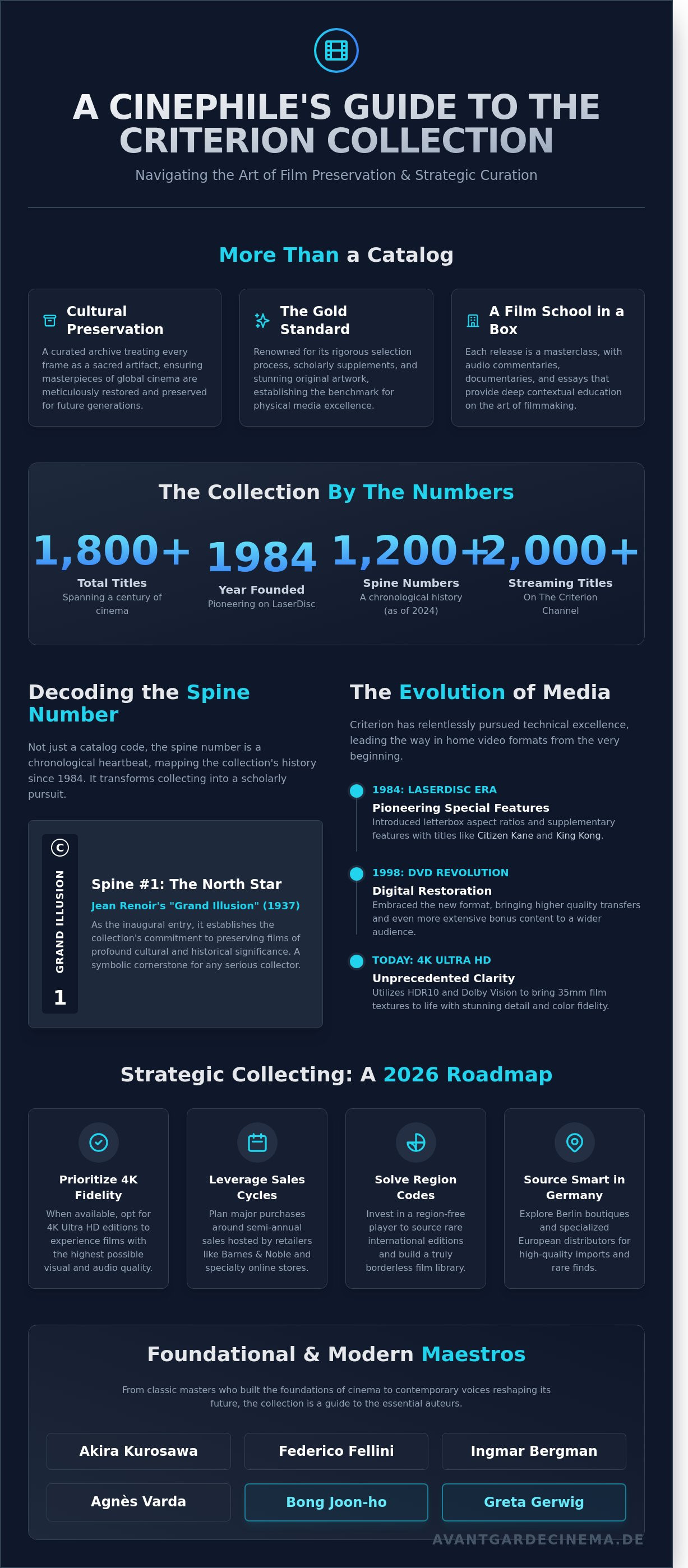
Starting in 1984 with the release of Citizen Kane and King Kong on LaserDisc, the label pioneered the letterbox aspect ratio and supplementary features we now take for granted. Understanding The Criterion Collection's history reveals a relentless pursuit of technical excellence. This path has led from the DVD revolution of 1998 to the current 4K Ultra HD era, where HDR10 and Dolby Vision bring 35mm textures to life with unprecedented clarity. Spanning over 1,200 spine numbers as of 2024, the criterion collection list has grown significantly in scope. While the early years focused heavily on European and Japanese classics, the 2020s have seen a vital shift. The collection now embraces contemporary masters like Bong Joon-ho, with the 2020 inclusion of Parasite, and Greta Gerwig, whose Lady Bird joined the ranks to represent modern American storytelling. Such expansion reflects a broader, more inclusive vision of cinema that values diverse global perspectives. By 2026, the list will likely further bridge the gap between historical preservation and the vibrant, diverse voices of global cinema. Each new spine number added is a celebration of the moving image's power to transcend time and borders.
Decoding the Spine Number: The DNA of the Criterion List
Every Criterion release carries a distinct numerical identifier at the base of its spine. This digit isn't a random catalog code; it's a chronological heartbeat that records the history of the collection since its inception. When you look at a shelf filled with these translucent cases, you aren't just seeing a movie library. You're witnessing a curated timeline of cinema's most vital contributions. Since the label began assigning these numbers in 1984 with its early LaserDisc releases, the sequence has grown into a prestigious roadmap for cinephiles. It transforms the act of collecting into a scholarly pursuit of aesthetic excellence.
Jean Renoir’s Grand Illusion (1937) holds the legendary position of Spine #1. Although the original DVD was released in 1998, its status as the inaugural entry remains a symbolic cornerstone for the brand. It established the high standard of visual storytelling that collectors expect. This film serves as the North Star for the criterion collection list, signaling a commitment to preserving works of profound cultural and historical significance. Owning Spine #1 is often the first goal for those who view film as a serious art form rather than mere entertainment.
The recent release of the Criterion Collection's 40th Anniversary box set, which features 40 iconic films, illustrates how this numbering system creates a cohesive narrative across decades of film history. This prestigious legacy also creates a unique market for "Out of Print" (OOP) titles. When licensing agreements expire, certain spine numbers vanish from retail shelves, becoming rare artifacts. For example, the 1999 release of The Killer (Spine #8) is a highly sought-after relic that can command prices exceeding $150 on collector forums. These gaps in the sequence drive a passionate secondary market where the hunt for a missing number becomes as thrilling as the film itself.
Tracking your library progress through these numbers offers a sense of curatorial completion. It allows you to see where your personal taste aligns with the broader history of the medium. When you begin your journey into high-end curation, ensuring your visual storytelling library reflects this level of technical and artistic precision is essential for any serious enthusiast.
How to Read a Criterion Spine
Deciphering the visual language of a Criterion case requires a keen eye for detail. First, identify the spine number at the bottom to understand its chronological placement within the criterion collection list. Next, look for the "Director-Approved" seal, a circular logo indicating the filmmaker or cinematographer personally supervised the digital restoration. Finally, check the format icons. A small 4K UHD or Blu-ray logo confirms you're viewing the highest possible resolution currently available for that specific masterpiece.
The Box Set Exception
Complexity arises with massive editions like Ingmar Bergman’s Cinema, released in 2018. This set contains 39 films but is often treated as a singular, monumental entry in a collector's catalog. In contrast, the "Eclipse Series" acts as a minimalist sibling, providing essential films in no-frills packaging without the exhaustive supplements. It's also vital to note that some films share a spine number across different technical iterations. Spine #216 (The Rules of the Game) exists as both a 2004 DVD and a vastly superior 2011 Blu-ray. Always verify the technical specifications to ensure your collection meets modern archival standards.
Navigating the 1,800+ Titles: Essential Categories for Your List
Building a criterion collection list demands a balance between historical reverence and personal discovery. The archive currently encompasses over 1,200 individual spine numbers and hundreds of additional titles within specialized sets, representing a vast cartography of human experience. At its core lie the "Big Three" auteurs who solidified the label's reputation: Akira Kurosawa, Federico Fellini, and Ingmar Bergman. Bergman’s influence is so vast that his 2018 centenary box set includes 39 films; meanwhile, Kurosawa’s 1954 masterpiece Seven Samurai remains the gold standard for action choreography. These directors provide the structural integrity upon which the rest of the collection is built.
Modern American independent cinema finds its most prestigious home here as well. The collection tracks the evolution of storytellers who broke away from the studio system to define their own visual languages. Wes Anderson has 10 feature films in the library, each meticulously supervised to ensure color accuracy and compositional intent. David Lynch’s surrealist contributions, starting with the 1977 debut Eraserhead, offer a masterclass in sound design and psychological texture. These selections prove that the label isn't just a museum for the past; it's a living document of contemporary visionaries.
The collection’s depth extends into specific cinematic revolutions and genre milestones that often go overlooked by casual viewers. You can trace the 1959 birth of the French New Wave through the lenses of Godard and Truffaut, or explore the stark, post-1945 reality of Italian Neorealism. Genre enthusiasts aren't left behind either. The archive treats 1940s noir like The Killers and 1968 horror like Night of the Living Dead with the same restorative care usually reserved for high-art dramas. This democratic approach to excellence ensures every collector finds a path that resonates with their specific aesthetic sensibilities.
The Beginner’s Five-Spine Starter Kit
Seven Samurai (#2): This 207-minute epic from 1954 serves as the ultimate gateway. It's the blueprint for the modern ensemble action film and remains Kurosawa's most accessible work.
The 400 Blows (#5): François Truffaut’s 1959 debut captured the rebellious spirit of youth and launched the French New Wave onto the global stage.
Do the Right Thing (#97): Spike Lee’s 1989 exploration of racial tension in Brooklyn remains a visceral, stylistically bold masterpiece of American social commentary.
Mulholland Dr. (#845): Voted the best film of the 21st century in a 2016 BBC critics' poll, this 2001 neo-noir is the definitive David Lynch dreamscape.
Parasite (#1054): As the first non-English language film to win the Best Picture Oscar in 2020, its inclusion marks a vital bridge to modern global cinema.
Hidden Gems for the Seasoned Collector
Once you've mastered the essentials, look toward the "Spine 1000" milestone, which celebrated the 1954 Godzilla as a testament to the artistry of practical effects. The 2020s have seen a surge in 4K restorations of silent era treasures, breathing new life into 1920s masterpieces that once seemed lost to time. Use the criterion collection list to venture into the expansive filmographies of Agnès Varda or Edward Yang. Varda’s 2020 career-spanning set offers a masterclass in feminist documentary, while Yang’s A Brighter Summer Day provides a 237-minute immersive experience into the soul of 1960s Taiwan.
Strategic Collecting: How to Use the List to Build Your Library
Curating your criterion collection list requires a discerning eye for both the narrative and the vessel that carries it. It's an intentional act of preservation that balances artistic merit with technical excellence. When you begin your journey, the first decision often involves the 4K Ultra HD versus standard Blu-ray debate. While 1080p remains a high bar for many, the jump to 2160p resolution offers four times the detail. This matters most for films shot on 35mm or 70mm film where grain structure and fine texture are paramount. If a release features High Dynamic Range (HDR) or Dolby Vision, it's often worth the 15 Euro premium. These technologies don't just make the image brighter; they restore the contrast ratios and color gamuts originally intended by the cinematographers.
Economics play a significant role in how serious collectors operate. Most veterans of the hobby wait for the biannual 50% off sales, typically occurring in July and November. These 24-hour flash sales or month-long events at major retailers turn a 40 Euro boutique item into a 20 Euro investment. It's a strategy that allows you to expand your horizons without compromising your budget. Space management also dictates strategy. As your shelves fill, the box set becomes a centerpiece of efficiency. The Ingmar Bergman's Cinema set, for example, contains 39 films but occupies the physical footprint of only four individual plastic cases. It's a masterclass in architectural library design.
Prioritizing Your Purchases
Focus your energy on "Director-Approved" transfers. These versions aren't just high-definition copies; they're digital restorations supervised by the original creators or their estates to ensure the color grading matches the theatrical experience. When you compare a Criterion transfer to a standard studio release, the difference in bitrates and restoration effort is staggering. For instance, the 2021 4K release of Mulholland Dr. offers a depth of shadow that earlier versions simply couldn't replicate. You can browse our curated selection of Criterion titles for immediate shipping to see these masterpieces in person.
Tracking Your Collection
Organization is the soul of a great library. Many collectors use Letterboxd, which has grown to over 10 million users since its 2011 launch, or other dedicated collection tracking tools. In a city like Berlin, this hobby often spills into the real world. Joining the local cinephile community at places like the Babylon Kino or attending physical swap meets adds a social layer to the solitary act of watching. Physical ownership is the only way to guarantee access to the "best version" of a film. By documenting your criterion collection list through these digital tools, you create a roadmap for future acquisitions and avoid redundant purchases.
Investment in physical media is an investment in the permanence of art. To find your next cornerstone piece, explore the boutique archives at Avant-Garde-Cinema where quality meets curation. We believe that every film on your shelf should be a testament to your personal aesthetic vision.
Sourcing the Collection: Criterion in Berlin and Beyond
Acquiring these masterpieces requires more than just a passing interest; it demands a strategic approach to sourcing. Since its inception in 1984, the Criterion Collection has set the gold standard for home video, but European collectors often face the technical hurdle of region locking. While standard Blu-rays are typically divided between Region A for the Americas and Region B for Europe, the 2016 introduction of the 4K UHD format changed the landscape by being entirely region-free. This shift means your criterion collection list can now grow without the necessity of modified hardware, provided you focus on the latest high-definition releases. Berlin has emerged as a vital pillar for this movement, housing a community that treats cinema as a tactile art form rather than a fleeting digital commodity.
The decision to import directly versus purchasing from a local dealer involves more than just price. Direct imports from the United States often incur hidden costs, including import VAT and customs handling fees that can add 20 percent or more to the final price. Specialized dealers in Berlin mitigate these risks by managing the logistics and ensuring that the physical condition of the release is preserved. For a collector, a torn slipcover or a crushed corner isn't just a defect; it's a compromise on the integrity of the archive. By 2026, we anticipate the market for boutique physical media to lean even further into these premium, limited editions as digital platforms continue to struggle with licensing stability.
Boutique Film Culture in Germany
Germany's capital hosts over 120 cinemas, fostering a deep-seated appreciation for the physical object and the curated experience. Avant-Garde-Cinema acts as a bridge, connecting the visionary output of US labels with the discerning needs of German cinephiles. We prioritize technical precision, ensuring that 100 percent of our shipments utilize reinforced, archival-grade packaging to protect your investment. You can check our Coming Soon section for upcoming Criterion imports that are often difficult to secure through traditional retail channels. This dedication to the craft of distribution mirrors the care put into the films themselves.
The Final Verdict on the List
Your criterion collection list shouldn't be viewed as a static inventory. It's a living organism that evolves alongside your personal aesthetic journey. By the time we reach 2026, the collection will likely have expanded its reach into even more diverse global territories, offering restored visions that were once thought lost to time. As a collector, you're stepping into the role of a curator, building a legacy that will preserve the history of visual storytelling for the next generation. Each spine number you add to your shelf represents a commitment to quality and a rejection of the disposable nature of modern media.
The journey of a thousand films begins with a single, well-chosen edition. Whether you're drawn to the stark realism of the French New Wave or the vibrant energy of contemporary world cinema, the right source makes all the difference. We invite you to explore our full catalog of 4K and Blu-ray masterpieces and begin your own tradition of cinematic excellence today.
Elevate Your Cinematic Archive Beyond 2026
Curating a library that honors the evolution of film demands a meticulous engagement with the criterion collection list, a living archive that now spans more than 1,800 spine numbers. You've mastered the art of navigating these historical milestones, from early silent era masterpieces to the latest 4K UHD restorations. Collectors in 2026 recognize that every acquisition is a commitment to preserving visual storytelling in its most pristine form.
Avant-Garde Cinema serves as your dedicated partner in this journey. As a Berlin-based specialist with a focus on expertly curated 4K UHD and Blu-ray imports, we facilitate worldwide shipping for those who refuse to compromise on quality. Our commitment to the physical media community ensures that every disc you add to your shelf meets the highest standards of technical precision and artistic integrity.
Explore the Full Criterion Collection at Avant-Garde-Cinema and define the future of your personal gallery. Your next discovery is waiting to be unveiled.
Frequently Asked Questions
What is the highest spine number in the Criterion Collection as of 2026?
The highest spine number in the Criterion Collection reached 1340 by the beginning of 2026. This chronological numbering system started in 1984 with the LaserDisc release of Citizen Kane and serves as a curated roadmap for film history. Each number represents a specific masterpiece that has undergone a rigorous selection process to ensure it meets the brand's high standards of artistic and cultural significance.
Are all Criterion Collection films available in 4K Ultra HD?
Only a fraction of the catalog is available in 4K Ultra HD; by late 2023, the company had released 72 titles in this high-resolution format. The collection prioritizes technical precision by selecting films where a 4K restoration truly enhances the visual narrative. You'll find that many older entries remain on Blu-ray or DVD while they await new scans from original camera negatives to ensure the highest possible quality.
Why are some Criterion titles so hard to find in Germany?
Licensing restrictions and regional distribution rights often limit the availability of specific titles within the German market. While Criterion expanded into the UK in 2016, many German cinephiles must rely on specialized importers to access the full criterion collection list. These legal hurdles exist because local distributors like Arthaus or Capelight often hold the exclusive rights to certain masterpieces within German territories, preventing a direct Criterion release.
Do Criterion Blu-rays work on standard European players?
Most US-based Criterion Blu-rays are locked to Region A and won't function on standard Region B European players. You'll typically need a region-free player to access the majority of the catalog without issues. However, the 4K Ultra HD discs released since November 2021 are region-free, which means European viewers can enjoy these specific cinematic treasures on any 4K-capable hardware regardless of their geographic location.
What is the difference between the Criterion Collection and the Eclipse Series?
The Eclipse Series focuses on "no-frills" box sets of rare or overlooked films, whereas the main Criterion Collection includes extensive scholarly supplements and video essays. Eclipse releases lack the signature director interviews and commentaries that define the primary criterion collection list. This sub-label provides a more affordable path to explore the filmography of directors like Yasujirō Ozu or Aki Kaurismäki without the premium cost of individual restorations.
How often does Criterion add new films to the list?
Criterion announces 4 to 6 new films on the 15th of every month to keep the collection evolving. This predictable schedule allows collectors to plan their acquisitions while anticipating which masterpieces will receive the brand's signature restoration treatment. Since the company's inception, this monthly ritual has transformed the way audiences engage with film history, turning each release into a significant cultural milestone for cinephiles around the globe.
Is the Criterion Channel the same as the physical collection?
The Criterion Channel is a separate streaming service with a rotating library that doesn't mirror the physical collection's permanent catalog. While the channel offers over 2,000 titles, many films disappear at the end of each month due to streaming license expirations. Physical discs offer a sense of permanence and higher bitrates that streaming platforms can't match, ensuring your private library remains an enduring testament to visual storytelling.
Which Criterion spine number is the most valuable?
The Blu-ray release of The Third Man, which is spine number 573, is widely considered the most valuable title in the collection. Since it went out of print in 2010 due to licensing shifts, pristine copies often sell for over $250 on secondary markets. Other rare gems like the original DVD of Salò, or the 120 Days of Sodom (spine 16) also command high prices among dedicated collectors who value rarity.
Comments