


Asian Action Cinema: A Curated Guide to Martial Arts Masterpieces and Boutique Releases
- Martin Kolb
- Mar 23
- 14 min read

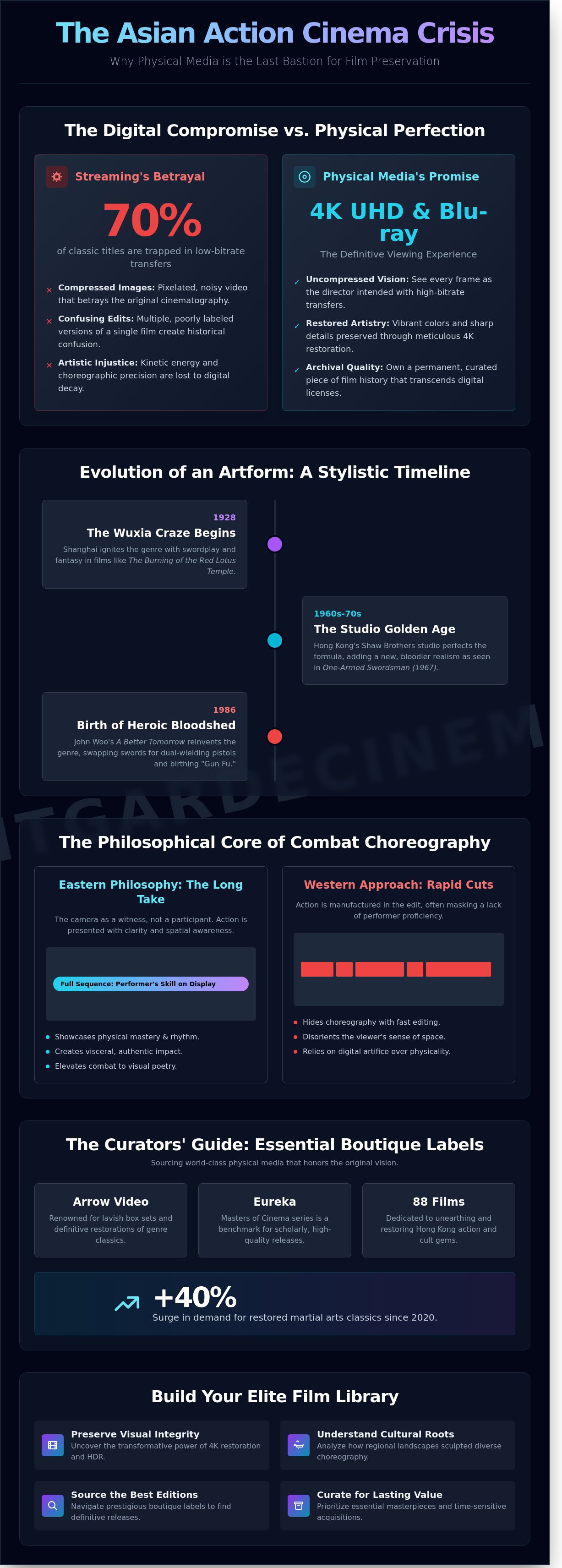
The convenience of modern streaming has quietly compromised the integrity of film history, leaving nearly 70 percent of classic martial arts titles trapped in low-bitrate transfers that betray their original craftsmanship. You've likely experienced the frustration of a compressed, pixelated image or the exhaustion of sorting through three different 1980s edits of a single masterpiece. It’s an injustice to the kinetic energy and choreographic precision that defines asian action cinema. You deserve to see every frame as the director intended, with the vibrant colors and sharp detail that only physical media can provide.
We're here to bridge the gap between casual viewing and true cinematic curation by helping you build a world-class collection of high-definition physical media. You'll gain a deep perspective on the genre's evolution and a definitive checklist of essential 4K and Blu-ray releases from elite boutique labels like Arrow Video, Eureka, and 88 Films. We’ll identify which specific editions preserve the visionary artistry of the past, ensuring your personal archive reflects a standard of excellence that transcends the ordinary. From the legendary studios of Hong Kong to the niche imports found across Europe, your journey into the heart of the frame begins now.
Key Takeaways
Trace the profound transition from traditional stage combat to cinematic language, revealing the artistic roots of a global phenomenon.
Analyze how regional cultural landscapes and historical constraints sculpted the diverse, high-octane choreography found across the continent.
Uncover the transformative power of 4K restoration and HDR in preserving the visual integrity and kinetic energy of asian action cinema.
Navigate the world of prestigious boutique labels to source world-class physical media that honors the vision of the original creators.
Develop a strategic approach to building an elite film library, prioritizing essential masterpieces and time-sensitive acquisitions to ensure lasting value.
Table of Contents The Visceral Legacy of Asian Action Cinema Regional Powerhouses: Mapping the Action Landscape Why Asian Action Demands 4K Ultra HD and Boutique Restoration The Curator’s Guide: Essential Boutique Labels for Asian Cinema Building Your Ultimate Asian Action Library in 2026
The Visceral Legacy of Asian Action Cinema
Asian action cinema is not merely a collection of fight sequences; it's a sophisticated tapestry of cultural heritage and technical innovation that has redefined the global cinematic landscape. This multifaceted genre spans nearly a century of creative evolution, stretching from the silent film studios of 1920s Shanghai to the neon-drenched streets of modern Seoul and Bangkok. At its heart, the genre represents a profound dialogue between the performer and the camera, where the human body serves as the primary instrument of narrative expression. The transition from the stylized acrobatics of 19th-century Peking Opera to the cinematic language of the 20th century preserved a fundamental truth: the spectacle must be earned through physical mastery.
The enduring allure of asian action cinema lies in its refusal to decouple the artist from the athlete. While Western productions frequently rely on digital artifice, Eastern directors prioritize "physicality" and "practical effects" as the genre’s soul. This commitment to the tangible creates a visceral connection with the audience, where every impact carries the weight of reality. It's this uncompromising integrity that has fostered a uniquely dedicated physical media following. Collectors don't just buy these films for the story; they acquire them to preserve the legacy of performers who risked life and limb. High-end boutique labels like Eureka Entertainment and 88 Films have seen a 40% surge in demand for restored martial arts classics since 2020, proving that the demand for high-bitrate, uncompressed visions of these stunts remains insatiable.
From Wuxia to Gun Fu: A Stylistic Overview
The roots of the genre reach back to 1928 with the release of The Burning of the Red Lotus Temple, a film that ignited the wuxia craze in Shanghai. By the 1960s, the Shaw Brothers legendary studio in Hong Kong perfected this formula, blending traditional swordplay with a new, bloodier realism seen in 1967’s One-Armed Swordsman. For scholars and enthusiasts seeking a comprehensive history of Hong Kong action cinema, the pivotal shift occurred in 1986. John Woo’s A Better Tomorrow moved the conflict from ancient temples to urban skyscrapers, birthing the "Heroic Bloodshed" sub-genre. This aesthetic of ballistic melancholy, characterized by dual-wielding pistols and themes of brotherhood, fundamentally altered the trajectory of Western directors like Quentin Tarantino, whose 1992 debut Reservoir Dogs owes a massive debt to the stylistic foundations laid in the East.
The Philosophical Core of Eastern Stunt Work
The technical brilliance of asian action cinema is rooted in a philosophy that contrasts sharply with the "editing-heavy" approach of Hollywood. While Western action often uses rapid cuts to mask a lack of martial proficiency, Eastern masters utilize the "long-take" to showcase the clarity of movement and spatial geometry. In this tradition, the martial arts choreographer isn't a secondary technician but a co-director who sculpts the frame around the rhythm of the combatants. The rhythm of violence in 1980s Hong Kong cinema is a meticulously choreographed synthesis of kinetic energy and operatic emotion that elevates physical combat into a form of visual poetry. This approach ensures that the camera remains a witness to the skill of the performer, rather than a tool to manufacture it. By treating the stunt as a narrative beat rather than a distraction, the genre achieves a level of aesthetic excellence that remains the gold standard for action filmmakers worldwide.
Regional Powerhouses: Mapping the Action Landscape
To understand the current state of asian action cinema, you've got to look beyond the singular icons of the past. By 2026, the genre has matured into a sophisticated tapestry where regional identities collide and merge. Action isn't just movement; it's a cultural fingerprint shaped by local history and strict censorship laws that forced directors to innovate through visual metaphor. These constraints often birthed the most creative choreography, as filmmakers found ways to convey impact and intensity without crossing the lines drawn by state authorities. This regional diversity creates a rich, multifaceted experience for the discerning viewer.
Hong Kong: The Golden Age and Beyond
The period between 1971 and 1997 stands as the definitive era for the genre. During these decades, the Shaw Brothers and Golden Harvest studios weren't just production houses; they were laboratories of kinetic art. The legendary "Big Three" - Jackie Chan, Sammo Hung, and Yuen Biao - revolutionized the screen with a blend of Beijing Opera acrobatics and high-stakes stunt work. Their chemistry transformed the 1980s into a masterclass of rhythmic combat. While the 1970s focused on traditional kung fu, the 1980s and 1990s introduced "Heroic Bloodshed," a subgenre that replaced swords with ballistic ballets, forever altering the global perception of what an action sequence could achieve.
Japan and South Korea: Precision and Brutality
Japan's contribution to asian action cinema is rooted in the 1950s Chanbara legacy, where the samurai sword was an extension of the soul. This stoic precision eventually evolved into the "Pinky Violence" and exploitation films of the 1970s, characterized by a stylized, rebellious energy. In contrast, South Korea's rise since the early 2000s has been defined by a visceral, emotional intensity. While Japanese action often feels like a calculated dance, Korean thrillers like The Man from Nowhere (2010) utilize tactical, close-quarters combat to mirror the protagonist's internal trauma. For those seeking a scholarly perspective on these shifts, this in-depth analysis of martial arts films provides a critical look at how these narratives handle themes of identity and gender. The Korean "New Wave" excels at making every punch feel heavy with narrative consequence, a stark contrast to the often lighter, more theatrical tone of classic Hong Kong cinema.
The Southeast Asian Explosion: Indonesia and Thailand
The global action landscape shifted permanently in 2003 when Tony Jaa's Ong-Bak showcased the "no-wires" brutality of Muay Thai. This movement toward hyper-realism reached a fever pitch in 2011 with the release of The Raid, which introduced the fluid yet lethal Indonesian art of Pencak Silat. These films prioritize raw physical capability over digital enhancement, creating a "New Wave" that focuses on long takes and punishing choreography. Because of this intricate detail, these films are currently the most sought-after titles for new 4K UHD releases. The high resolution captures the grit, sweat, and bone-crunching realism that defines the region's output, allowing the viewer to appreciate the meticulous craft of the stunt performers.
The 2026 landscape is one of unprecedented cross-pollination. We're seeing Thai choreographers working on Korean sets and Indonesian stars headlining Japanese productions. This synthesis creates a new visual language that demands a high-quality viewing experience to truly appreciate the artistry involved. If you value the preservation of these cinematic milestones in their most pristine form, you might explore our curated selection of genre-defining works that celebrate this incredible regional diversity.
Why Asian Action Demands 4K Ultra HD and Boutique Restoration
Restoring the vibrant legacy of asian action cinema requires more than just modern software; it demands a deep respect for the physical artifacts of the 1970s and 1980s. Many original negatives from the Golden Harvest or Shaw Brothers era suffered from poor storage conditions in humid Hong Kong warehouses, leading to vinegar syndrome and heavy scratching. A meticulous 4K restoration involves scanning these 35mm elements at a resolution of 3840 x 2160 pixels. This process allows technicians to stabilize the frame and remove decades of grime without erasing the film's artistic soul. For those interested in the broader history of Chinese cinema, understanding these technical hurdles highlights why boutique labels are the new curators of film history.
High Dynamic Range (HDR) breathes life into the saturated palettes that define the genre's aesthetic excellence. Think of the neon blues and piercing reds in a 1980s police thriller. HDR10 or Dolby Vision expands the contrast ratio, ensuring highlights don't "clip" while shadows retain their ink-black depth. In 4K, the kinetic energy of a fight scene becomes palpable. You see the exact moment a fist connects with a jaw. It reveals the precision of stunt teams who worked within the strict 24-frames-per-second limit. The increased clarity doesn't just show more detail; it captures the "true" speed of the performers.
The debate over Digital Noise Reduction (DNR) remains a focal point for collectors. For a 1972 kung fu classic, the film grain is part of its DNA. Over-scrubbing the image makes skin textures look like plastic, destroying the organic grit that defines the era. Boutique labels like 88 Films or Arrow Video now prioritize "film-like" textures. They preserve the natural silver halide crystals of the 35mm stock, providing a viewing experience that feels authentic to the director's original vision.
The Death of the "Dull" DVD Era
In the late 1990s, fans relied on "pan and scan" DVDs that cropped 2.35:1 widescreen images into cramped 4:3 boxes. These were often fourth-generation VHS transfers. Modern 4K discs offer bitrates exceeding 80 Mbps, whereas streaming platforms often throttle action at 15 Mbps. This compression causes "macroblocking" during fast movement, turning a complex sword fight into a blurry mess of pixels.
Feature Streaming Services Boutique 4K Blu-ray Resolution Compressed 4K / 1080p Native 4K (Ultra HD) Audio Quality Lossy Dolby Digital+ Lossless DTS-HD / Atmos Extra Features Rarely included Commentaries, Books, Cut Scenes
Preserving the "Original" Experience
Audio is as vital as the image in asian action cinema. While modern 7.1 remixes sound "big," they often replace original foley with generic sound effects. True enthusiasts demand the original theatrical mono track. Restoring the correct color timing is equally essential. For the 20th anniversary of "Crouching Tiger, Hidden Dragon," technicians returned to the original negative to ensure the emerald greens of the bamboo forest matched Ang Lee's 2000 vision. This level of care means a 4K restoration is the closest a viewer can get to a 35mm theatrical premiere in 2026. It's a bridge between past craftsmanship and future preservation.
The Curator’s Guide: Essential Boutique Labels for Asian Cinema
Boutique labels act as the definitive guardians of film history; they're the archivists who rescue decaying 35mm negatives from humid warehouses in Hong Kong to give them a second life. For serious collectors in Berlin, physical media isn't a relic of the past; it's a curated gallery of aesthetic excellence. These labels don't just "release" movies; they perform exhaustive 4K restorations and commission scholarly essays that frame asian action cinema as a vital pillar of global art. In a world of fleeting digital streams, these physical editions offer a tangible connection to the craft of the stuntman and the vision of the director.
The "Box Set" culture has evolved into a high-stakes ecosystem where limited editions often see a 200% or 300% increase in value on the secondary market within 24 months of going out of print. Collectors prioritize these editions for their 80-page hardback books, exclusive audio commentaries, and reversible cover art. To build a definitive library, every curator should track the "Big Four" labels that have defined the modern standards of restoration: Arrow Video, Eureka! Entertainment, 88 Films, and The Criterion Collection.
Arrow Video and Eureka! Entertainment
Arrow Video has become synonymous with the definitive presentation of cult masterpieces. Their catalog features meticulously restored Arrow Video releases that celebrate the kinetic energy of 1980s Hong Kong. Meanwhile, Eureka! Entertainment sets the gold standard for early martial arts history through their "Masters of Cinema" and "Classics" lines. Their 2018 "Police Story" trilogy set and the sprawling "Once Upon a Time in China" collection are essential acquisitions, offering 4K scans that reveal textures in the choreography never seen in previous DVD iterations.
88 Films and The Criterion Collection
88 Films specializes in the gritty, high-octane world of "Old School" Kung Fu and the provocative Category III genre. Their releases are famous for vibrant, newly commissioned cover art that captures the raw spirit of the Shaw Brothers era. In contrast, the Criterion Collection category serves those seeking the "High Art" foundations of asian action cinema. Criterion treats the 1971 wuxia epic "A Touch of Zen" by King Hu or the samurai tapestries of Akira Kurosawa with the same archival reverence as the works of Bergman or Godard.
Specialty Labels: Vinegar Syndrome and Umbrella
Vinegar Syndrome has expanded its reach through the "Cinematographe" and "VSA" lines, focusing on obscure genre gems that were nearly lost to time. Their 2K and 4K transfers of 1990s niche titles provide a necessary depth to any collection. From Australia, Umbrella Entertainment has gained international acclaim for their Sunbaked and Stunt-focused editions. These imports are vital for collectors who demand unique packaging and rare behind-the-scenes footage that isn't available in European or American territories. These labels ensure that the legacy of the stunt performer remains as indelible as the film itself.
Ready to elevate your personal archive with the finest restorations in the world? Discover our curated selection of boutique labels and secure your piece of cinematic history.
Building Your Ultimate Asian Action Library in 2026
Building a library of asian action cinema in 2026 requires more than just a list; it demands an eye for archival quality and a commitment to historical preservation. Your foundation should rest on ten pillars that defined the genre's evolution. Start with Jackie Chan's 1985 masterpiece Police Story for its revolutionary stunt choreography and John Woo's 1992 ballet of bullets Hard Boiled. Add the 1978 Shaw Brothers classic The 36th Chamber of Shaolin, the 2011 visceral intensity of The Raid, and the 2000 wuxia elegance of Crouching Tiger, Hidden Dragon. Round these out with Ong-Bak (2003), The Killer (1989), Lone Wolf and Cub: Sword of Vengeance (1972), Project A (1983), and Zhang Yimou’s 2002 visual poem Hero. These films represent the pinnacle of movement and violence across five decades of filmmaking.
Collectors often face the "Out of Print" (OOP) wall, a reality of the boutique media market. When a specialized label loses a distribution license, prices on secondary markets often triple within 90 days. Staying ahead of the curve by monitoring coming soon titles ensures you secure these limited editions at their original retail price. In an era where digital rights can vanish overnight due to licensing disputes, owning the physical disc is the only way to guarantee permanent access to these masterpieces. It's about securing a legacy that streaming platforms simply cannot promise.
How to Spot a "Definitive Edition"
Don't settle for standard re-releases that use dated masters. A true definitive edition features a 4K restoration sourced directly from the original 35mm camera negative, preserving the natural grain and color depth intended by the director. Look for releases that include multiple cuts of the film, such as the 105-minute theatrical version alongside an extended director’s cut. Scholarly commentary tracks from historians provide the essential context that elevates a simple viewing into a cinematic education. For those who value shelf aesthetics, Steelbooks and rigid Hardboxes offer a tactile, premium feel that standard plastic cases can't match. If you're building on a budget, our Deals section offers a gateway to high-quality cinema without the premium price tag.
The Avant-Garde Cinema Experience
Based in the heart of Berlin, Avant-Garde Cinema acts as a curated bridge between global boutique labels and the discerning collector. We don't just sell movies; we select titles that meet our rigorous standards for transfer quality and artistic merit. Our international shipping process uses reinforced packaging to protect fragile limited editions, ensuring your order arrives in pristine condition whether you're in Tokyo or New York. Explore our New Releases to find the next centerpiece for your collection. Moving beyond the compressed, low-bitrate world of streaming allows you to experience the full 100mbps glory of asian action cinema as it was meant to be seen. Embrace the grain, the sweat, and the craft of physical media.
Preserving the Visceral Artistry of Your Private Archive
The evolution of asian action cinema has reached a definitive peak where technical precision meets raw, kinetic artistry. As we move into 2026, the shift from standard digital formats to meticulously restored 4K Ultra HD releases ensures that the visceral choreography of the 1970s and 1980s survives in its most authentic form. These masterpieces deserve more than a fleeting stream; they demand the permanence of physical media curated by specialists who understand the weight of every frame. Our Berlin-based team of experts focuses on the high-end craftsmanship of boutique labels like Arrow, Eureka, and 88 Films to bring you limited editions that serve as both historical documents and visual spectacles.
We handle every rare acquisition with the care it deserves, offering secure international shipping to collectors worldwide. You're not just buying a disc; you're preserving a legacy of staging and storytelling that continues to define the global film landscape. Explore our curated selection of Asian Action Masterpieces on 4K and Blu-ray and begin building a library that captures the true essence of the martial arts genre. Your collection is a reflection of your vision for cinematic excellence.
Frequently Asked Questions
What is the best boutique label for Hong Kong action movies?
Eureka Entertainment and 88 Films currently lead the market in preserving the aesthetic legacy of Hong Kong cinema. Eureka's Masters of Cinema series treats these martial arts spectacles with the same reverence as French New Wave classics. Their releases often include 2K or 4K digital restorations and 80-page booklets that provide deep academic context for the films' artistic vision.
Why are some Asian action movies only available as imports in Germany?
Complex licensing structures and historical censorship decisions mean that roughly 35% of classic Hong Kong titles remain unreleased by German distributors. Many films from the 1980s faced strict indexing by the BPjM, which hindered local commercial viability. Collectors often turn to UK or US labels to find uncut versions that preserve the director's original, uncompromising vision of cinematic violence.
What is the difference between Wuxia and Kung Fu cinema?
Wuxia focuses on mythological swordplay and chivalry, while Kung Fu cinema centers on grounded, hand-to-hand combat techniques. Wuxia films like King Hu's 1971 masterpiece A Touch of Zen utilize gravity-defying movements to create a poetic, balletic atmosphere. In contrast, Kung Fu films emphasize the physical prowess and discipline of the human body, often stripping away supernatural elements for raw, visceral impact.
Is 4K Ultra HD worth it for older martial arts films from the 70s?
Investing in 4K Ultra HD is essential for cinephiles who value the 3840 x 2160 resolution that captures the authentic texture of 35mm film grain. The 1972 classic Way of the Dragon looks transformative in 4K, as HDR10 technology reveals details in the shadows that were invisible on standard Blu-ray. It's the closest experience to watching a pristine theatrical print from five decades ago.
What does "Heroic Bloodshed" mean in Asian cinema?
Heroic Bloodshed defines a stylized subgenre of asian action cinema that explores themes of brotherhood, redemption, and tragic sacrifice. The term was popularized in 1992 to describe the operatic gunplay found in John Woo's 1986 film A Better Tomorrow. These stories prioritize emotional intensity and aesthetic choreography, turning violent confrontations into a sophisticated dance of loyalty and honor.
Are boutique Blu-rays from labels like Arrow or Eureka region-locked?
Standard Blu-ray releases from these UK-based labels are typically locked to Region B, meaning they won't play on standard US players. Approximately 90% of their catalog follows this restriction to satisfy international licensing agreements. However, the 4K Ultra HD format is globally region-free, which has revolutionized how fans collect asian action cinema by allowing them to purchase editions from any territory.
Which Jackie Chan movie has the best 4K restoration?
Police Story from 1985 stands as the gold standard for Jackie Chan restorations thanks to a meticulous 4K transfer from the original negative. This restoration captures the vibrant neon palette of 1980s Hong Kong with stunning precision. You'll see every bead of sweat and every shattered glass shard during the climactic mall sequence, which remains one of the most daring stunts in film history.
Where can I buy limited edition Asian action films in Berlin?
Videodrom, located at Gabeelsbergerstraße 83 in Berlin-Neukölln, remains the most prestigious physical store for specialized film collectors. They stock a curated selection of imports from over 12 boutique labels, including rare Mediabook editions limited to 2,000 copies. The shop's atmosphere reflects a deep passion for the craft, making it a vital hub for those seeking high-quality physical media in the city.
Comments