


Building the Ultimate Movie Collection: A 2026 Guide to Physical Media Curation
- Martin Kolb
- Apr 18
- 12 min read

Your digital film library is a temporary lease on a ghost that can vanish the moment a corporate licensing agreement expires. You've likely felt the frustration of a favorite masterpiece disappearing from your watchlist; in 2024, one major studio delisted over 1,300 titles from its digital storefronts, proving that ownership in the cloud is a fragile illusion. It's a compromise that no true cinephile should have to accept. We believe that cinema is an art form deserving of permanence and technical perfection. By building the ultimate movie collection in 2026, you're not just buying discs; you're preserving the integrity of visual storytelling for a lifetime.
This guide reveals how to transform a simple shelf into a curated gallery of cinematic excellence. You'll learn to distinguish between standard releases and the archival grade transfers provided by boutique labels like Criterion, MOC, or Radiance Films. We'll examine why the 100 Mbps bitrates found on 4K UHD discs consistently outperform even the best fiber optic streams. From mastering the 2026 acquisition landscape to identifying the definitive editions of forever films, this article provides the strategic blueprint for your private archive.
Key Takeaways
Define a personal philosophy of curation to safeguard your cinematic access against the "Streaming Purge" and ensure lifelong ownership.
Identify the technical superiority of 4K Ultra HD bitrates over streaming standards to experience films as the directors originally intended.
Elevate your library by navigating the boutique landscape, focusing on archival-quality releases from prestigious labels like The Criterion Collection.
Develop a sophisticated strategy for building the ultimate movie collection by mastering the timing of limited edition windows and out-of-print market dynamics.
Implement professional archival standards for preservation and cataloging to transform your physical media into a timeless, well-maintained gallery.
Table of Contents The Philosophy of Curation: Why Physical Media Matters in 2026 Technical Excellence: Choosing the Right Formats for Your Collection The Boutique Landscape: Curating Beyond Studio Releases Strategic Acquisition: How to Build Your Library Without Waste Preservation and Presentation: Maintaining the Ultimate Collection
The Philosophy of Curation: Why Physical Media Matters in 2026
To curate is to choose with intent; it is an act of artistic discernment that transcends simple consumption. In 2026, building the ultimate movie collection has evolved into a vital necessity for the cinephile who views film not as a disposable commodity, but as a cornerstone of cultural history. This personal archive functions as a sanctuary for the moving image, protecting the vision of the director from the whims of corporate algorithms. It represents a shift from the passive "watch-once" mentality toward a sophisticated preservationist mindset, where every addition to the shelf is a deliberate choice to honor the craft of storytelling.
The sensory experience of physical media remains unparalleled. There is a profound weight to a premium Steelbook or a meticulously designed box set that digital files cannot replicate. From the texture of high-quality paper in a director’s booklet to the intricate cover art that serves as a visual prologue, these objects demand tactile engagement. By adopting modern media preservation techniques, collectors ensure that the high-bitrate transfers and uncompressed audio tracks remain pristine for decades. This commitment to quality transforms a living room into a private cinematheque, where the integrity of the image is never sacrificed for bandwidth efficiency.
The Streaming Paradox and the Case for Ownership
The "Streaming Purge" is no longer a theoretical threat; it's a documented reality of the mid-2020s. In 2024 alone, major platforms removed over 1,000 hours of original content to optimize tax liabilities, leaving fans with no legal way to access their favorite works. This licensing volatility exposes the myth of "Digital Ownership," where a purchased title can vanish if a studio’s distribution rights expire. Physical media remains the only definitive method to secure a permanent, unalterable claim to cinema in 2026. When you own a disc from a boutique label like Criterion or Arrow, you possess a tangible piece of history that cannot be edited, censored, or deleted by a remote server.
Curation vs. Accumulation: Finding Your Focus
True curation requires a "North Star" to guide your acquisitions. Without a clear focus, the process of building the ultimate movie collection can quickly devolve into mindless accumulation, leading to "The Backlog" and eventual collector burnout. A curated library should reflect your unique cinematic identity, whether that centers on 1970s Italian horror, the evolution of French New Wave, or the technical brilliance of 4K UHD restoration. Setting strict criteria for your library prevents it from becoming a cluttered warehouse. Ask yourself if a film warrants repeated viewings or if its historical significance justifies its place in your archive. By prioritizing quality over sheer volume, you create a collection that isn't just a list of titles, but a cohesive narrative of your passion for the art form.
Technical Excellence: Choosing the Right Formats for Your Collection
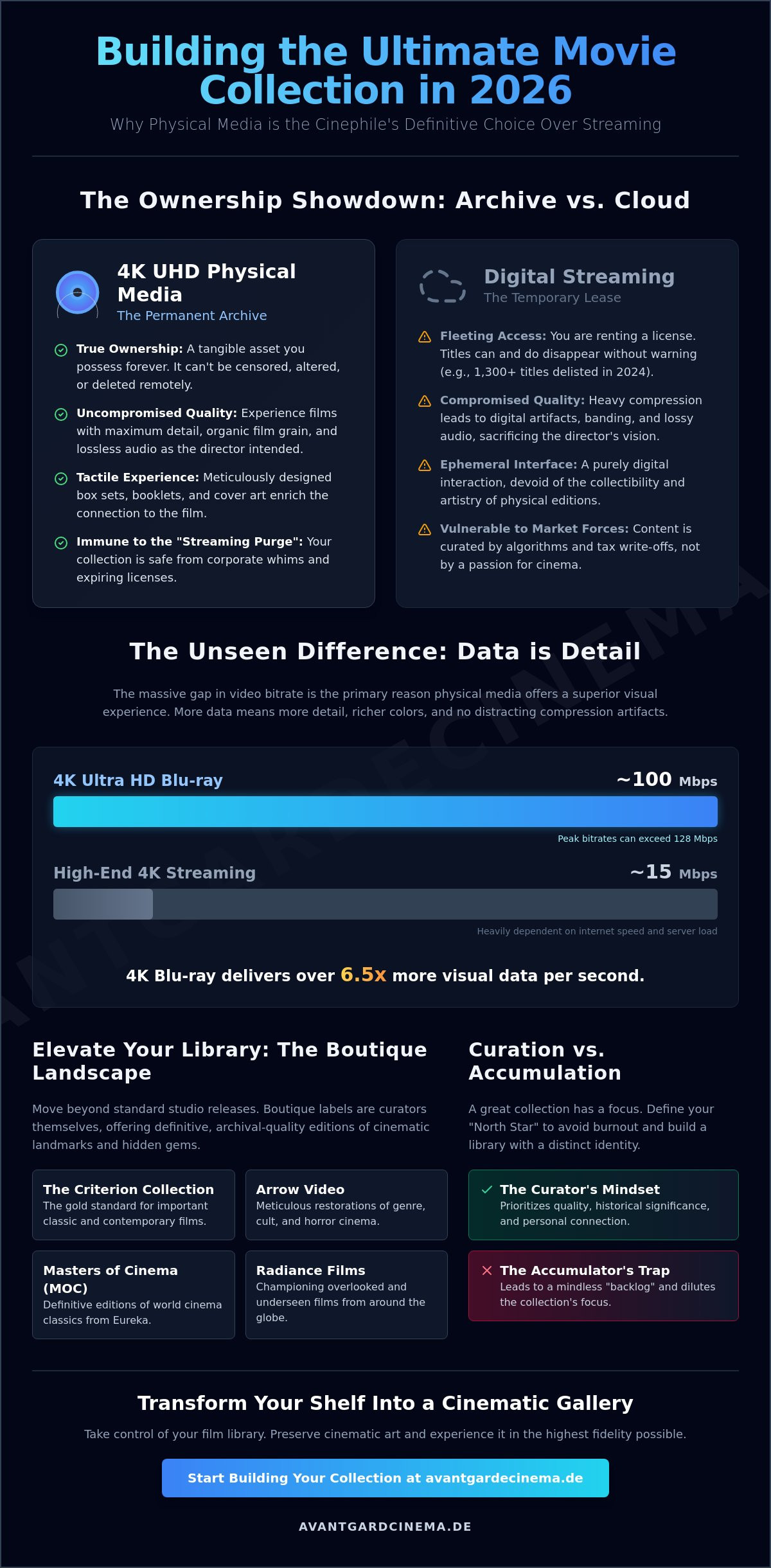
In 2026, building the ultimate movie collection demands more than just passion; it requires a deep understanding of the technical architecture that preserves cinematic intent. While convenience often dictates mainstream consumption, the cinephile prioritizes the 100Mbps bitrate of a physical disc over the compressed 15Mbps typical of high-end streaming services. This massive delta in data allows for a grain structure that feels organic and a depth of field that remains stable during complex motion sequences. 4K Ultra HD has emerged as the definitive standard because it respects the texture of the medium, offering a canvas where light and shadow coexist without the digital artifacts of heavy compression.
Visual fidelity reaches its zenith through HDR10+ and Dolby Vision. These formats utilize dynamic metadata to optimize every frame, ensuring that the director's vision is translated accurately to your display. To complement this, the sonic landscapes provided by Dolby Atmos and DTS:X serve as the backbone of the modern home theater. These object-based audio formats allow sound to move freely through space, creating an immersive environment that mirrors the theatrical experience. When you're building the ultimate movie collection, these technical benchmarks aren't just luxuries; they're the foundation of aesthetic excellence.
4K UHD vs. Blu-ray: When to Upgrade
Deciding when to upgrade requires a discerning eye for historical context and technical provenance. For films shot on 35mm or 70mm stock, a 4K scan from the original camera negative provides a revelation in detail that standard Blu-ray cannot replicate. This is particularly vital for titles preserved in the National Film Registry, where historical accuracy is paramount. If a release boasts a new restoration from the best surviving elements, the leap to 4K is almost always justified. You can explore the nuances of these advancements in our 4K Ultra HD definitive guide.
Understanding Disc Capacity and Compression
The choice between a BD-66 and a BD-100 disc often dictates the final image quality. The larger 100GB capacity of a BD-100 provides the "breathing room" necessary for high-bitrate encodes that avoid compression noise in dark or complex scenes. The skill of the encoding house is equally critical. A masterfully authored 1080p boutique disc from a dedicated label can easily outperform a 4K stream by preserving fine detail that streaming algorithms often smooth away. For those seeking the pinnacle of visual integrity, browsing our curated selection of 4K UHD releases is the next logical step in your curatorial journey.
The Boutique Landscape: Curating Beyond Studio Releases
Major studios like Warner Bros., Sony, and Universal treat physical media as a secondary revenue stream for their massive libraries. Their releases often prioritize mass appeal and cost-effective packaging. In contrast, boutique labels view the disc as a definitive art object. This distinction is vital when building the ultimate movie collection in 2026. These independent publishers invest in frame-by-frame digital restorations, often sourcing original camera negatives that have languished in vaults for decades. They transform forgotten celluloid into 4K Ultra HD masterpieces that frequently outperform the original theatrical presentations in clarity and color depth.
The Big Three: Criterion, Arrow, and Indicator
The Criterion Collection remains the undisputed titan of the industry. Since its inception in 1984, the label has defined the "film school in a box" concept. Their editions provide scholarly essays and rare archival interviews that contextualize cinema history. You can explore their meticulously curated library through these Criterion Collection products to see how they elevate global cinema. Arrow Video followed a different path; they began by rehabilitating the "Video Nasties" of the 1980s. They provide once-maligned cult films with the same reverent treatment Criterion gives to Kurosawa or Fellini. Powerhouse Films, under their Indicator label, has set a benchmark for the limited edition box set. Their releases often include 80-page hardback books and dual-format presentations that serve as historical records for British and American cinema.
Genre Specialists and Niche Curators
Vinegar Syndrome focuses on a specific, noble mission: the preservation and restoration of American independent and exploitation cinema. They often rescue films that are on the verge of physical decay, scanning original elements at 4K resolution. According to industry analysis of the best boutique Blu-ray brands, their commitment to technical precision has redefined the perceived value of genre cinema. Newer entrants like Radiance Films and established legends like Eureka! bridge the gap by finding hidden gems from Italy, Japan, and Hong Kong. These labels are essential for building the ultimate movie collection because they offer a perspective that exists outside the Hollywood mainstream.
Restoration Quality: Boutique labels often use 4K scans from original negatives rather than recycled master tapes.
Supplemental Content: Expect audio commentaries, video essays, and behind-the-scenes footage that you won't find on streaming services.
Physical Aesthetics: Custom artwork, rigid slipcases, and thick booklets turn a simple movie into a collector's centerpiece.
The boutique landscape thrives on the idea that every film, regardless of its budget or origin, deserves to be preserved with dignity. When you choose a release from Second Sight or Vinegar Syndrome, you aren't just buying a movie; you're supporting the survival of film history. These curators ensure that the "non-generic" collection is one of depth, variety, and uncompromising technical excellence.
Strategic Acquisition: How to Build Your Library Without Waste
Building the ultimate movie collection requires a surgical approach to the release calendar. It's not about mass consumption; it's about the precision of a curator. By 2026, the window for securing premium limited editions has narrowed significantly. Pre-order windows for high-end boutique releases often close within 14 to 21 days of their initial announcement. If you miss this brief period, you're forced into the secondary market where prices for "Out of Print" (OOP) titles frequently surge by 150% or more within a single fiscal quarter.
Understanding the lifecycle of a release is vital. Most licensing agreements for cult and art-house films span between five and seven years. When these contracts expire, the physical copies vanish from retail shelves. This scarcity transforms a standard purchase into a sought-after relic. You should also master the "Double-Dip" dilemma. Before committing to a standard Blu-ray, research the film’s restoration history. If a 4K scan was completed in the last 18 months but only released in 1080p, a UHD version is likely on the horizon. Patience prevents the waste of both shelf space and financial resources.
Navigating Limited Editions and Box Sets
Collectors prioritize the "Hardbox" edition for its structural integrity and archival presence. These rigid slipcases protect the internal components better than standard cardstock, ensuring your investment retains its value. You must distinguish between genuine rarity and manufactured FOMO. A set limited to 2,000 units with a perfect-bound book offers tangible artistic value. Conversely, a "limited" edition with 40,000 units is often just a marketing tactic. True craftsmanship is found in the details of the packaging and the exclusivity of the supplements. Explore current high-value editions in our Box Sets and Steelbooks collection to see what defines a centerpiece for building the ultimate movie collection.
Importing for the Advanced Collector
The serious collector doesn't let geography dictate their library's quality. A region-free player is the most important tool you'll ever own. It unlocks superior transfers from international labels that often outperform domestic releases. Labels like Second Sight in the UK or Umbrella in Australia frequently secure exclusive rights to restorations that aren't available elsewhere. Often, an international release features a higher bit-rate or more comprehensive archival interviews. For a deep dive into the logistics of international sourcing, read The Cinephile’s Guide to Import Blu-rays.
Ready to elevate your curation? Browse our latest curated arrivals to find your next definitive edition.
Preservation and Presentation: Maintaining the Ultimate Collection
Building the ultimate movie collection requires more than a keen eye for cinema; it demands the discipline of a museum curator. Once you've acquired a definitive edition, the focus shifts from acquisition to stewardship. Physical media is an investment in history, and its longevity depends entirely on the environment you create. Light, temperature, and humidity aren't just variables; they're the primary factors that determine whether a disc remains playable for decades or succumbs to degradation. Ultraviolet rays fade the vibrant inks of custom-commissioned cover art, stripping away the visual identity of your library. Precision in storage reflects the same care that went into the film's original cinematography.
The atmosphere of your viewing room should mirror the excellence of the films themselves. A dedicated space with controlled lighting and bespoke shelving transforms a simple hobby into a gallery of visual storytelling. Shelving solutions from manufacturers like Boltz or custom-built solid oak units offer the structural integrity needed for heavy box sets while honoring the aesthetic of the packaging. When you treat your library as an exhibition, every film becomes a conversation piece rather than just data on a shelf.
Protecting Your Investment
Collectors often debate the merits of protective sleeves. While bare spines look sleek, 100-micron archival polypropylene bags prevent the friction-based "shelf wear" that devalues rare boutique releases. Handling discs requires equal care to prevent physical scratches or the transfer of oils that can attract dust. For long-term preservation, collectors should maintain a consistent environment between 15 and 20 degrees Celsius with relative humidity levels hovering around 35 percent. This stability prevents the chemical breakdown of the disc layers. Disc rot, often caused by the oxidation of the aluminum reflective layer, is largely avoidable when these archival standards are met.
Cataloging and Community Engagement
Managing a vast library requires sophisticated digital tools to prevent duplicate purchases and track technical metadata. Apps like CLZ Movies or MyMovies provide instant access to your inventory via barcode scanning, allowing you to filter by director, studio, or HDR format. Beyond personal organization, the modern collector relies on a global network of enthusiasts. Online communities serve as the frontline for verifying transfer quality. Before a disc enters your sanctuary, consult forums like Blu-ray.com or the Criterion Forum to ensure the encode meets your standards for artistic integrity. This holistic approach ensures that your pursuit of building the ultimate movie collection remains a legacy for the future. Explore our New Releases to find your next centerpiece.
Defining Your Legacy in Physical Media
The year 2026 marks a pivotal era where intentional preservation outshines passive streaming. By prioritizing 4K UHD formats that offer bitrates peaking at 100 Mbps, you ensure your library remains a definitive testament to cinematic integrity. True curation focuses on the specialized restorations from worldwide boutique labels like Criterion and Arrow, which honor the director's original vision through 10-bit color depth and HDR10+ standards. Building the ultimate movie collection is an ongoing dialogue between the viewer and the art form; it's about securing physical artifacts that won't vanish when a licensing contract expires.
Our film experts at Avantgarde Cinema bypass the sterile logic of algorithms to hand-select editions defined by aesthetic excellence. We specialize in sourcing rare releases from international boutique houses and provide secure shipping to over 50 countries. This ensures your investment arrives in pristine condition regardless of distance. Begin your curation journey with our curated 4K UHD collection at avantgardecinema.de to transform your viewing space into a sanctuary for the moving image. Your future self will value the permanence you've crafted today.
Frequently Asked Questions about Curation
Is it worth building a movie collection in the age of 4K streaming?
Yes, physical media remains the only way to ensure true cinematic fidelity and permanent ownership. While 4K streaming bitrates rarely exceed 25 Mbps, a 4K UHD disc delivers up to 128 Mbps, preserving the grain and texture of the original film. Building the ultimate movie collection protects your library from the 15% of titles that rotate off streaming platforms monthly due to licensing shifts.
What is the best format for a permanent movie library in 2026?
The 4K Ultra HD Blu-ray stands as the definitive format for archival quality and aesthetic excellence. These 100GB triple-layer discs provide the necessary bandwidth for Dolby Vision and uncompressed Dolby Atmos audio tracks. Unlike digital files, these physical assets offer a tangible connection to the craft of filmmaking. They ensure your home cinema experience mirrors the director's original vision without the artifacts of compression.
How do I know if a boutique Blu-ray release is better than the studio version?
You should prioritize releases that specify a 4K restoration from the original camera negative. Boutique labels often spend 6 to 12 months on color grading and manual frame cleanup that major studios might overlook. Consult technical analysis sites like DVDBeaver or Caps-a-holic to see side-by-side comparisons. These visual benchmarks prove that boutique encoding often handles film grain with far greater precision than mass-market versions.
What are the most essential boutique labels for a new collector?
The Criterion Collection, Arrow Video, and Second Sight Films represent the pinnacle of curation for any serious enthusiast. Criterion has preserved over 1,000 essential films since 1984, treating each release like a museum piece. Second Sight is famous for their rigid box sets that include 200-page scholarly books. These labels don't just sell movies; they provide a comprehensive education in film history through exclusive supplements and restored transfers.
Can I play imported Blu-rays from other countries on my local player?
Standard Blu-rays are locked to three specific regions, but 4K UHD discs have been 100% region-free since their 2016 launch. You can play a French 4K disc on an American player without any hardware modifications. For standard 1080p discs, you'll need a dedicated region-free player. These modified devices bypass the geographical coding that prevents a Region B disc from playing in a Region A machine.
How do I stop my physical discs from degrading over time?
Store your collection vertically in a room where temperatures stay between 60 and 75 degrees Fahrenheit. High humidity is the primary enemy of optical media, so keep levels below 50% to prevent oxidation. When building the ultimate movie collection, avoid stacking discs horizontally. This pressure can cause microscopic warping over a 10-year period, potentially leading to playback errors or disc rot in cheaper pressings.
What should I do if a movie I want is "Out of Print"?
Track secondary markets like eBay and set specific keyword alerts on specialized retailer sites. When a boutique label loses a license, prices can rise by 200% within a single week. Check boutique-focused forums like Blu-ray.com daily to catch "Last Chance" sales before titles disappear. Often, a different international label will announce a new restoration within 18 months of a title going out of print in your home country.
Are Steelbooks actually better than standard plastic cases?
Steelbooks provide enhanced aesthetic appeal and physical protection, though the disc content is usually identical to standard releases. These metal cases feature lithographed artwork that turns a simple movie into a tactile art piece. Collectors often pay a premium for these editions because they're limited to specific print runs. While they don't change the 2160p resolution, they significantly increase the resale value and shelf presence of your library.
Comments